
One Prop Trader a Day – Lucas Luo: I Blew Six Evals, Got Funded, Then Blew That Too


One Prop Trader a Day – Episode 104

Lucas Luo
My name is Lucas Luo. I am a day trader from the Bay Area, California, and I mainly trade Nasdaq futures using ICT concepts.
My name is Lucas, I am a day trader from the Bay Area, California, and I mainly trade Nasdaq.
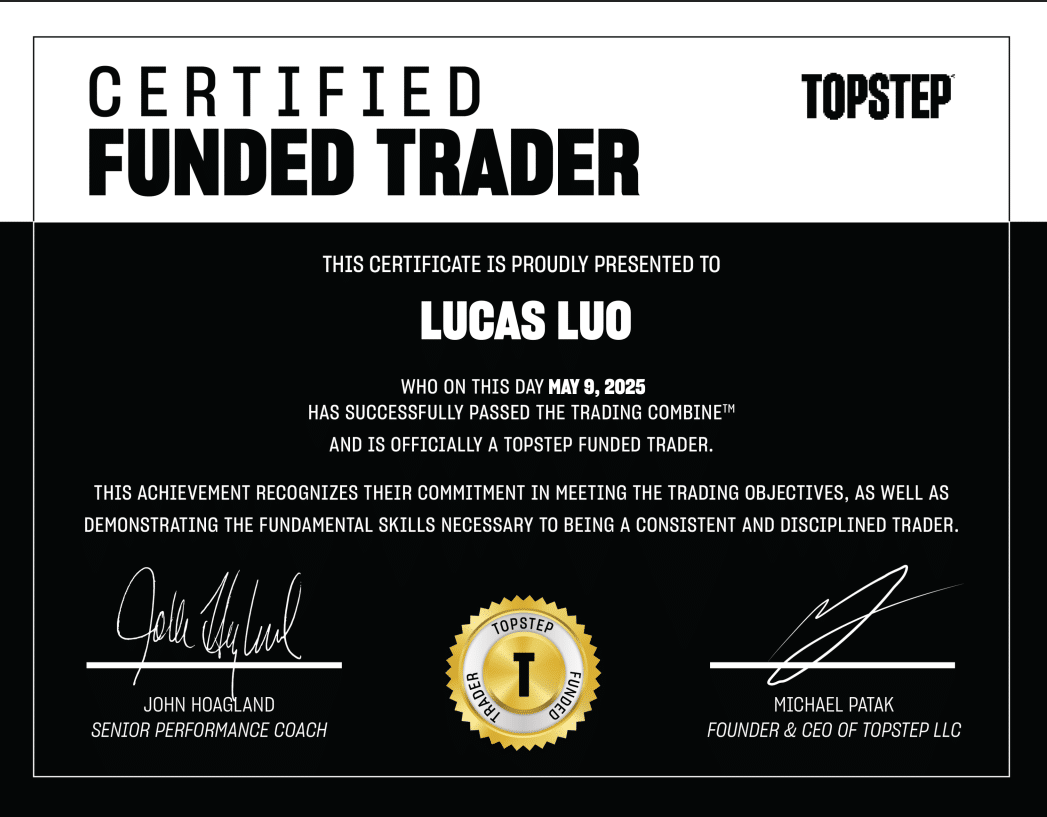
I became a funded trader after passing my first ever eval with TopStep back in May of 2025. A lot was changing for me at the time, mainly because I was switching from options to futures. It’s quite different and you’ll understand what I’m talking about if you’ve traded both.
The biggest shift was mainly my mindset. Options allowed me to define my risk upfront and just let time decay do some of the work, but in futures, they move dollar for dollar with no cushion, so I had to be a lot more disciplined and strategic about my risk management.
If I’m being honest, I’m not really a materialistic guy, so I’m not about having the nicest things or the flashiest items. Proof for me was that I was able to give back to my parents and family. Knowing that they’ve sacrificed a lot for me, it’s always been a goal of mine to give back. Outside of that, I mostly reinvest my gains back into my Robinhood investment portfolio to keep compounding.
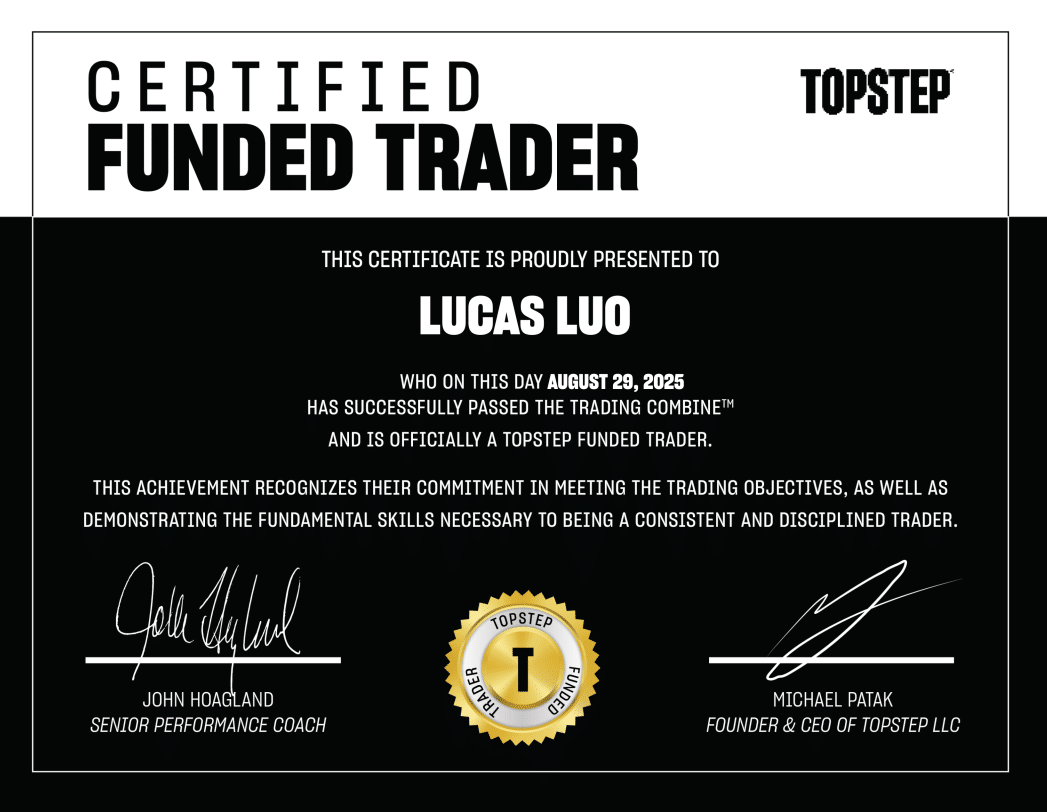
How many times did I fail before getting funded? Okay, let me be straightforward and honest here. I bought my first eval with TopStep back in March of 2025. I’ve blown a total of 6 evals before getting my first funded account, then I continued to blow my funded account and 10+ evals before getting funded again.
Was I frustrated and disappointed? Yes. Did I want to quit and give up on trading? Yes, but I didn’t. Now what kept me coming back? It was simple. I wanted it super bad. I blew countless evals, but that desire never went away, if anything, every failure just made me want to succeed even more. I wanted to prove to myself, and to my family, that I was capable of this, and honestly, I’ve never been the type to give up so easily on something I’ve put so much work and effort into.
The biggest lesson I’ve learned wasn’t from futures trading. It was when I was first starting out with options trading. It was an afternoon in class, I was trading the S&P 500 with another friend of mine. Note that I was still a total beginner at the time, messing around with buy and sell buttons.
It was 5 minutes before one of the market’s biggest financial news events, FOMC. I knew what it was at the time, not really, but I knew that it can cause the market to either full send to the moon or deep down to hell. If I remember, I bought around $3,600.00 worth of SPY calls at the time. The trade was going solid for a moment. It was up around 50 to 60% on my SPY calls after the news was released, but I was greedy.
And so because my mind wanted to see my trade hit that 100% profit, I held onto my position, and within seconds my position turned red. It wasn’t just a little red, it was a lot of red. Ended up closing my position for an 80% loss and I went to my next period all frustrated and confused. Confused on why I hadn’t just taken the 60%. I blamed myself for it because it was honestly my fault. I was greedy and I was simply just gambling.
Yes, trading did definitely take a mental and emotional toll on me, especially when I first started out. I struggled a lot with being able to control my emotions. I’d lose a trade, then revenge trade to try to win it back, and then I’ll end up losing even more, even knowing in the moment that I shouldn’t be doing it. There was a stretch where I was stuck in that losing loop and it really hit me mentally.
But over time, I was able to build a structure around it. I follow a consistent trading plan now, cap the number of trades I take per day and journal every trade so I can reflect afterward.
Having that mindset has really made me a much more consistent trader.
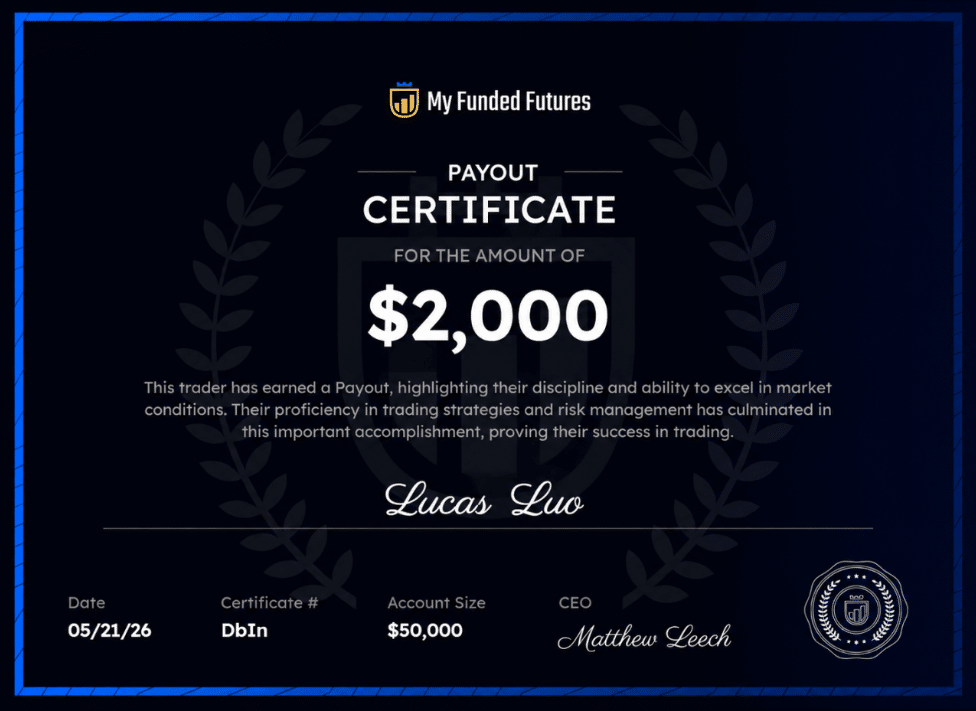
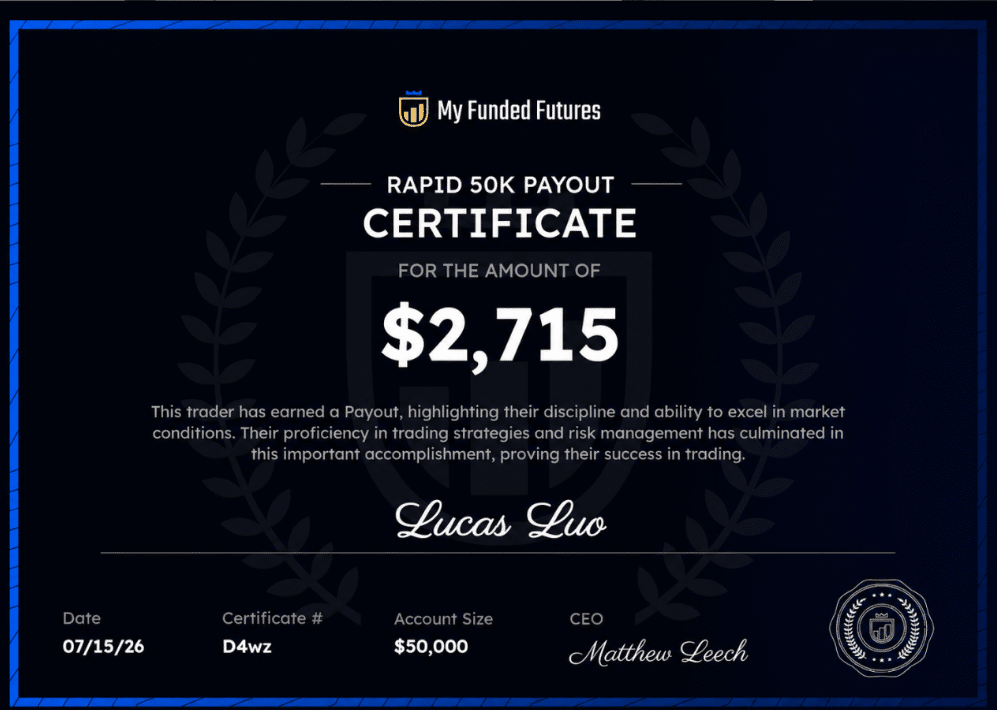
Throughout my career so far, I’ve traded with both TopStep and My Funded Futures. What I look for in a firm is simple. One word, transparency. A firm that’s transparent about what they actually offer versus what they market is very important to me. I also pay attention to how strict or realistic their trading rules are, since overly rigid rules can set traders up to fail unnecessarily. But the biggest thing is how consistent they are with paying out their traders. That alone tells you a lot about whether a firm actually stands behind its traders or not.
My trading style today is quite simple, I don’t tend to over complicate things. I trade ICT, I’m sure a lot of you have heard of ICT concepts. I do top down analysis from 4hr to 5m, mark out high time frame liquidity zones, along with key zones within price.
Wait for a sweep of any sort of liquidity on the higher time frame, then I go on the lower time frame to look for any sort of fair value gaps that may be inverted, wait for a break of structure to either side, then a retrace into an optimal trade entry zone, set a limit, then I target either a recent low or high or an unfilled gap, usually a 1:3 risk to reward or more depending on the situation I’m given.
My typical trading day is decently relaxed. I’m from California so the New York session opens at 6:30 AM for me. I wake up 30 to 40 minutes before the market opens, wash up and I do a little bit of meditation to clear my mind. I make sure to drink plenty of water because it’s important to stay hydrated throughout your trading day.
I mainly trade AM sessions so I’m only on the charts for about 2 to 3 hours, and if I don’t catch any moves then I’m pretty much done for the day. I aim for one trade a day. If I win then I’m off. If I lose one trade, I’ll look to take one more if the opportunity presents itself. I might even take no trades on certain days when the market isn’t moving in my favor. After my trading session, I go work on other stuff, making sure to stay productive as much as possible throughout my day.
The most recent trade I lost was quite a silly mistake. NQ, before New York opened, price was pretty much moving up towards the high of the week. Price started to chop back and forth for a little after the London session and there was a lot of sell side liquidity that hadn’t yet been taken out. At the same time, I saw on the 5m that there were order blocks, where price was rejecting consistently off of.
I knew that there was a possibility that price could open up, tap the order block and immediately reject that level. And so I placed a sell limit order at the order block, the market opened, filled my order and hit my stop right away. Was I surprised? No, not really. The price on the 1m made a wick down and flipped bullish right away, and from that moment I knew I was going to get stopped out.
Not long after, price tapped into a 1hr order block, which I didn’t see beforehand, and completely rejected that level. Inverted a 3m fair value gap and just free fell for the rest of the day, cool right? Just to show that sometimes, people like me can still make small mistakes within the markets.
I’m still quite young, considering I’m 17, and doing stuff like day trading is quite unusual here in the Bay. You’d expect me to be a nerd in school, taking 10 to 20 AP courses, but I’m really not one of those kinds. Only a few people around me, including my family, understand what I do.
They have a different perspective on day trading compared to mine. I see potential in places they don’t, which is totally understandable. My family is very traditional and they’re from a different generation, which shows why they may see it differently. Totally understandable. In short, they know about what I do but I don’t tell them much about behind the scenes.
What separates me from someone who washed out at their third evaluation? I think it really comes down to how bad I wanted it. Failing a challenge never made me question if I could do this or not. It made me want to prove it even more.
Every blown eval was just more experience for me, something to learn from and adjust. In short, quitting was never really on the table for me, but it may be different for some others.
Honestly, if I was given $1,000,000 to trade with, I wouldn’t change much about how I trade. I’d just scale my position sizing appropriately to the account, but still stick to the exact rules and process that got me funded in the first place.
For the first few days I’d probably trade more conservatively than usual, just to get a feel for how the size affects my decision making, since trading a million dollar account can hit different psychologically even if the percentages are the same. I won’t take bigger risks or more trades just because the number is bigger. If anything, I’d probably be more disciplined and strict on myself.
Verified funded – the receipts

About the writer – Lucas Luo
Lucas Luo is a day trader from the Bay Area who trades Nasdaq futures with ICT concepts.


