
One Prop Trader a Day – Kyle Verhagen: Trading Is Not You Against the Market, It Is You Against You


Updated
TL;DR — Kyle’s futures trading and discipline lessons
Kyle Verhagen describes trading ES and NQ futures with his Current Market Structure system, developing his approach through practice and data, and learning that a technical edge still needs discipline and protective stops. His account covers funding, setbacks and keeping risk consistent as account size changes. These are his reported experiences.
One Prop Trader a Day – Episode 97

Kyle Verhagen
I am Kyle Verhagen, 23 years old, from Appleton, Wisconsin. I mainly trade ES and NQ futures.
What does two years of grinding actually build? Kyle Verhagen, a 23-year-old futures trader from Appleton, Wisconsin who trades ES and NQ around market structure sweeps, became funded with Topstep on 30 November 2023 and put an early payout into a 1,200 dollar car repair rather than anything flashy. In this interview, he explains the edge he spent two years proving with data, the pride that cost him weeks of work in single days, and why a bigger account would not raise his risk.
Kyle’s funding journey and setbacks
I became funded for the first time on 30 November 2023. The main thing that changed is that I had developed an edge by that point and knew what I was looking for day in and day out, rather than viewing the markets blind with no real edge.
Early on I did not spend trading profits right away. My intention was always to put payouts back into developing myself as a trader. One of the coolest things I was able to use trading profits for was a random 1,200 dollar car repair that I paid off instantly, straight out of my funded account balance.
I failed for months. I committed to trading early on knowing I needed to go through the trenches, and trading was a passion I could not see myself not pursuing, so giving up was never the issue. It was just a matter of getting enough reps and time to develop the mental and technical edge that would lead to consistency. A lot of my early months trying to get funded, I would pay the monthly fee, fail, then go grind on a practice account to keep developing my edge. That process took a solid two years to fully flesh out a system I had conviction and data on that proved my edge.
My most expensive lesson came down to pride, early in my career: putting my will over the market. When I was trading anywhere from 5 to 10 thousand dollars of my own real money, I would watch weeks of work go out the window in a single day because I decided to trade my own bias rather than the one the market was actually showing me. One of those days included a 1,211 dollar loss on TSLA alone, for a total loss of 1,248 dollars on the day.
I do not think anyone who has spent years in this industry has not thought about quitting, especially in the early stages when you are getting beat down by the market day after day with no real proof of the work you are putting in.
One of my lowest points came about three and a half years in. I had my edge by then, and I thought that edge was the missing piece, but the mental side was not there yet. I would get funded, build a nice balance over weeks or months, then lose discipline for a day or two and give it all back. At one point I had 5 funded accounts, built with a lot of discipline, time and money, and within a couple of days I did not have the stops in place to protect myself, and blew them all up. Waking up the next day knowing I had done that on a smaller scale before, and had not actually fixed it, felt like months of wasted effort.
The doubt creeps in, but what always carried me through was clearing my mind and identifying why I was losing or blowing up. It was always 100 percent my fault, and that always gave me the confidence to keep going, because it meant I just had to grow and fix the parts of myself holding me back.
Trading absolutely affected me mentally and emotionally. It showed me a lot about my character and human nature, what happens when you view things emotionally rather than logically. It affected me a lot early on, but you need a kind of amnesia in this game to operate at a high level, because the past is done. The only thing you should be focused on is taking whatever lesson you can get and adapting for the future.
His Current Market Structure approach
I trade ES and NQ, highly liquid names, across all different timeframes from the 1-minute up to the 4-hour, with the daily and weekly setting my bias.
I struggled in the early years with how to view the markets, because nothing felt sound enough to base risking money on: random indicators, lagging EMAs, arbitrary support and resistance. I took everything I hated about retail concepts and turned it into a technical approach that reads the market the exact same way every single time, with highs, lows, uptrends and downtrends all defined consistently.
Once I built a system to consistently identify what trend we are in, I started picking up on real consistencies in price and developed an edge. That became my CMS system, Current Market Structure. I run two lines on my screen at a time, the current high and low based on my system, and I correlate multi-timeframe trends. My setup is a sweep where we shift from uptrend to downtrend or vice versa, part mean reversion, part trend following: I buy in discount and sell once we reach equilibrium. I only want to be in the market when I have an edge in one direction, and my system shows me visually, on the chart, exactly when that is: buy when we are in discount confirmed by a new low, sell at equilibrium of the range, or vice versa, selling in premium and buying back at equilibrium.
I trade CST, so an 8:30 AM open. I have tested a lot of routines, but I do not like spending much mental energy before trading. I wake at 6:45, move my body, hydrate, maybe take a short walk outside. Then I ground myself with prayer, Bible study and breathing techniques. I get to my computer about 15 minutes before the trading day to make sure I have my levels and a plan, then trade if there is opportunity in the first couple of hours of the session. Around 11 or 12 I will get lunch and lift. Depending on the day and market conditions, I will come back after and trade the last two hours.
My most recent losing trade was an NQ short. All higher timeframes were bearish, and I got a 30-minute bearish setup on both ES and NQ. My entry was the close of the confirmed high after a sweep, with double confluence between ES and NQ plus higher-timeframe confluence, all bearish. I entered on the candle close and targeted the 30-minute 50 percent retracement.
It swept that 30-minute high, then made the move after. I try to wait for the highest valid timeframe to set up, and the hourly was also in a sweep, but the hourly high had not been put in yet. Within that hour, taking the high on the 30-minute is fine, since the higher timeframe had not printed its high. After the 1-hour high was put in, we made the retracement I was initially looking for. The takeaway is to stay patient for the high to be confirmed on the highest valid timeframe before acting.
Risk, stops and trade exits
The rule I completely ignore is set risk-to-reward ratios, the 1:1 or 1:3 crowd. I have never jived with that. I need conviction in why I am holding, and the market does not care about my entry, so an arbitrary target never made sense to me. I enter based on my system, set my stop where it invalidates my thesis, and exit when my thesis targets are hit. I never sell at a random level or a set tick count. It is all based on what the chart is actually showing me.
It has always been hard to talk about trading with non-traders. It is a different world, and I have not found it very useful going deep on it with people outside the industry. I will talk to people who are curious, but I do not initiate. Wisconsin is not exactly full of traders, but I have been lucky to meet a few people around me I can share ideas with and talk through struggles and optimisation with, which has been really valuable.
Trading has built me into a disciplined, focused and persistent person. If you take trading seriously, you cannot show up and kill it in the markets and then live the rest of your life however you please. Trading is a lifestyle in itself. Building trust and confidence in yourself starts with telling yourself you will wake up at a certain time, or go to the gym, and actually doing it. It has molded and fixed parts of my life I never would have imagined when I first got into this industry. Trading is one of the most instant ways to expose your flaws, through something a lot of people have a strong attachment to: money. It has made me very introspective and self-aware, which has benefited a lot of other areas of my life too.
What separates me from someone who washed out at their third evaluation is delusional confidence paired with obsession. It started for the money and turned into a love for the markets and for self-development itself. I loved the art of trading I had developed, and it fit my personality extremely well.
Editor’s note: The “95 to 99 percent” figure is Kyle’s estimate. No supporting study is cited for it in this interview, and JoinProp has not verified it as an industry-wide loss rate.
The advice I would give myself one year ago is to slow down. You do not need to skip stages in the process. Long-term outlook, showing up daily and doing what you need to do that day, and over time you will be where you need to be. I would often get too short-sighted, forcing decisions because I thought I needed to hit certain milestones in a week or a month, rather than trusting the process and understanding the markets will still be there tomorrow.
If prop firms disappeared tomorrow I would absolutely still be trading. I traded before firms and I will continue after. They are a great way to leverage skill for cheaper than loading a cash account, which made sense for me at the specific point I was at in my career. Right now I am pursuing a desk role at an in-person trading desk to take my skills to the next level. Otherwise, I would be trading a personal account.
If you gave me a 1,000,000 dollar funded account today, I would do nothing different from what I do now. I would not change my system or my risk per trade just because the account is bigger, because that is how people blow up size they have not earned. In the first 7 days I would trade my normal size relative to the account, prove to myself I could execute with the same discipline at that scale, and let the P and L take care of itself. The account size does not change my process, it just changes the stakes, and I already trust the process.
Verified funded – the receipts
About the writer – Kyle Verhagen
Kyle Verhagen is a 23-year-old futures trader from Appleton, Wisconsin, trading ES and NQ across multiple timeframes and funded through Topstep.
Frequently asked questions
What does Kyle Verhagen trade?
Kyle trades ES and NQ futures. He describes using his Current Market Structure system to define highs, lows and trends consistently across multiple timeframes.
When did Kyle first become funded?
Kyle reports first becoming funded on 30 November 2023. He describes spending about two years developing a system he trusted; this is his own timeline, not a typical result.
How does Kyle approach risk and trade exits?
Kyle says he places stops where his trade thesis is invalidated and exits at targets defined by his system. He says a larger account would not cause him to change his system or risk per trade.
Source and context
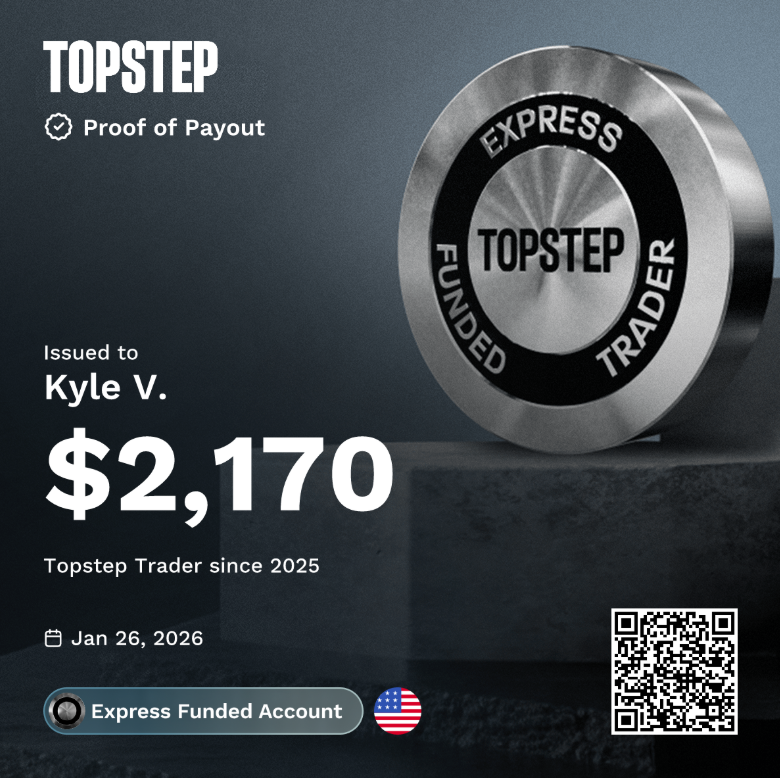
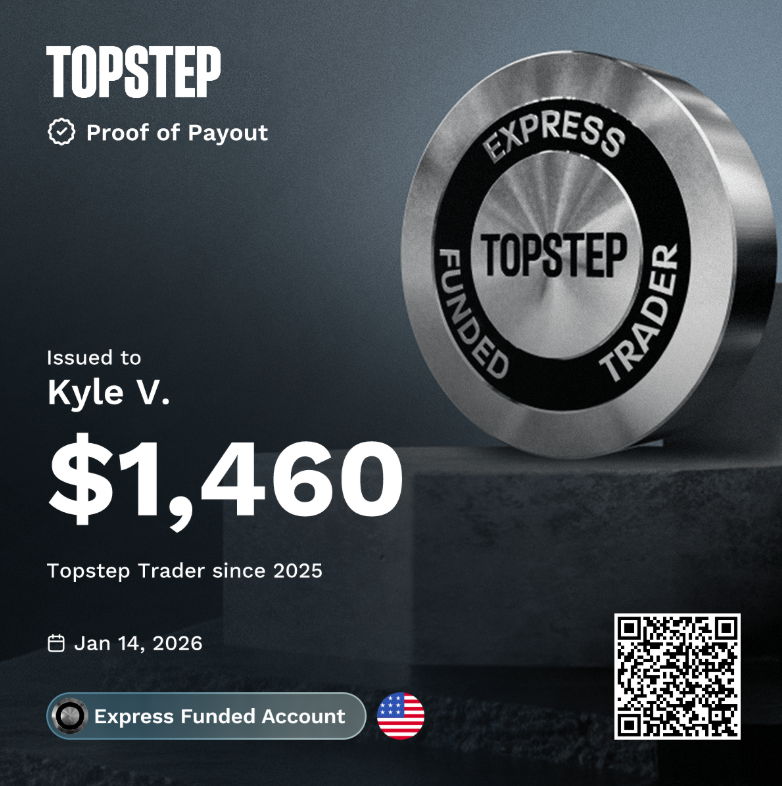
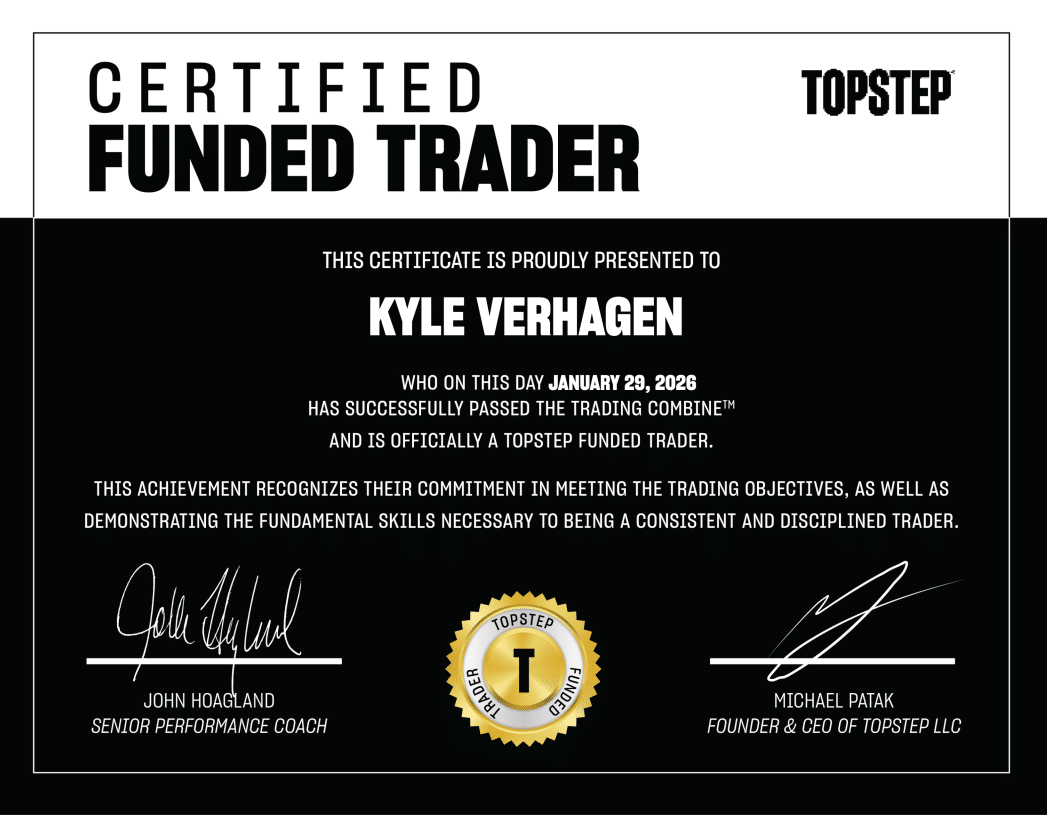
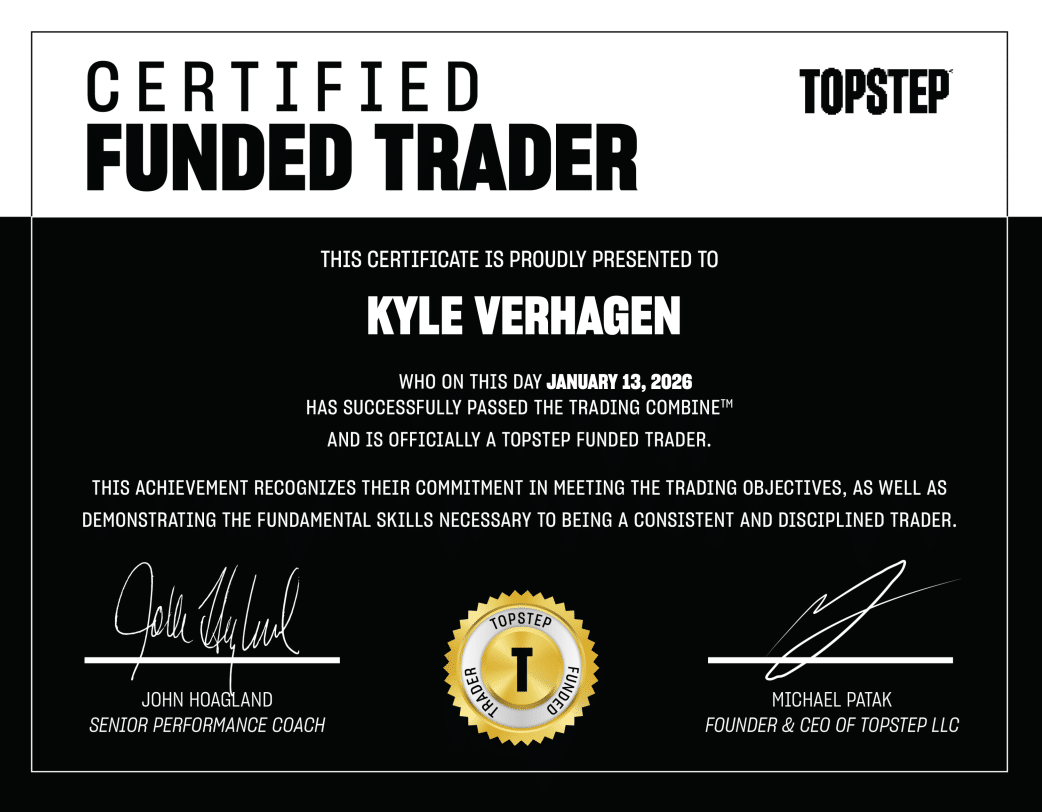
The primary source is Kyle Verhagen’s first-person account above for JoinProp’s One Prop Trader a Day series, interviewed by Omer. The summary and FAQs draw from that interview. Funding dates, results and strategy descriptions are reported by Kyle. The certificate and payout images provide supporting context, not an independently audited performance record or a guarantee of future outcomes.
Enjoyed this article? Add JoinProp as a preferred source on Google.


