
One Prop Trader a Day – Tautvydas Kazlauskas: A Failed Challenge Is Just Data and Tuition Paid


One Prop Trader a Day – Episode 125

Tautvydas Kazlauskas
Tautvydas Kazlauskas is a 21-year-old systematic futures trader from Lithuania and a former high-level rugby player. He trades the Micro E-mini Nasdaq (MNQ) around the New York open using orderflow and price action, with four years of trading behind him. Here is his story, in his own words.
What does it take to go from blowing more than 100 accounts to chasing 1 million dollars in funded capital? Tautvydas Kazlauskas, a 21-year-old former high-level rugby player from Lithuania, spent his first two years blowing Forex accounts before switching to Micro E-mini Nasdaq futures in year three. In this interview, he explains why the 10,000 dollars he lost was really the cumulative cost of ego, why a failed challenge is just tuition to him, and what he thinks of Topstep, the firm he reviews here.
My name is Tautvydas Kazlauskas, I’m 21 years old from Lithuania. Before fully committing to trading, I spent six years playing high-level rugby in Lithuania, which built the foundation for my discipline and mental toughness. Today, I’m a systematic trader focused on Index Futures, specifically trading the Micro E-mini Nasdaq (MNQ) using price action and orderflow mechanics.
I’ve been trading for four years now. My first payouts came toward the end of year three, and that was really the turning point for me. What changed wasn’t my technical setup, but my mindset. I stopped chasing dopamine and trying to force money out of the market every day. I realized that staying in this game is all about capital protection – focusing on strict risk control, executing my process, and having the discipline to sit on my hands when my setup isn’t there.
Honestly, it was buying a nice automatic watch I’d been eyeing for a while. Pulling money straight from a payout to import it directly was huge. Wearing it on my wrist was the first time it really hit me that this wasn’t just numbers on a screen anymore, but a skill that was actually producing real-world results.
I failed on easily more than 100 accounts. I spent my first couple of years blowing Forex accounts across almost every prop firm out there, but that market never fit my style. Everything changed in year three when I switched to MNQ and found my rhythm with index market structure. What kept me going was obsession and stubbornness. I knew the potential was real, but I had to stop acting like a gambler and start operating like a business. I just kept showing up every day until my discipline caught up with my analysis.
My most expensive lesson cost me easily around 10,000 dollars. But it wasn’t lost in one single bad trade, it was the cumulative cost of ego. I spent years buying things to project success and blowing accounts because I wanted fast results. That mindset completely ruined my discipline. Paying that price was brutal, but it was the only way I learned that the market doesn’t care about your image. It only respects execution and humility.
Did trading take a mental and emotional toll? Absolutely. In the early years, the emotional toll was huge. Every blown account felt like a personal failure because my identity and self-worth were tied directly to my trading results. That constant loop of revenge trading, dopamine chasing, and self-doubt was mentally exhausting. Today, I manage it by separating my ego from the market. I stopped looking at trading as a way to make quick money and started viewing it strictly as an operational process. I focus entirely on setup quality and risk control, and once my session is over, I close the platform and step away. I no longer let short-term market behavior dictate my emotional state.
Early on, I used Forex firms like FTMO, FundedNext, and FundingPips. Since switching to Index Futures, Topstep has been my main platform. What I look for in a firm today comes down to two things: payout reliability and clear, fair risk parameters. I prefer companies with solid execution and transparent rules that actually allow you to manage risk properly.
My strategy is built directly around orderflow and tracking institutional movements. I focus exclusively on MNQ during the New York session open, using only the 15-minute and 1-minute timeframes. The 15-minute sets my direction through internal and external liquidity, while the 1-minute provides precise entries based on market structure shifts and institutional displacement. If my exact A+ criteria aren’t on the chart, I simply don’t trade.
Because the New York open is at 4:30 PM in my timezone, my day is split into two clear parts. I use the morning and early afternoon to work on my other projects, train at the gym 5 days a week, and handle daily priorities. About 30 minutes before 4:30 PM, I lock in, do my pre-market prep, and trade the opening window. Once my session is finished, I journal, close down the charts, and I’m done for the day. It keeps trading highly focused and sustainable while giving me full freedom for other work.
My last losing trade was actually about 8 weeks ago. I view losses strictly as a cost of doing business, so when a loss happens within my rules, it’s just an operational expense. Throughout August, the market completely lacked institutional volume. Instead of forcing trades, I stayed patient, skipped low-probability days, and only took two break-even trades. Now that September is here, institutional participation and volume are returning, bringing cleaner setups. Looking back at that last loss 8 weeks ago, I wouldn’t do anything differently. It met 100% of my strategy criteria, and executing a valid trade that ends in a loss is simply part of managing probabilities.
I don’t track success by individual payouts, because focusing on short-term cash completely distracts from process. My major milestone right now is reaching 1 million dollars in funded capital. The goal is to scale risk management and hold proper size professionally, rather than resetting accounts for small wins.
To be honest, my family still compares what I do to a casino. Most people around me never believed it was possible because 99% of people are conditioned to think strictly in terms of a traditional 9 to 5 job. When they see big numbers or results, they write it off as luck rather than seeing the years of discipline, trial, and risk management behind it. I used to try to explain it or seek their approval, but now I don’t look for outside validation. I stay quiet, execute my system, and treat this strictly as a professional business.
What separates me from someone who quits after three failed attempts comes down to persistence and how I view the market. Most people treat three failed challenges as a reason to give up because they’re only looking at the short-term outcome. For me, quitting isn’t even an option. I have a deeply analytical approach and I love breaking the market down into its smallest moving parts. Where 99% of traders are just looking at standard candlesticks and basic FVGs, I go much deeper. I’m reading institutional volume, tracking actual buying and selling pressure in real time, and understanding the real mechanics behind the move. A failed challenge isn’t a failure to me. It’s just data and tuition paid to refine my execution, sharpen my risk control, and build the mental resilience needed to do this long term.
If you gave me a 1 million dollar funded account today, honestly, I wouldn’t change a single thing. I would just wait for my A+ setups and execute them with strict risk management. The account size changes the scale, but it doesn’t change my process. If the market gives me no valid entries during those first 7 days, I’ll take zero trades. Capital preservation always comes first.
My take on the firms
My experience with Topstep has been solid from an execution standpoint. When trading futures, clean order flow execution and reliable platform stability during high-volatility sessions are non-negotiable, and Topstep delivers on that infrastructure. The clear rules and drawdown parameters allow you to focus purely on executing your system without hidden friction. For any trader looking to operate in a structured environment with reliable payouts and straightforward evaluation criteria, Topstep provides a solid foundation to scale capital professionally.
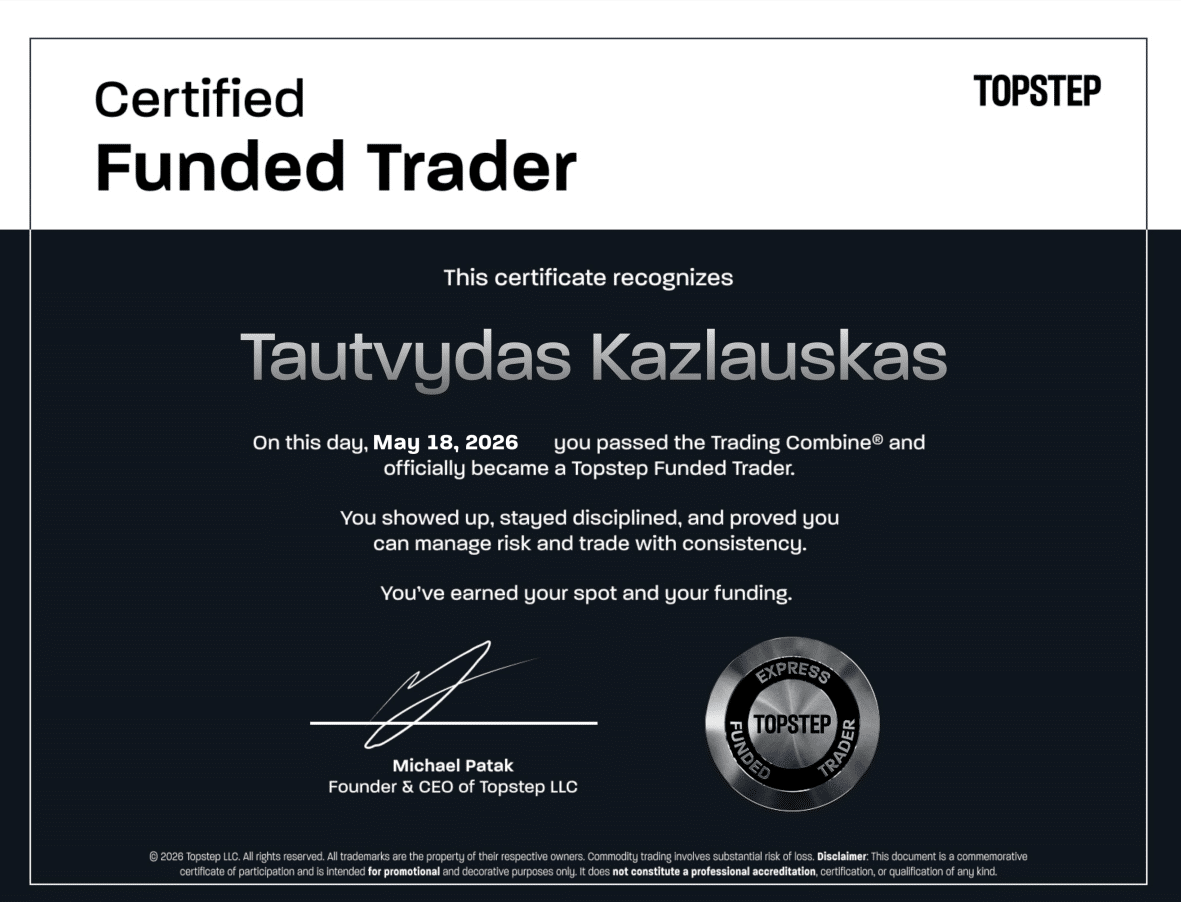
Verified funded – the receipts
About the writer – Tautvydas Kazlauskas
Tautvydas Kazlauskas is a 21-year-old systematic futures trader from Lithuania and a former high-level rugby player. He trades the Micro E-mini Nasdaq (MNQ) around the New York open using orderflow and price action, with four years of trading behind him.Connect on LinkedIn
Enjoyed this article? Add JoinProp as a preferred source on Google.


