
One Prop Trader a Day – Syed Iman: Four Blown Funded Accounts Taught Me What Passing Never Did


TL;DR — interview summary
Syed Iman describes balancing engineering studies with forex prop trading, mainly in Gold. He reports losing four funded accounts after abandoning the discipline that helped him pass evaluations. His central lesson is to keep risk consistent, accept losses and wait for a valid setup. He keeps his first payout amount private.
One Prop Trader a Day – Episode 98

Syed Iman
Hi, I am Syed Iman, a 20-year-old engineering student from Karnataka, India. Alongside my studies, I am a forex prop trader.
What do four blown funded accounts teach that passing never does? Syed Iman, a 20-year-old engineering student in India who trades gold with price action, breaks of structure and support and resistance, keeps his first payout private but split it between future trading capital and his college fees. In this interview, he explains why he thinks trading is far more psychology than technique, what those blown accounts corrected in him, and the strict rules that now run his day.
Getting started and the first payout
I mainly trade Gold (XAU/USD) and occasionally major forex pairs such as EUR/USD and USD/JPY. My focus is on consistency, discipline and following strict risk management rather than chasing quick profits.
I started learning forex in 2024. One of my friends was already learning to trade, and his journey introduced me to the forex market. I have always been passionate about learning new things related to finance. Although I was studying engineering, I wanted to explore something different, because I was more interested in financial markets than in my academic field.
I learned the market basics in about two months, but I quickly realised that trading is much more about psychology than technical knowledge. Becoming a funded trader changed me completely. It made me more disciplined, emotionally controlled, patient and capable of making better decisions under pressure. Following a strict set of rules became part of both my trading and my daily life.
I prefer to keep the amount of my first payout private. However, receiving that payout was proof that all the struggles and hard work were worth it. Instead of spending it on luxury, I divided it into two parts. One half was reserved for future trading capital, while the other half helped me contribute toward my college fees. It was not a huge amount, but being able to support my education through trading gave me a great sense of achievement.
What four lost funded accounts taught him
I passed several evaluation phases, but once I became funded, greed got the better of me. I blew four funded accounts because I stopped following the same discipline that had helped me pass the evaluations. Those experiences forced me to reflect on my mistakes. I created a strict set of personal trading rules and committed myself to never breaking them again. Once I learned to control my emotions and trust my process, I became a much more disciplined and consistent trader.
The biggest lesson I learned is that trading knowledge alone is never enough. The real learning begins when you trade in a live market. You will experience losses, FOMO, overtrading, and moments where you will be tempted to break your own rules. Every time I ignored my trading plan, it eventually cost me an account. My biggest lesson is simple: do not try to become rich overnight. Focus on protecting your capital, following your rules and staying consistent. Chasing quick money often leaves you with nothing.
Balancing studies and trading pressure
As a student, every blown account felt much heavier because I did not have another source of income to buy a new challenge account. There were times when I felt financially helpless and even cried because I could not easily afford another opportunity. Those moments were painful, but I never truly considered quitting. Instead, I accepted my mistakes, learned from them and kept moving forward.
Trading definitely affected me mentally and emotionally. Managing engineering studies alongside trading was not easy. In the beginning, I traded fearlessly because I had nothing to lose. But when I experienced losing streaks, trading became mentally exhausting. Over time, I learned how to manage stress, accept losses and stay patient. Today, I believe psychology is just as important as technical analysis, and emotional control has become one of my greatest strengths.
His strategy and daily routine
Today I mainly trade Gold and occasionally major forex pairs. My strategy is based on simple price action, including Break of Structure, trendline analysis, and support and resistance. I believe traders do not need complicated indicators to become profitable. A simple strategy, supported by proper backtesting, disciplined execution and strong risk management, is more than enough. Most of my trades last between 5 and 30 minutes, although I occasionally hold trades for up to a day if the market structure supports it. I always adjust my risk according to what I can comfortably manage.
My trading day begins by checking the economic calendar to stay aware of high-impact news. Then I analyse the market and patiently wait for my setup. If my strategy gives me a valid entry, I take the trade. Otherwise, I simply watch the market and wait.
Responding to losses and overconfidence
My most recent losing trade was on Gold using a basic support and resistance setup. I identified a strong support zone and expected the price to move toward resistance. Instead, the market broke below support and hit my stop loss. Rather than trying to recover the loss immediately, I accepted it, reviewed the trade and moved on. No strategy wins every time, which is why risk management is more important than trying to predict every market move.
Earlier in my journey, I sometimes ignored my own rule of maintaining consistent risk, because I became overconfident after winning trades. Sometimes it resulted in bigger profits, but eventually that confidence turned into impatience and emotional decision-making, which led to larger losses. That experience taught me that consistency is more valuable than chasing bigger returns. Today, I stick to my risk management rules regardless of how confident I feel.
Personal changes and advice to his earlier self
Do people around me understand what I do? Not really. Most people around me see trading as gambling, because they do not understand how financial markets or prop firms actually work. Even some of my friends think trading is simply pressing the buy or sell button, without realising the analysis, discipline and psychology involved. Because of these misconceptions, I rarely discuss my trading journey with others. My parents also view it as risky, because they are not familiar with financial markets.
Trading has helped me become mentally stronger and more mature. I am more patient, emotionally controlled and disciplined than I was before. I argue less, think more logically, and follow a structured daily routine that helps me balance my studies and trading.
Many people start trading because they only want money. When they fail a few evaluations, they quit. For me, every failure became an opportunity to rebuild myself. I never saw a blown account as the end of my journey, it was simply another lesson. My determination to keep improving is what separates me from those who give up.
The advice I would give myself one year ago is to stop chasing money. Focus on building patience, discipline, emotional control, and on mastering one trading setup. If you consistently follow your rules, the profits will eventually follow.
If prop firms disappeared tomorrow I would absolutely still be trading. I would focus on building my own trading capital and continue trading with the same discipline and risk management principles.
Whether the account is 1 dollar, 10 dollars, 5,000, 10,000 or even 1,000,000 dollars, my approach would remain exactly the same. The account size does not change my trading rules. I would continue following my strategy, respect my risk management plan and trade with discipline. Consistency, not account size, is what creates long-term success.
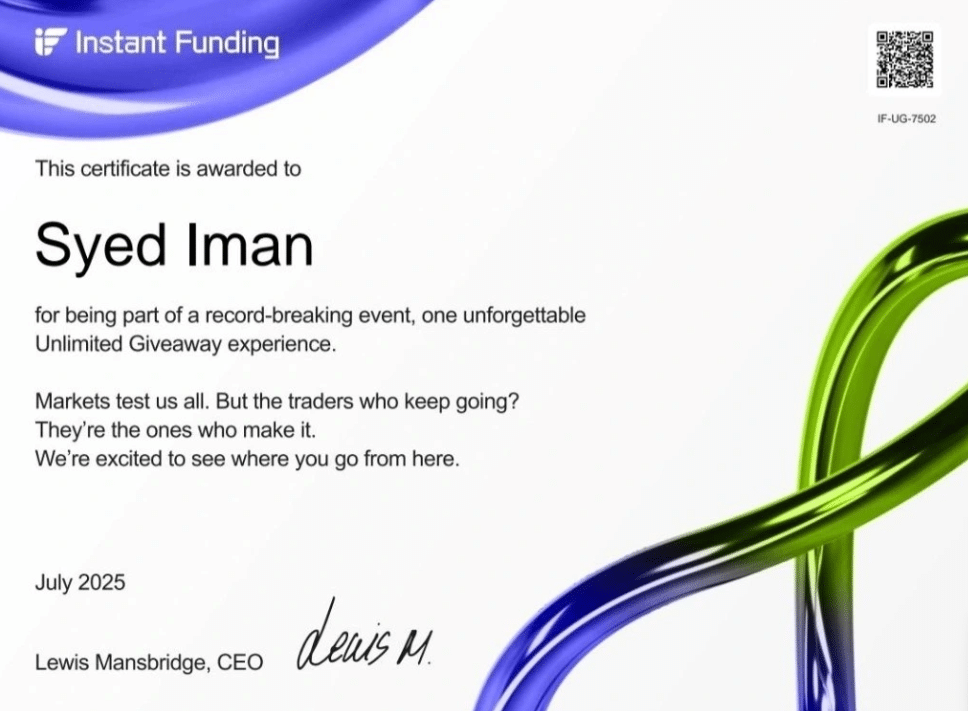
Verified funded – the receipts




Interview FAQs
Editorial answers summarizing Syed’s account above.
What does Syed Iman trade?
Syed says he mainly trades Gold (XAU/USD), with occasional trades in EUR/USD and USD/JPY.
How many funded accounts did he lose?
He reports losing four funded accounts after passing evaluations and attributes those losses to departing from the discipline that helped him pass.
What strategy does he describe?
He describes price action using Break of Structure, trendlines, and support and resistance. Most of his trades last 5–30 minutes, though he sometimes holds for up to a day.
Did he disclose his first payout amount?
No. He chose to keep the amount private. He says he divided it between future trading capital and his college fees.
Are his results typical or independently audited?
This interview records his personal account. It does not establish typical trader outcomes or independently audit his results.
Source and editorial note
Primary source: Syed Iman’s first-person interview published by JoinProp on September 1, 2026, presented above. His linked public profile provides additional identity context, not independent verification of trading results.
This article presents Syed Iman’s account of his trading experience. His results are individual and do not establish typical outcomes. He chose not to disclose his first payout amount. The summary, headings and FAQs were added on September 24, 2026; ages and personal circumstances refer to the original interview.
Affiliate disclosure: The firm links are referral links. JoinProp may earn a commission if you purchase through them.
About the writer – Syed Iman
Syed Iman is a 20-year-old engineering student and funded forex trader from Karnataka, India, trading Gold with simple price action and strict risk rules.
Enjoyed this article? Add JoinProp as a preferred source on Google.


