
One Prop Trader a Day – Khandakar Ashiful Amin: Every Failure Was Feedback, Not the End


One Prop Trader a Day – Episode 132

Khandakar Ashiful Amin
Khandakar Ashiful Amin is a 42-year-old Forex technical analyst and prop firm trader from Bangladesh, active in the financial markets for around 10 years and funded with FTMO since 2024. He trades Forex and Gold using market structure, price action and liquidity, and he also has several years of experience in SEO and digital marketing. He has traded with FTMO, WeMasterTrade and Audacity Capital. Here is his story, in his own words.
How does a trader fail three challenges and still come back to get funded? Khandakar Ashiful Amin, a 42-year-old Forex and Gold trader from Bangladesh, became funded with FTMO in 2024 after three failed attempts. In this interview, he explains why he treated each failure as feedback, how a 1,000 dollar lesson taught him that protecting capital matters more than chasing profits, how he used his first trading money to pay off a loan, and what he thinks of FTMO, WeMasterTrade and Audacity Capital.
My name is Khandakar Ashiful Amin, I’m 42 years old, and I’m from Bangladesh. I’ve been involved in the financial markets for around 10 years, primarily focusing on Forex and Gold. I’m a Forex technical analyst and prop firm trader, with experience in technical and fundamental analysis, risk management, and developing consistent trading strategies. Alongside trading, I also have several years of experience in SEO and digital marketing.
I became a funded trader with FTMO in 2024. It was a major milestone in my trading journey because it gave me the opportunity to trade larger capital while putting my risk management and consistency to the real test.
The biggest change for me was my mindset. I became much more focused on protecting capital, managing risk, and following my trading plan rather than chasing individual trades. It helped me become more disciplined and consistent as a trader.
The first thing I did with my trading money was pay off a loan. That was a very meaningful moment for me because it was the first time I could use money I had earned from trading to take care of a real financial responsibility.
For me, that felt like the first real proof that trading was actually working. It wasn’t about buying something expensive – it was about using the income from something I had worked so hard to build to improve my financial situation.
I failed three times before I became a funded trader. Each failure taught me something different, but the biggest lessons were patience, discipline, and emotional control.
What kept me coming back was the belief that I could improve if I was willing to learn from my mistakes. Instead of treating each failure as the end, I treated it as feedback. Over time, I learned to control my psychological emotions, become more patient, manage risk better, and trust my trading plan. That mindset eventually helped me become a funded trader.
The single most expensive lesson I paid for was around 1,000 dollars.
It came from a period when I wasn’t managing my risk properly and allowed emotions to influence my decisions. Losing 1,000 dollars was painful, but it taught me one of the most important lessons in trading: protecting your capital is more important than chasing profits.
Since then, I’ve become much more disciplined with risk management, patience, and emotional control. That 1,000 dollar loss was expensive, but the lesson I learned from it has been worth much more.
Yes, definitely. Trading can take a mental and emotional toll, especially during losing periods or when things don’t go according to your plan. I’ve experienced frustration, stress, and the pressure of trying to recover from losses.
Over time, I learned that emotional control is just as important as technical analysis. Now I focus on patience, proper risk management, and following my trading plan rather than reacting to every market movement. I also accept that losses are part of trading, which helps me stay calm and make decisions objectively.
I’ve traded with FTMO, WeMasterTrade, and Audacity Capital.
When choosing a prop firm, I mainly look at the credibility and reputation of the company, the clarity of its rules, realistic risk parameters, payout reliability, and how transparent the overall process is. For me, a good prop firm should provide a fair trading environment where traders can focus on consistency and proper risk management rather than trying to work around complicated rules.
Today, my trading style is mainly focused on Forex and Gold. I primarily trade on the lower to medium timeframes, depending on the market conditions and setup.
My approach combines technical and fundamental analysis. I focus heavily on market structure, price action, support and resistance, liquidity, and key economic events. I prefer taking selective, high-probability setups rather than overtrading, with strict risk management and patience being a major part of my strategy.
A typical trading day starts with preparation rather than immediately looking for trades. I first check the major economic news and fundamental factors that could affect the markets, especially for Gold and Forex.
Then I analyze the higher timeframes to understand the overall market structure and identify important support, resistance, liquidity areas, and key levels. After that, I move to lower timeframes to look for potential entries that match my overall bias.
I don’t try to trade every move. I wait for my setup, define my risk and stop-loss before entering, and then let the trade play out according to my plan. Once I’m in a trade, I try to stay objective and avoid making emotional decisions.
For me, the goal of a typical trading day isn’t to take as many trades as possible – it’s to execute my plan with discipline and protect my capital.
My most recent losing trade was on Gold. I saw a setup that matched my overall market bias and entered after getting confirmation on the lower timeframe. However, the market didn’t follow through and the trade eventually hit my stop-loss.
The important thing was that the loss was within my predefined risk, so I didn’t try to immediately recover it with another trade. Afterward, I reviewed the setup and realized that I could have been more patient and waited for stronger confirmation before entering.
If I could take the same trade again, I would wait for better confirmation and be more selective with the entry. The trade was a loss, but it was still a controlled loss and another opportunity to improve my execution.
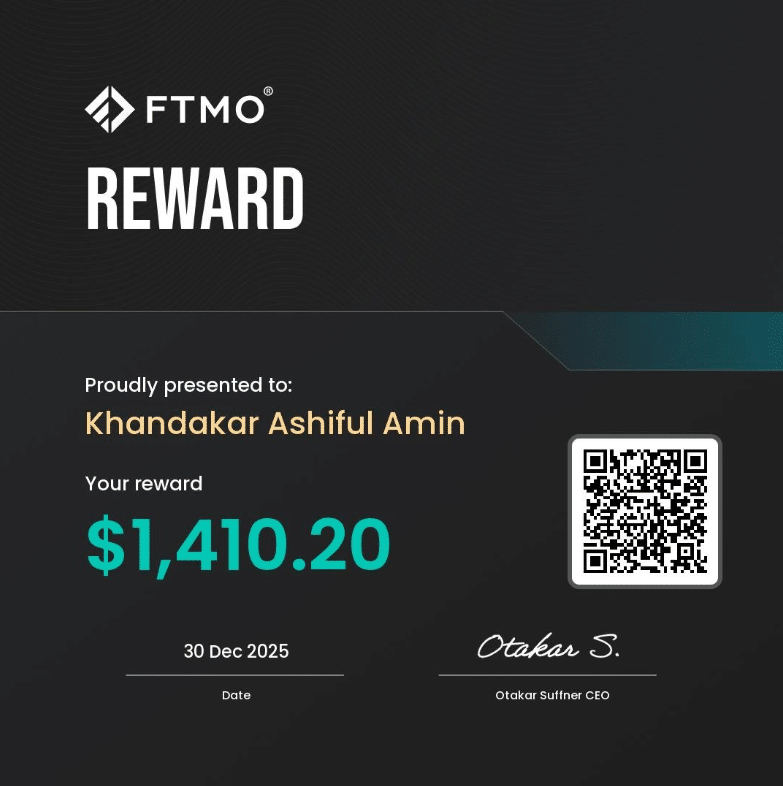
My biggest payout so far has been 1,410.20 dollars.
For me, it was a meaningful milestone because it represented more than just the money. It was proof that the discipline, patience, risk management, and emotional control I had been working on were starting to produce consistent results. It also gave me more confidence to continue developing as a trader.
Not everyone around me fully understands what I do. Trading can be difficult to explain to people who aren’t familiar with financial markets, especially because they often see only the profits or losses and not the amount of analysis, discipline, and risk management behind each decision.
My close family and friends have gradually become more supportive as they’ve seen my progress. At the beginning, there was some uncertainty, but over time, my results and consistency helped them understand that I take trading seriously as a profession.
I think the biggest difference is my mindset. After failing three challenges, I could have easily decided that trading wasn’t for me, but I chose to look at each failure as feedback rather than a reason to quit.
I understood that getting funded wasn’t about finding a perfect strategy – it was about becoming a better trader. I worked on my patience, risk management, discipline, and emotional control, and kept improving after every setback.
What separates me is simply that I was willing to keep learning, adapt, and come back stronger instead of giving up.
If I were given a 1 million dollar funded account today, I wouldn’t rush to trade it just because the capital is larger.
During the first 7 days, my priority would be understanding the firm’s rules, daily drawdown, maximum drawdown, and payout conditions. I would then study the account and market conditions, focusing mainly on Gold and Forex, and continue trading the same setups I already know rather than changing my strategy because of the larger account size.
I would keep my risk conservative, take only high-probability setups, and focus on protecting the account. My goal in the first week wouldn’t be to make a huge profit – it would be to establish consistency, preserve capital, and build confidence with the new account size.
My take on the firms
I’ve traded with FTMO, WeMasterTrade, and Audacity Capital. My experience with FTMO has been very positive – they have a professional environment, clear processes, and overall I’ve had a good experience trading with them. Audacity Capital has also been a good experience for me, and I appreciate their approach to funded trading.
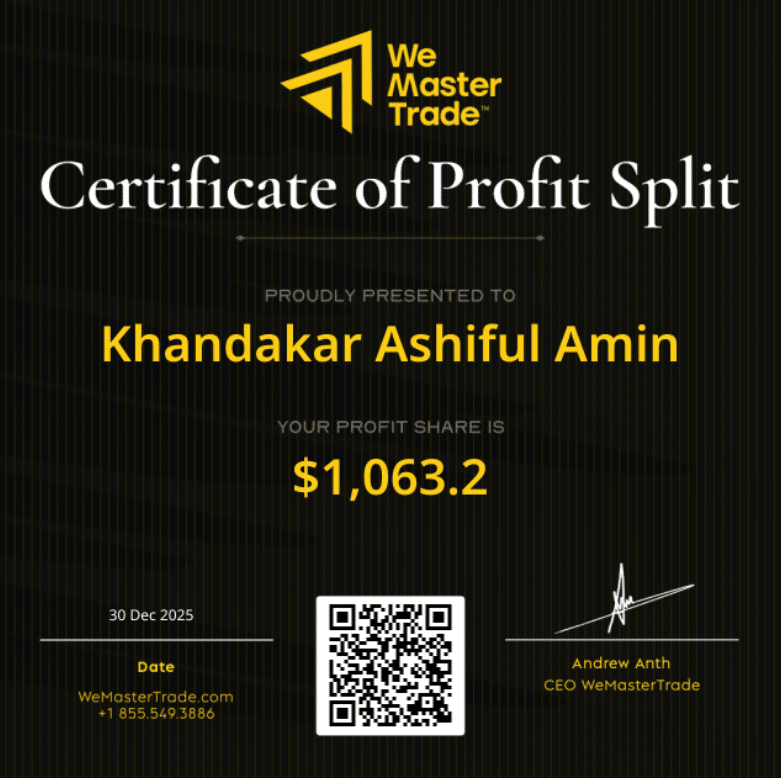
With WeMasterTrade, my experience has been mixed. While there are positive aspects, I found that some less obvious or hidden rules can sometimes be frustrating for traders, particularly when they are not fully clear from the beginning. Overall, I believe traders should carefully read and understand all the rules before choosing a prop firm.
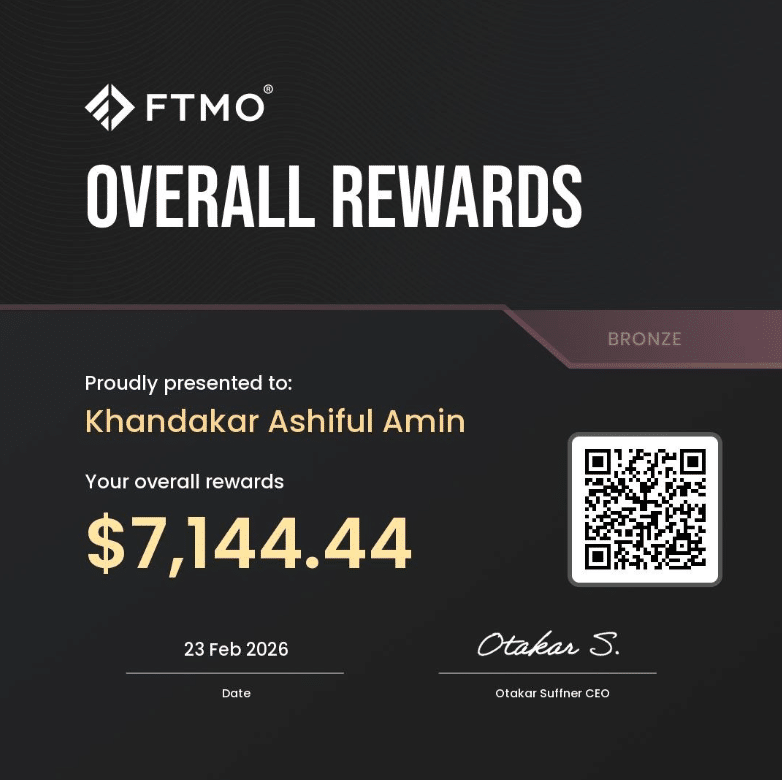
Verified funded – the receipts
About the writer – Khandakar Ashiful Amin
Khandakar Ashiful Amin is a 42-year-old Forex technical analyst and prop firm trader from Bangladesh, active in the financial markets for around 10 years and funded with FTMO since 2024. He trades Forex and Gold using market structure, price action and liquidity, and he also has several years of experience in SEO and digital marketing. He has traded with FTMO, WeMasterTrade and Audacity Capital.
Enjoyed this article? Add JoinProp as a preferred source on Google.


