
One Prop Trader a Day – Nuwan Kularathna: From Market Frustration to Discipline


One Prop Trader a Day – Episode 136

Nuwan Kularathna
Nuwan Kularathna is a funded trader who developed his own framework, PTAM (Price Transmission Allocation Model), which reads the market as a sequence of Invite, Fill, Trap, and Move. He focuses on liquidity, key levels, market structure, and risk management. Here is his story, in his own words.
What happens when a trader stops asking where price will go and starts asking what the market wants traders to believe? Nuwan Kularathna, a funded trader, built his own framework, PTAM (Price Transmission Allocation Model), around the sequence of Invite, Fill, Trap, and Move. In this interview, he explains how risk management changed his results, why a winning streak can be as dangerous as a losing one, why he sometimes takes a rest day after consecutive winning days, and the one piece of advice he would give anyone starting their funded-trader journey.
My trading journey did not begin with a perfect strategy or a clear roadmap. Like many traders, I started with the belief that if I could find the right setup, I could make money consistently. The reality was very different.
Over time, I realized that trading is not simply about predicting whether price will go up or down. It is about understanding how price behaves around liquidity, key levels, market structure, and, perhaps most importantly, how I behave when money is on the line.
That realization eventually led me to develop my own framework, which I call PTAM, Price Transmission Allocation Model.
Finding My Own Way
In the beginning, I studied different approaches to technical analysis and market structure. I experimented, made mistakes, changed my execution, and constantly questioned why certain setups worked while others failed.
Eventually, I started looking at the market from a different perspective.
Instead of asking only, “Where will price go?”, I began asking:
What is the market trying to make traders believe before the real move happens?
This became one of the foundations of PTAM.
My framework focuses on understanding the sequence of Invite, Fill, Trap, and Move. I don’t see the market simply as candles moving from one price to another. I try to understand the interaction between liquidity, positioning, market structure and price delivery.
PTAM became my way of organizing everything I had learned into a process that made sense to me.
From Strategy to Risk Management
One of my biggest lessons was that having an edge is not enough.
A trader can have a profitable strategy and still lose because of poor risk management, overtrading, revenge trading, or simply becoming too confident after a winning streak.
My own approach to risk management changed significantly over time.
I became much more interested in protecting the account and staying in the game than trying to make the maximum amount of money from every trade.
When trading funded accounts, this became even more important. Profit targets and consistency requirements taught me that making a large amount of money quickly isn’t necessarily the objective.
Sometimes the best trade is simply the trade you don’t take.
Learning the Psychology of Winning
Interestingly, one of the biggest psychological lessons I’ve learned did not come from losing trades.
It came from winning.
When you have several successful trades in a row, it is very easy to feel that you have figured everything out. Confidence increases, dopamine increases, and the temptation to take more trades or increase risk can appear.
I learned that a winning streak can create its own form of danger.
That is why I started placing more importance on protecting my mental state. If I have consecutive winning days, I can deliberately step away and take a rest day rather than allowing a winning streak to turn into overconfidence.
For me, discipline is not only about controlling yourself after a loss.
It is also about controlling yourself after a win.
The Funded Trader Journey
The funded-account environment added another layer to my development.
It taught me that trading a funded account is not just about proving that you can make profits. You have to demonstrate that you can manage risk, respect rules and remain consistent.
My objective became much simpler:
Stay consistent. Protect the account. Follow the process. Let the profits take care of themselves.
I don’t believe in trying to force a certain amount of profit every single day. The market doesn’t owe me a setup.
If my setup isn’t there, I can wait.
That mindset has helped me move away from the emotional side of trading and toward a more systematic approach.
What Trading Has Taught Me
The biggest lesson trading has given me is that the market is constantly testing the trader, not only technically, but psychologically.
You can learn thousands of concepts, indicators and strategies, but if you cannot control your risk and emotions, none of them will save you.
I’ve learned to respect uncertainty.
I’ve learned that being flat is also a position.
I’ve learned that protecting capital is more important than proving that I’m right.
And I’ve learned that consistency is built through small decisions repeated over a long period of time.
My Vision for the Future
PTAM is still evolving.
I don’t consider it a finished system. Markets evolve, and I believe a trader should evolve with them.
My goal is to continue developing PTAM into a structured and disciplined trading framework while continuing to improve myself as a trader.
I also want my journey to show other traders that success doesn’t necessarily come from finding a magical strategy.
It comes from developing an edge, managing risk, understanding yourself, and having the discipline to follow your process even when emotions are telling you to do something different.
If I could give one piece of advice to someone starting their funded-trader journey, it would be this:
Don’t focus on how quickly you can pass the challenge. Focus on becoming the trader who can keep the account after passing it.
That change in mindset made a huge difference in my own journey.
Trading is not about winning every day.
It’s about surviving, learning, adapting, and staying disciplined long enough for your edge to play out.
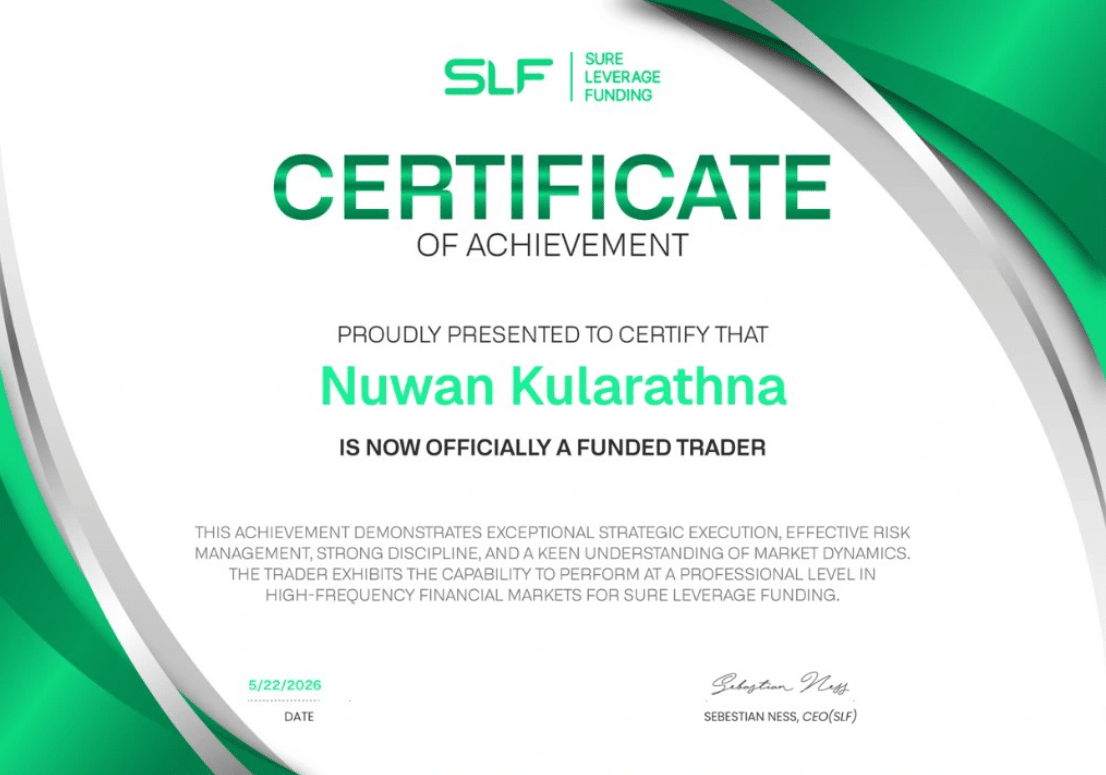
Verified funded – the receipts
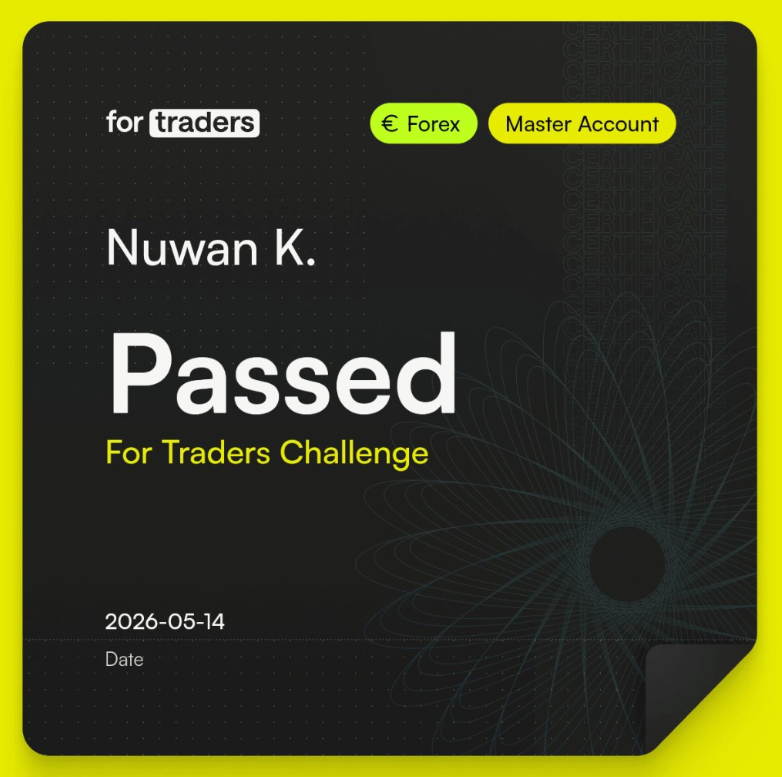
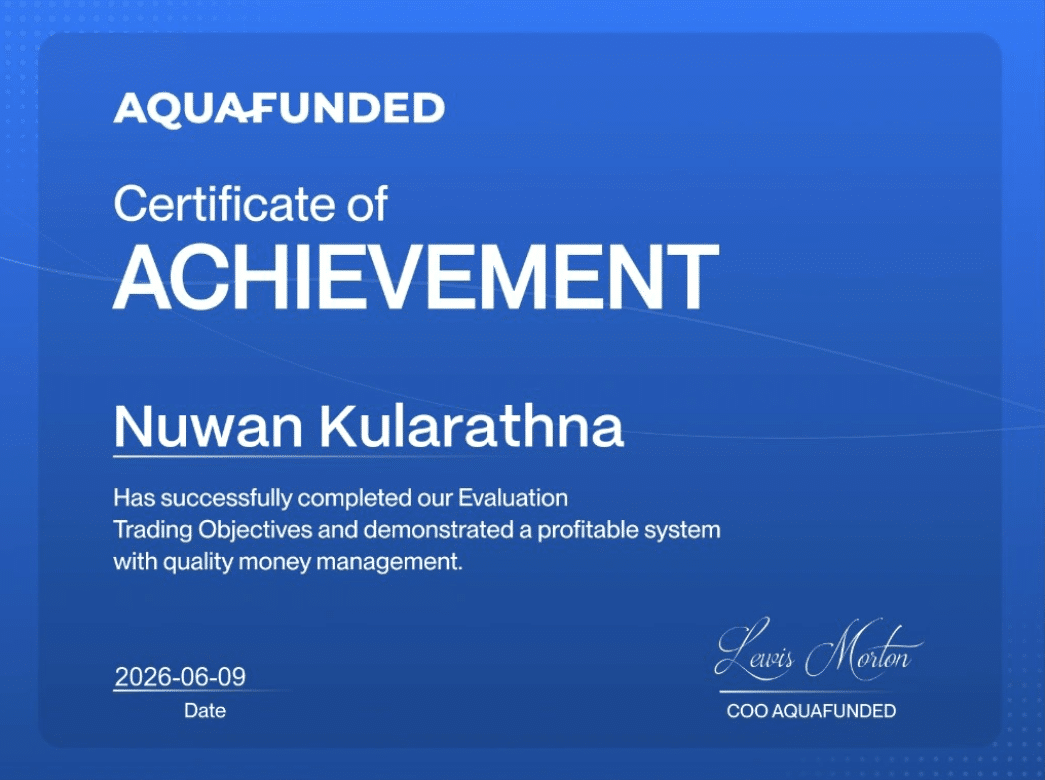
Challenges passed – the receipts
About the writer – Nuwan Kularathna
Nuwan Kularathna is a funded trader who developed his own framework, PTAM (Price Transmission Allocation Model), which reads the market as a sequence of Invite, Fill, Trap, and Move. He focuses on liquidity, key levels, market structure, and risk management.
Enjoyed this article? Add JoinProp as a preferred source on Google.


