


One Prop Trader a Day – Episode 150

Rohit Bisht
Rohit Bisht is a 25-year-old trader from Dehradun, India who trades Nasdaq futures during the New York AM session, with some gold futures on the side, using a trend-following system with volume profile in his entry models. After about three years of trading on and off, he became consistently profitable around August 2025 and has taken approximately 24,000 dollars in payouts since. He has traded with Topstep, Lucid and Tradeify, and he also does freelance work in AI. Here is his story, in his own words.
What if it took three years of experimenting and losing money before the payouts started? Rohit Bisht, a 25-year-old trader from Dehradun, India, trades Nasdaq futures with a trend-following system built around volume profile. In this interview, he explains how failed funded accounts and near-misses taught him to develop an edge before forcing money out of the market, why he trades only from 9:30 to 11:00 a.m. New York time, how he took approximately 24,000 dollars in payouts in a year, and what he would do with a 1 million dollar funded account.
I’m 25, from Dehradun, India, and I predominantly trade Nasdaq futures, with some gold futures on the side.
My trading journey wasn’t an overnight success story. For about three years, I was trading on and off – first in the Indian markets and then moving into US futures. During that period, I wasn’t consistently profitable. I was experimenting, losing money, testing different ideas, and trying to figure out whether I could actually develop an edge in the market.
For a long time, I simply hadn’t been able to.
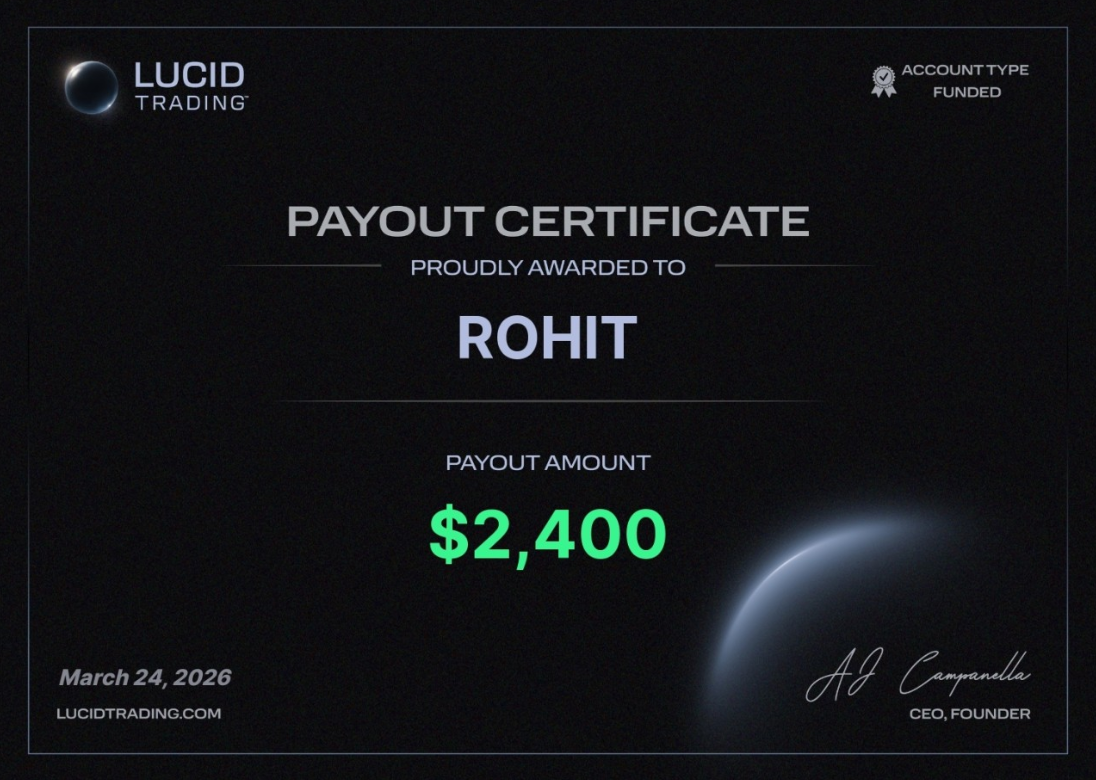
Things started changing around August 2025. That was when I started becoming consistently profitable and, more importantly, began taking consistent payouts. Over the following year, I’ve taken approximately 24,000 dollars in trading payouts.
For me, that was the real proof that things were starting to work. It wasn’t about buying something expensive with my first trading payout. The milestone itself was being able to repeatedly take money out of the market after spending three years trying to figure it out.
Before becoming consistent, I lost a lot of money and went through plenty of failed funded accounts.
One of the most frustrating experiences was getting extremely close to a payout – sometimes being just one day or around 150 dollars away from a potential 2,000-4,000 dollar payout – and then losing the account.
Those experiences were expensive, but they taught me something important.
You can’t expect to become profitable simply by taking more trades or trying to force money out of the market. You have to spend a lot of time experimenting to actually develop an edge, and then you need the discipline to execute that edge consistently.
Trading is also mentally stressful. But I’ve come to understand that becoming profitable isn’t a finish line. Markets are constantly changing, so your approach has to change with them. You have to continuously adapt and evolve.
That mindset is probably one of the biggest things that kept me going.
Today, I primarily trade Nasdaq futures during the New York AM session, usually from 9:30 to 11:00 a.m. EST.
My approach is essentially a trend-following system, with volume profile playing an important role in my entry models.
I also sometimes trade gold during the Asian session.
I don’t spend the entire day staring at charts. I’m usually at my setup around five minutes before the New York open. I start trading at 9:30 and stop at 11.
Then I move on with the rest of my day, including my freelance work in AI.
That structure is important to me because trading is only one part of what I do.
I’ve traded with Topstep, Lucid, and Tradeify.
Of those, I particularly like Lucid because of its quick payout process and the number of trading platforms it supports.
I don’t think one losing trade is particularly meaningful.
There are going to be winners and losers in the market. What matters to me is whether I’m overall positive at the end of the month.
That’s a much more useful way to look at trading than obsessing over individual trades.
The biggest milestone for me so far has been taking 24,000 dollars in payouts over one year.
That number means more to me because of where I started. Before that, I had spent three years experimenting, losing money, and trying to develop a consistent edge.
So the important part isn’t just the 24,000 dollars. It’s the transition from constantly experimenting to having something I could actually execute consistently.
Trading is still a relatively foreign concept to my family.
And honestly, I understand why there can be skepticism around it.
There are a lot of people online selling trading courses or operating through affiliate models who claim to make substantial income from trading, when their actual business may be selling courses or earning affiliate commissions.
That creates a lot of skepticism around genuine trading income.
So I don’t really blame people for being cautious about it. The space has given people plenty of reasons to question these claims.
For me, the difference is that I’m not trying to convince people that trading is easy or that anyone can make money from it. My own experience has been almost the opposite.
It took me three years of experimentation, losing money, failing funded accounts, and trying to develop an edge before I became consistent.
I think the biggest difference is understanding what the process actually requires.
You need to experiment a lot to develop an edge.
Then you need to execute that edge in the real market.
And once you have an edge, you can’t assume it will work forever. Markets change, so you have to continuously adapt and evolve your approach.
And throughout all of that, you need a robust risk-management protocol.
I think that’s what ultimately separates persistence from simply repeating the same mistakes.
Honestly, I wouldn’t suddenly change what I do just because the account was larger.
I’d execute the same edge that I use now, but with reduced position sizing initially.
I’d spend the first couple of weeks getting comfortable with the account and making sure the execution remained consistent. After around two to three weeks, assuming everything was going well, I’d gradually increase the position sizing.
The account size shouldn’t change the process.
That’s probably the biggest lesson I’ve taken from my trading journey: the goal isn’t to predict every move in the market. It’s to develop an edge, execute it consistently, manage risk, and keep adapting as the market changes.
Verified funded – the receipts

About the writer – Rohit Bisht
Rohit Bisht is a 25-year-old trader from Dehradun, India who trades Nasdaq futures during the New York AM session, with some gold futures on the side, using a trend-following system with volume profile in his entry models. After about three years of trading on and off, he became consistently profitable around August 2025 and has taken approximately 24,000 dollars in payouts since. He has traded with Topstep, Lucid and Tradeify, and he also does freelance work in AI.
Enjoyed this article? Add JoinProp as a preferred source on Google.


