


One Prop Trader a Day – Episode 137

Jordan Williams
Jordan Williams is a 30-year-old trader originally from Kingston, Jamaica, who now lives in Bogotá, Colombia. He trades indices, metals, crypto and currencies with a top-down approach, first passed a funded challenge with FTMO in 2023, and has traded with FTMO, FundingPips, Blue Guardian, Maven, Instant Funding and Top One Trader. Here is his story, in his own words.
FirmFTMO FirmFunding Pips FirmBlue Guardian FirmMaven FirmInstant Funding FirmTop One Trader
What changes when a trader stops asking how much he can make and starts asking how much risk he is actually taking? Jordan Williams, a 30-year-old trader from Jamaica now based in Bogotá, trades indices, gold, oil, crypto and currencies, passed his first funded challenge with FTMO in 2023, and has received 11 rewards totaling 14,234.60 dollars from FundingPips. In this interview, he explains the 2,500 dollar weekend that changed how he treats losses, why he no longer has trading days, how he copes with winning, why he never quit, and how he rates FundingPips and FTMO.
My name is Jordan Williams. I’m 30 years old, originally from Kingston, Jamaica, moved to Orange, New Jersey when I was 16, and I’m writing this from Bogotá, Colombia.
I was first introduced to trading around 2017, and I actually thought it was stupid.
At the time, everybody around me talked about Forex: EUR/USD, USD/JPY, currency pairs over and over again. I couldn’t understand the appeal. If currencies were the investment, why wouldn’t I just buy the currencies themselves?
Then I discovered indices.
The Dow Jones was the first one that really caught my attention around 2019. It moved differently. It felt like something happened every day. Eventually I added the DAX, which has probably been one of my strongest instruments historically, along with the S&P 500 and Nasdaq.
Over the years, the watchlist expanded. Gold, silver, oil, Bitcoin, Ethereum and eventually currencies came into the picture. Ironically, I returned to currencies for a completely different reason than the one that introduced me to trading: risk.
Today I might use USD/CAD or CAD/JPY because of their relationships with oil and broader macro conditions. I also watch currencies such as USD/CHF, USD/SGD, GBP/USD, EUR/USD, AUD/USD, USD/MXN and USD/ZAR depending on what is happening in the market.
That evolution probably summarizes my entire trading career. I went from, “How much can I make?” to, “How much risk am I actually taking?”
Getting Funded
I traded my own money before I ever became a funded trader, and in retrospect, that probably taught me some lessons in the most expensive way possible.
Early on, I didn’t respect the process. I used ridiculous position sizes and tried to catch relatively small movements. These were more bets than trades. So, as one would expect, I also thought prop-firm rules were unnecessarily restrictive.
My perspective eventually changed.
A prop firm is in the business of making money, just like the trader. Once I started thinking about the rules in that context, drawdown limits and risk parameters stopped looking arbitrary. They were simply a quantified definition of acceptable risk.
I first passed a funded-account challenge in 2023 with FTMO. I subsequently traded accounts with firms including FTMO, FundingPips, Blue Guardian, Maven, Instant Funding and, most recently, Top One Trader.
I’ve passed challenges. I’ve lost funded accounts. I’ve received payouts. I’ve also had payouts denied.
The progression has definitely not been linear.
But one thing became apparent over time: nothing necessarily gets easy. You just get better at it.
It took years between realizing that I needed to take risk management seriously and becoming consistently capable of passing prop-firm challenges. What kept me coming back was fairly simple: I believed I could get good at it.
I’ve never thought of myself as somebody innately gifted at anything. Everything I think I’m good at, or even capable at, took practice. Sometimes being trash has its perks. You get better at learning, and that’s what I do think I’m unusually good at. If experience keeps changing my results, I have a reason to continue.
I always knew what would make me quit trading: if learning stopped producing improvement.
So far, it hasn’t.
The 2,500 Dollar Weekend
My most expensive individual lesson came in 2019.
I was long the Dow going into a weekend. My reasoning, if I’m being generous to my younger self, was basically: It’ll go back up.
Then President Trump announced new tariffs on China late on a Friday afternoon.
I spent that entire weekend knowing exactly what was waiting for me when futures reopened Sunday evening.
When they did, I was down roughly 2,500 dollars, using my own money.
That loss hurt, but what happened afterward was arguably more educational. I started forcing trades because I wanted the money back. My confidence had been damaged, and suddenly I wasn’t responding to the market anymore. I was responding to the loss.
It was amateurish, but it changed the way I thought about trading.
Losses today don’t carry the same meaning.
My most recent losing trade, for example, was a short GBP/USD position. There isn’t a dramatic lesson attached to it. It was executed according to plan and it lost.
The difficult part was actually not moving my stop.
I had already decided how much exposure I was willing to accept and how much the idea was worth to me. Then I had to watch myself be wrong for several days without giving the trade additional room simply because I wanted to be right.
Sometimes a properly executed trade loses.
That’s trading.
How I Trade Now
My trading today is built around probabilities, patience and controlling exposure.
The monthly chart establishes much of my broader directional context. From there, I use weekly highs and lows and internal and external liquidity to understand where price is trading within the larger structure. I eventually work down toward the four-hour chart when I’m considering entries and stops.
I also use divergence between price action and CCI when I want additional confirmation.
My approach probably looks boring compared with a lot of trading content online.
That’s intentional.
There is an enormous temptation in trading to make things beautiful. There are endless concepts, formations, indicators and increasingly esoteric terminology. Some of those concepts are useful, but complexity can also make traders feel as though understanding more terminology automatically means understanding the market better.
I’ve gradually moved in the opposite direction.
If I’m bullish, I want to know what price cannot do without invalidating my idea. If I’m bearish, I want the same thing. Then I decide how much I’m willing to lose if I’m wrong.
That’s the game.
I compare it to football sometimes. Being flashy on the ball isn’t mutually exclusive to being efficient or effective. Analyses can be aesthetically beautiful, but ultimately I care about whether something works.
The result is that I don’t spend all day staring at charts anymore.
I set levels. I place orders when the conditions exist. I check the market periodically, update things when necessary, and then I go live my life.
I run. I read. I work. I spend time with friends. I do other things.
I don’t really have trading days anymore. I just have days.
Trading happens inside them.
Winning
People talk constantly about coping with losing.
I think traders also have to learn how to cope with winning.
Once you’ve received one payout, then another, and you’ve started using profits to pay for things in your actual life, expectations change. Success stops feeling hypothetical. Eventually you begin expecting yourself to perform.
Then when you don’t, the effect on your confidence can be surprisingly severe.
That’s probably been the largest emotional challenge trading has presented me.
I took an extended career break where I had the opportunity to treat trading like my job. I wanted to find out what happened if I gave myself the time to obsess over becoming a better trader rather than squeezing trading around everything else.
That was valuable, but it also forced me to confront how closely performance can become connected to self-perception.
Journaling helped. Keeping records helped. Exercise helped. Running and playing sports help. Even chess helps me. All these things force my attention to the now. Trading can make you focus on outcomes and possibilities that aren’t actually your concern. At first, it’s hard to constantly remind yourself that your chief concern is making good decisions. Your feelings may be out of your control, but your reactions aren’t. Make good decisions for yourself and your account.
The biggest thing I’ve learned is to separate what happened from how I feel about what happened.
A loss is data. A payout is data. Neither needs to become my identity.
Proof That It Worked
I never really had the stereotypical trading moment where I received a payout and immediately bought a Rolex or a sports car.
I was already an adult with bills and relationships when trading started producing money.
I bought a PlayStation. I bought new tires. I paid bills. I traveled and spent money on people I cared about.
It wasn’t glamorous.
But maybe that’s why it felt real.
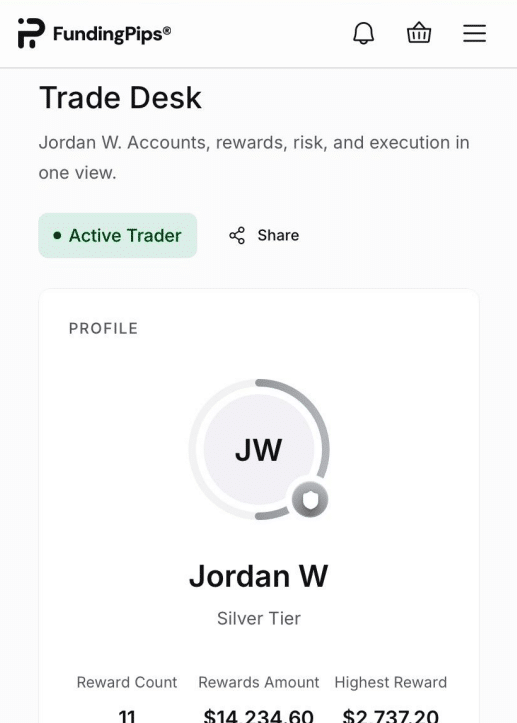
With FundingPips alone, I’ve received 11 rewards totaling 14,234.60 dollars. That number probably means more to me than any single payout because it represents repetition. It wasn’t one trade, one lucky month or one screenshot. I had to get paid, come back, trade again and get paid again.
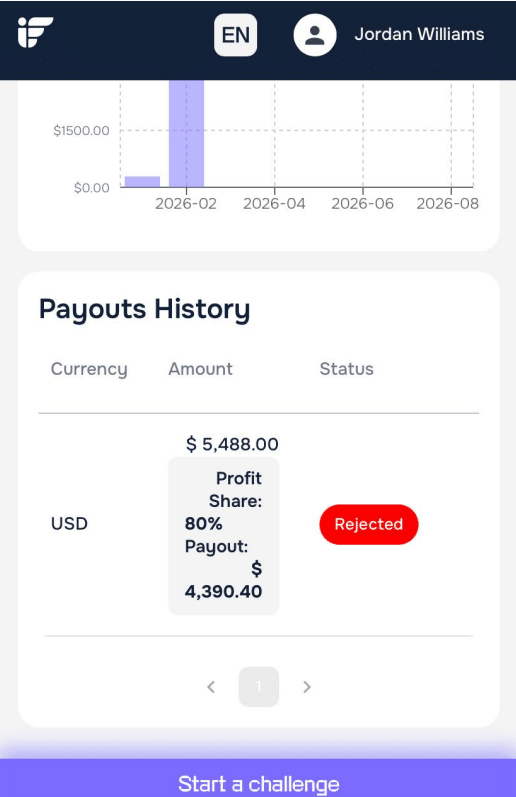
That doesn’t mean everything went perfectly. I’ve lost funded accounts. I’ve failed challenges. I’ve had a roughly 5,000 dollar payout denied by another firm. There have been plenty of mistakes between those payouts.
I’m still building.
And I’m comfortable saying that.
“So What Exactly Do You Do?”
Most people around me don’t completely understand trading.
Their reaction is usually intrigue, but not necessarily interest.
Once you actually explain what goes into it, people tend to fall into a few categories. Some think it sounds impossibly complicated. Some understand how long developing the skill takes and immediately decide they want nothing to do with it. Others simply realize they don’t care about financial markets that much.
My favorite reaction is boredom because then I don’t have to explain it anymore.
I’m probably the worst finance bro in the world.
Despite having studied accounting and finance academically, I don’t particularly enjoy talking about finance just because somebody knows I trade. I enjoy talking about it with people whose way of thinking interests me. Not to say I don’t find finance interesting. I do.
The way money acts and behaves is fascinating. The ways in which it can reproduce, even more so. How we spend it is interesting too. But ultimately, a transaction has to be involved. That means a price had to be arrived at. What was the journey of that price before the transaction? I think finance, broadly, is about the transactions dollars are taking, may take, or have taken over their lifespan.
How trading is portrayed online versus what I just described feels worlds apart. I think trading requires passion and curiosity.
But fortunately for all of us, there are plenty of other things to talk and ponder about.
Why Didn’t I Quit?
Part of the answer is my mother.
Growing up, she was relentlessly persistent about persistence itself: don’t give up, keep going, figure it out. Some of my favorite memories of her involve those conversations.
Then I joined the military, where resilience was reinforced from another direction.
As I’ve gotten older, though, my definition of toughness has changed.
Being tough doesn’t mean repressing frustration, disappointment or fear. I think it’s almost the opposite. The faster I can admit that I’m feeling something, the faster I can deal with the reality in front of me.
And I’m stubborn.
If I decide something is learnable, and I can see evidence that I’m getting better at it, I’m generally willing to pay the cost of learning it.
That may be what separates me from the person who stopped after the third failed challenge.
Not superior intelligence. Not some secret strategy.
I just kept learning.
What If You Gave Me 1 Million Dollars Tomorrow?
My first question would be:
What are the markets doing?
That’s it.
I wouldn’t suddenly create trades because the account had another zero attached to it. I’d look at the same instruments. I’d evaluate the same setups. I’d manage the account according to the same principles and size the risk appropriately.
If one of the setups I was already waiting for remained valid, I’d trade it.
If nothing was there, I’d do nothing.
I’d keep working. Keep running. Keep reading. Keep living my normal life.
A 1 million dollar account shouldn’t make me a different trader.
If it did, I probably shouldn’t have the 1 million dollar account.
My take on the firms
FundingPips
FundingPips has probably been my favorite prop firm to trade with. I started using the firm when its pricing was extremely competitive, and over time I watched payout turnaround improve dramatically. I’ve also appreciated the firm’s communication and the visibility of its leadership. In an industry where trust matters enormously, being able to see management communicate directly with the trading community makes a difference.
What I value most is that my experience with FundingPips felt closer to being treated as a trader rather than simply as someone purchasing another challenge. I’ve received 11 rewards totaling 14,234.60 dollars from FundingPips, more success than I’ve had with any other individual firm, and despite changes in pricing over time, it remains the firm I associate most strongly with my development as a funded trader.
FTMO
FTMO gets enormous credit from me for something different: longevity and professionalism. I genuinely don’t know whether I would have developed the same way as a prop trader without FTMO existing as an established benchmark in the industry. It was the first firm where I passed a funded challenge, and its rules forced me to become more disciplined about risk.
My criticism would be responsiveness. In my experience, customer service hasn’t always felt as immediate or accessible as what I’ve experienced elsewhere. Even so, FTMO’s track record and professionalism are why I still rank it very highly. In an industry where firms can appear and disappear quickly, longevity means something.
Verified funded – the receipts
Payout denied – the receipts
About the writer – Jordan Williams
Jordan Williams is a 30-year-old trader originally from Kingston, Jamaica, who now lives in Bogotá, Colombia. He trades indices, metals, crypto and currencies with a top-down approach, first passed a funded challenge with FTMO in 2023, and has traded with FTMO, FundingPips, Blue Guardian, Maven, Instant Funding and Top One Trader.
Enjoyed this article? Add JoinProp as a preferred source on Google.


