


One Prop Trader a Day – Episode 133
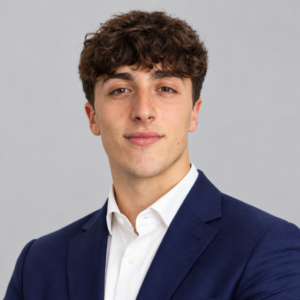
Daniel Scomparin
Daniel Scomparin is a 21-year-old trader from Italy who is building an AI-assisted, evidence-based trading system around prediction markets and option markets. He has used FTMO and The5ers, and plans to run his next prop challenge as an open public experiment with the support of JoinProp. Here is his story, in his own words.
Can the best trade be the one you never take? Daniel Scomparin, a 21-year-old trader from Italy, says the more he studies trading, the less he wants to trade. In this story, he explains what a 150 euro loss taught him about edge versus a chart full of reasons, why he is building an AI-assisted system around prediction markets and option markets to give him reasons not to trade, how he compares FTMO and The5ers, and why his next prop challenge will be a public experiment where every trade, every day of nothing and every loss stays visible.
“Give a finance guy a chart, money and five hours in front of a screen and he’ll find a romantic reason to click buy or sell. Even if there’s no reason at all.”
My name is Daniel, I’m 21, from Italy, and strangely enough, the more I study trading, the less interested I become in taking trades.
When I started, I did what many retail traders do. I opened a chart, drew levels, looked for patterns and tried to understand where price was going next. My biggest real loss doing this was around 150 euros. The money itself could look irrelevant but what bothered me the most was realizing that, if someone had asked me to prove objectively why that trade had an edge, I couldn’t have done it.
I had a chart full of reasons, but no evidence that those reasons gave me a statistical advantage.
And the dangerous part was that sometimes those trades worked. A winning trade could reinforce a bad process just as easily as a losing trade could punish a good one.
That completely changed my relationship with markets.
I stopped asking myself how I could find more trades and started asking how I could eliminate almost all of them. That’s what I call the art of not trading.
I think one of the biggest misconceptions in trading is that your job is to constantly discover where the market is going. I see it differently now: my job is to do absolutely nothing until the evidence becomes difficult enough to ignore. The market pays you not to trade.
The problem is that humans aren’t particularly good at doing nothing. Give someone a chart, money and five hours in front of a screen and eventually they’ll find a reason to click something. Fear, boredom, FOMO, overconfidence and confirmation bias slowly transform uncertainty into a story that feels convincing.
So I became fascinated by a different idea: instead of spending years trying to turn myself into a perfectly rational human being, what if I could build the rational part outside of myself?
That’s where AI entered my trading.
Not as an oracle. I don’t ask a chatbot whether the next candle will be green or red. I want machines doing what humans struggle to do consistently: processing information without getting bored, excited, scared or emotionally attached to an outcome. And that obsession eventually led me somewhere I didn’t expect: prediction markets and option markets.
Both are trying, in very different ways, to put a price on an uncertain future. What if I could find a correlation? That absolutely fascinated me.
If two different markets are looking toward the future, what can we learn when they strongly agree? What happens when they dramatically disagree? And, most importantly, are there circumstances in which that information becomes useful enough that doing nothing is no longer the best decision?
That’s the system I’m building.
I won’t explain the mechanism in detail yet, partly because I’m still developing it and partly because I think trading has enough people explaining incredible systems before demonstrating that they work.
I’d rather reverse the order.
I’ve used FTMO and The5ers, and I preferred FTMO’s trading conditions, particularly spreads and commissions. Beyond that, I don’t want to build credibility around stories of previous challenges, payout screenshots or numbers that a reader has no way of verifying.
I think the internet already has enough of those. What I want to do next is much more uncomfortable and therefore interesting.
I want to test this publicly.
I want the next prop challenge to become an open experiment across Instagram, LinkedIn, potentially TikTok with the support of JoinProp. If the system says trade, people will see the trade. If it says don’t trade for three days, they’ll see three days of nothing. If it loses, the loss stays there.
And if it works, the results will be visible too.
Any money generated from the experiment goes back into it: larger prop allocations, more testing and eventually a much bigger question about how far an evidence-based trading process can actually be scaled.
Maybe the most valuable thing I’m building won’t be a system that discovers more opportunities.
Maybe it will be a system that gives me thousands of reasons not to trade – until one reason is finally good enough.
I have no interest in pretending I’ve figured out the market but I’m trying to build a machine that knows when I should leave it alone.
The challenge itself will answer the rest.
About the writer – Daniel Scomparin
Daniel Scomparin is a 21-year-old trader from Italy who is building an AI-assisted, evidence-based trading system around prediction markets and option markets. He has used FTMO and The5ers, and plans to run his next prop challenge as an open public experiment with the support of JoinProp.
Enjoyed this article? Add JoinProp as a preferred source on Google.


