
One Prop Trader a Day – Samuel Kimutai: The Strategy Didn’t Change Nearly as Much as I Did


One Prop Trader a Day – Episode 130

Samuel Kimutai
Samuel Kimutai is a 42-year-old trader from Eldoret, Kenya, who first came across trading in 2007 and has been funded since 2024. He trades Gold (XAUUSD) and Nasdaq (NAS100) using liquidity sweeps and market structure shifts, and he also builds AI automation and AI tutoring startups. He has traded exclusively with Funding Pips. Here is his story, in his own words.
What happens when you blow more than 10 accounts with a strategy that wins only around 35% of the time? Samuel Kimutai, a 42-year-old trader from Eldoret, Kenya, first came across trading in 2007, got funded in 2024, and says he reached the number one spot globally on the Funding Pips live leaderboard for 10,000 dollar accounts. In this interview, he explains why he treats every trade as one data point in a large sample, how he trades Gold and Nasdaq with liquidity sweeps and market structure shifts, how he lost a 100,000 dollar funded challenge to emotion, and what he thinks of Funding Pips.
I’m Samuel Kimutai, 42 years old, from Eldoret, Kenya. I trade Gold (XAUUSD) and Nasdaq (NAS100), reading price off liquidity and market structure rather than indicators.
I got funded in 2024 – but that’s not where the story starts. I actually first came across trading back in 2007. I had no mentorship and no real structure, so those early years were painful: blown accounts, money burned on courses and “signals” that went nowhere, and long stretches where I walked away from it entirely because it simply wasn’t working. There were years of on-again, off-again attempts in between.
What actually changed was two things happening at once. First, prop firm access itself changed – years back it was reserved for the elite, with fees running into the thousands. Post-COVID, that model opened up, and funding became accessible at a price an ordinary trader like me could actually afford to test himself against. Second, and more important, is that things finally clicked for me during COVID because I stopped treating trading as purely a charts problem and started working seriously on the mental side – discipline, patience, and not needing to be right on every trade. The strategy didn’t change nearly as much as I did.
I was in the middle of designing a piece of construction equipment at the time and needed capital for it. Most of that first real payout went straight into building the machine – that was the moment trading stopped being theoretical and started funding something real in my life.
I’ve blown through more than 10 accounts on the way here. My strategy’s win rate is only around 35%, so with a hit rate that low, losing accounts is genuinely part of the business, not a sign something’s broken. What kept me coming back was trusting that the curve works out over a large enough sample – in the long run, it’s up, even though any single stretch can look brutal.
Never trade when you’re having a bad day. I once lost a 100,000 dollar funded challenge because I let emotion override the plan after a rough start – one bad mental state turned into one very expensive account. That single lesson changed how seriously I take my own state of mind before I ever click a button now.
Winning trades and losing trades both come with emotion at the extremes, and both are dangerous if left unmanaged – euphoria after a win can blow up the next trade just as easily as fear after a loss. If I’m honest, most of the real work over the years hasn’t been on the charts at all, it’s been on my own mind – building the discipline to treat every trade as one data point in a large sample rather than a verdict on my ability.
I’ve exclusively traded with Funding Pips. What I look for in a firm: fair challenge pricing, fast withdrawal speed, and excellent customer support – Funding Pips has delivered on all three, which is why I’ve stayed with them through every account I’ve taken since getting funded.
I trade Gold and Nasdaq using a liquidity-sweep-and-market-structure-shift approach: I mark bias on the higher timeframes, then wait for price to sweep a key liquidity level intraday and confirm a genuine shift in structure before considering an entry – I’m not chasing candles. Every position has a defined stop and target set before I’m in, sized as a fixed percentage of the account, never as a fixed dollar figure.
My day starts before the London open, marking overnight structure and key levels on Gold and Nasdaq. I wait for the London and New York kill zones, where the highest-probability moves tend to happen, and only act when a liquidity sweep and a market structure shift line up together. Outside those windows I’m largely hands-off – I built and run my own monitoring system that watches price around the clock and flags qualifying setups automatically, including a Telegram channel where I publish and track live signals for a group of subscribers. That system is what keeps me disciplined about acting only inside my actual edge, instead of sitting in front of charts all day.
That hands-off time is also when I build. I run an AI automation startup focused on lead generation for social commerce – AI sales agents and customer support that work a brand’s DMs and comments around the clock. Alongside that, I’m concurrently building an AI tutoring startup using interactive, realistic AI avatars – no booking required, available 24/7. Trading is what taught me to build systems that run without needing me watching them constantly, and that’s the same principle behind both companies.
The pattern behind most of my losing trades looks the same: a liquidity sweep forms, but the displacement confirming the structure shift is weaker than it should be, and I take the entry anyway on the promise of the setup rather than the full confirmation. Price runs to my stop, which is placed at the structurally correct invalidation point, so the loss itself is clean and sized exactly as planned – never a surprise. What I’d do differently, and what I hold myself to now, is waiting for the full displacement candle every time rather than anticipating it. A 35% win rate only works if the losers are this disciplined and the setups I do take are the real ones.
It’s in the higher tens of thousands – I won’t put an exact figure on it. But the milestone I’m proudest of isn’t a payout at all: I hit the #1 spot globally on Funding Pips’ own live leaderboard for 10,000 dollar accounts, ahead of funded traders from Switzerland, France, the UK, Thailand and beyond. That’s the moment that told me the process holds up against anyone, not just against my own past results.
Where I’m from, people are used to a fixed routine – wake up, go to a job, come home. The idea of making a living from a laptop, reading charts, still doesn’t fully compute for a lot of people around me. Reactions range from genuine confusion to outright suspicion – some of the “illuminati” jokes aren’t even meant as jokes. At this point I’ve stopped trying to explain it in detail and just let the results speak instead.
Trusting the process. Trading is a game of probability, and my win rate is a good example – around 35% means I can lose 7 out of 10 trades and still be exactly on plan, not off it. What separates someone who stays in the game from someone who quits after their third failed challenge is knowing that going in, so a losing streak reads as ordinary variance instead of a signal to quit. The traders who blow up emotionally are usually the ones who never priced the losses in ahead of time.
I wouldn’t change how I trade just because the size changed – that’s exactly how people blow up big accounts. The first 7 days would look like any other: same kill zones, same liquidity-sweep-and-structure-shift setups on Gold and Nasdaq, same risk per trade as a fixed percentage rather than a dollar number that suddenly feels heavier. I’d lean fully into the swing-trading nature of the approach – I’m not scalping to stay busy, I’m waiting for genuine structural setups, even if that means some days produce nothing at all. The one real advantage: I’ve already built an automated monitoring and Telegram alert system to track price and manage risk hands-off, so I’d let that system run exactly as designed rather than feel pressure to “do something” just because the account is bigger.
My take on the firms
Funding Pips has been the only prop firm I’ve traded with, and I’ve never felt a reason to look elsewhere. Challenge pricing is fair for what you get, the rules are clear and consistently enforced, and – critically for anyone trading from Kenya – withdrawals have always been fast and reliable, with support that actually responds.
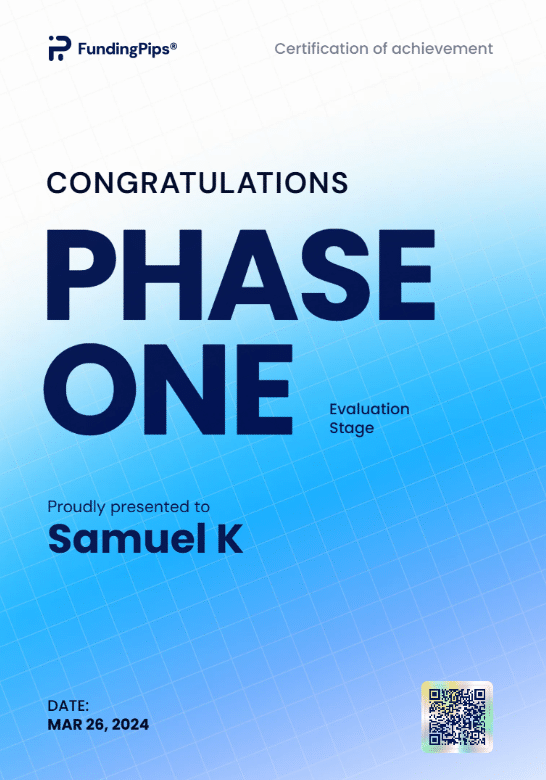
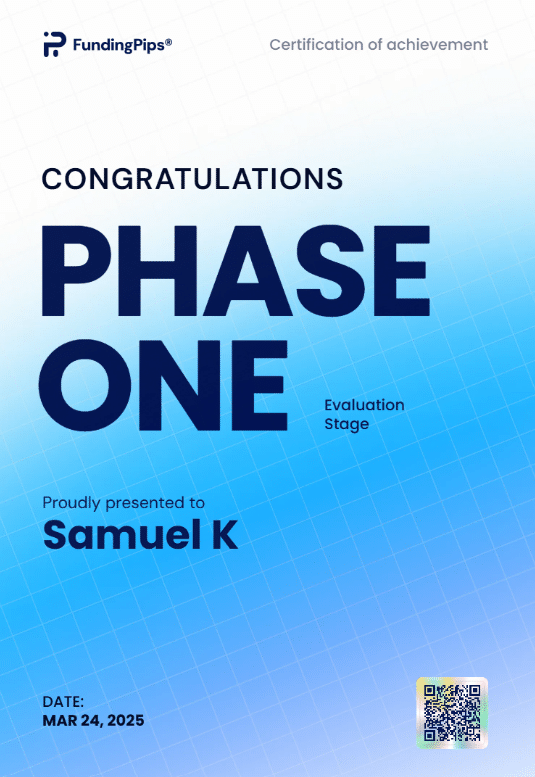
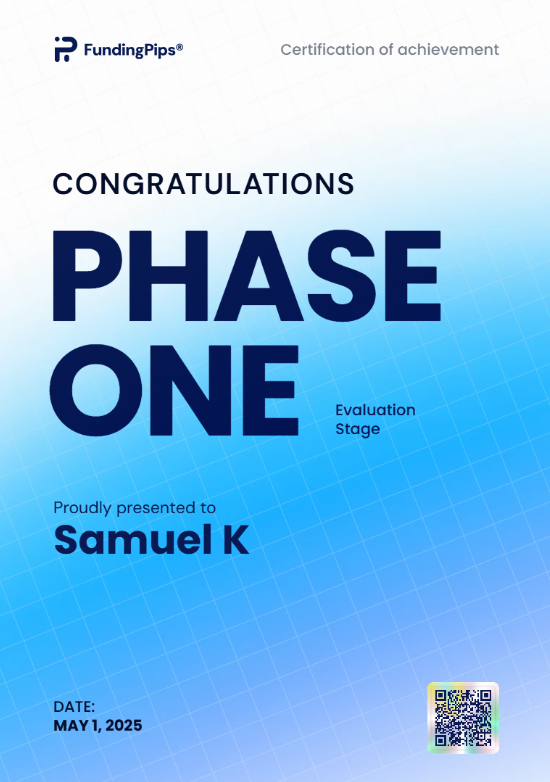
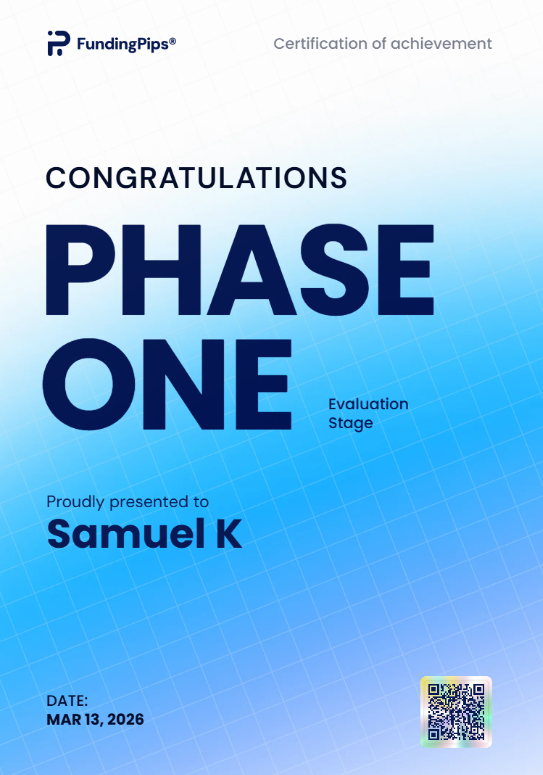
Since getting funded in 2024, I’ve passed multiple Phase One and Phase Two evaluations, most recently in July 2026. I also reached the #1 spot globally on Funding Pips’ own live leaderboard for 10,000 dollar accounts. None of that happens without a firm that gets out of the way and lets a strategy actually play out – that’s the best review I can give them.
Challenges passed – the receipts






About the writer – Samuel Kimutai
Samuel Kimutai is a 42-year-old trader from Eldoret, Kenya, who first came across trading in 2007 and has been funded since 2024. He trades Gold (XAUUSD) and Nasdaq (NAS100) using liquidity sweeps and market structure shifts, and he also builds AI automation and AI tutoring startups. He has traded exclusively with Funding Pips.
Enjoyed this article? Add JoinProp as a preferred source on Google.


