
One Prop Trader a Day – Abdoul Aziz Sy Seck: My Job Is to Execute My System, Not to Chase the Market


One Prop Trader a Day – Episode 128
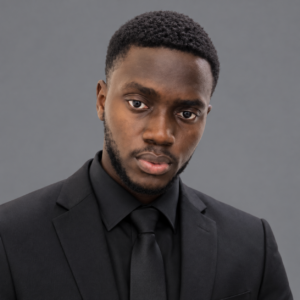
Abdoul Aziz Sy Seck
Abdoul Aziz Sy Seck is a 28-year-old trader from Senegal with four years of trading behind him. He specializes in Gold (XAUUSD) and EURUSD, trading with the trend using Dow Theory, market structure and Volume Profile, with strict risk of 1% per trade and a daily limit of 2%. He has traded with FTMO and FundedNext. Here is his story, in his own words.
What do you do when your first funded account does not last even a month? Abdoul Aziz Sy Seck, a 28-year-old trader from Senegal, passed his FTMO challenge with ease after dozens of free challenges and months of demo trading, then learned that a strategy alone is not enough. In this interview, he explains how he built a complete trading system with precise rules, 1% risk per trade and a 2% daily limit, how he trades Gold and EURUSD, and how he compares FTMO and FundedNext.
My name is Abdoul Aziz. I am a 28-year-old young trader from Senegal. I have been trading for four years, and I have specialized mainly in Gold (XAUUSD) and the EURUSD Forex pair.
My first funded account was with FTMO. When I became a funded trader, I felt a strong sense of satisfaction, but also relief. It had taken me two years of hard work, doubts, and starting over many times to get there.
It was a long battle against myself, and finally I felt that I had come out victorious. It was a beautiful experience that I really appreciated. But I also learned that passing a challenge was only the beginning.
Honestly, I did not buy anything.
Reality caught up with me very quickly. I realized that passing a challenge was only the beginning; the real work was maintaining the funded account. Unfortunately, my first funded account did not last even one month.
That experience taught me that getting funded is not the same thing as becoming a consistent trader.
My case is a little different. I passed my first challenge with ease, but before taking that challenge, I had already gone through dozens of free challenges and months of demo trading while developing and testing my strategy.
That accumulated work allowed me to succeed on my first real challenge.
However, at that time I only had a strategy. I did not yet have a complete trading system, precise rules, a structured plan, or properly developed trading psychology. That is why I was unable to protect my first funded account.
I learned that no matter how good a strategy is, it is not enough. To succeed in trading, you need a complete system with precise rules, solid risk management, and the right psychology.
I have lost approximately 1,000 dollars since I started trading, from the transition between demo trading, live accounts with my own capital, and eventually prop firms.
It cost me a lot, but I learned several important lessons from those losses. Today, I see the money I lost in trading almost like a form of education: it was the price I paid to develop my skills, understand the markets better, and learn what it really takes to become a trader.
At the beginning, I took my trading losses personally. I would question myself, my life choices, my career path, and many other things.
With time, however, I changed the way I looked at the markets. I understood that losses are an integral part of trading.
Trading is a probabilistic activity. We work with statistical probabilities, but we can never reach 100% certainty. Financial markets reflect the behavior and interactions of economic, social, and political factors around the world. Because of that, no strategy or analysis can guarantee the final outcome of a trade.
Today, I focus less on being right on every individual trade and more on executing my system consistently.
Throughout my journey as a trader, I have mainly worked with two prop firms: FTMO and FundedNext.
When choosing a prop firm, I particularly look for transparency, reasonable drawdown rules, low spreads, fast execution, and the freedom to trade according to my own system and approach.
My trading style comes mainly from many years of disciplined work.
I always trade in the direction of the market trend, which I determine using Dow Theory and market structure, such as HH/HL in an uptrend and LL/LH in a downtrend.
I use H4 for directional analysis and higher-timeframe context. Then I move to M15 to identify the structure and the setup in the direction of the HTF trend. Finally, I use M5 for confirmation and entry confluence.
My confluences can include Supply & Demand zones, Fair Value Gaps (FVGs), liquidity, and volume. My favorite tool is Volume Profile because it allows me to identify the Point of Control (POC) of each move.
I trade only two sessions. I focus on EURUSD during the London session and Gold (XAUUSD) during the U.S. session.
My risk is always 1% per trade, and my predefined daily limit is -2%. If I reach a 2% loss for the day, I stop trading.
I start my trading day at 7:30 AM. First, I check the economic calendar and look at some news to build my fundamental context.
Then I open my charts and focus on EURUSD. I prepare before the London session by identifying the trend and the areas of interest.
Around 8:00 AM, I wait for price to break structure in the direction of the HTF trend. Once that happens, I move down to M5 to look for confirmation and confluence with my strategy.
If the setup is validated, I take the position, place my stop loss in a safe structural area, and target 2R.
I only trade A+ setups. I trade EURUSD until around noon, then I take a break.
After that, I prepare for the U.S. session and focus on Gold from approximately 1:30 PM to 6:00 PM.
At the end of the day, I complete my trading journal and then finish my day with a workout.
My most recent losing trade was on EURUSD.
The execution was perfect and everything respected my trading system. The trade actually moved in my direction and came within just three pips of my take profit.
Then the price reversed, came back to my entry, and eventually hit my stop loss. After that, the market reversed again and continued in the direction of my original analysis.
It was frustrating, of course, but I accepted it because this is part of trading. I don’t believe there was anything fundamentally wrong with my execution.
My job is to execute my system, not to chase the market.
The only significant gains I have made so far have been on a live account, but I prefer not to disclose the specific amounts.
For me, the most important thing in trading is discipline. Payouts are a consequence of consistency and discipline. The goal is not simply to make money quickly, but to become disciplined enough to remain in this business for the long term.
Honestly, this has been one of the most difficult battles.
Trading is often misunderstood and poorly perceived by people around you. One of my biggest struggles was dealing with the doubts of my family, friends, and people close to me. They tried to discourage me several times.
There was always the fear that I was risking my future, the doubts, and especially the comparisons with the career paths of people around me.
Trading requires patience, construction, and a long-term mindset, just like entrepreneurship. Many people are afraid of that uncertainty and of waiting for something to be built over time.
I went through all of that, but I never gave up. Trading is my passion, so I continue working toward my dreams and goals, Insha’Allah.
My case is a little special.
Of course, I refuse to give up because trading is a passion for me. But I also have to be honest: I continued because I did not have many other opportunities that worked out for me.
I tried to find employment, but nothing was offered to me. Trading was the field where I felt accepted and where I felt that I truly belonged.
For me, trading is therefore not just a skill or a simple hobby. It has become part of my identity.
If such an opportunity were given to me today, I believe I would be able to manage the account with discipline and continue improving over time.
I have built a trading system that I consider both profitable and protective. Therefore, the first seven days would mainly be about preparation and flawless execution of the system I have spent four years building.
I would not suddenly change who I am as a trader simply because the account was larger. I would focus on protecting the capital, following my rules, and executing my system consistently.
My take on the firms
I have had experience with both FTMO and FundedNext, and I consider both to be strong prop firms. From my perspective, FundedNext offers more flexible challenge conditions. For example, the profit target is 8% in the first phase and 5% in the second phase, while FTMO requires 10% in the first phase and 5% in the second phase. I have also found the commission costs to be higher with FTMO than with FundedNext.
Where FTMO has a particularly strong advantage is its reputation. It has established itself as one of the leading and most recognized names in the prop firm industry. For me, both firms have their strengths, and the right choice ultimately depends on the trader’s priorities and trading style.
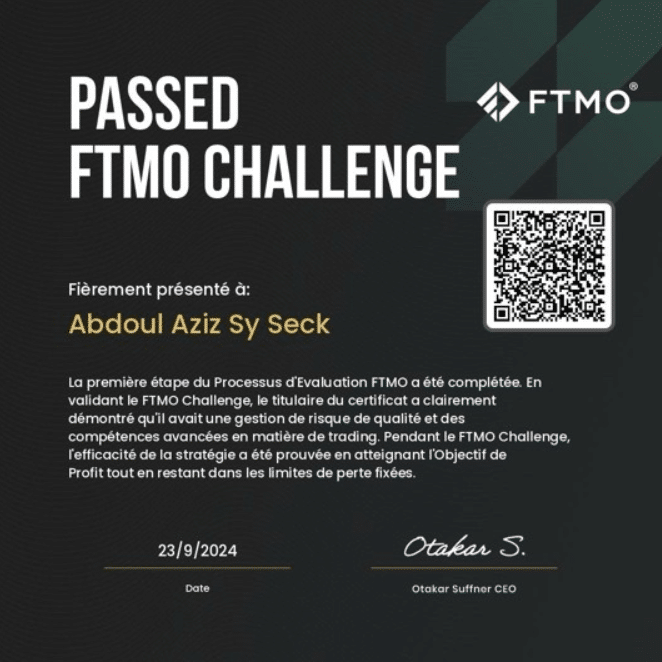
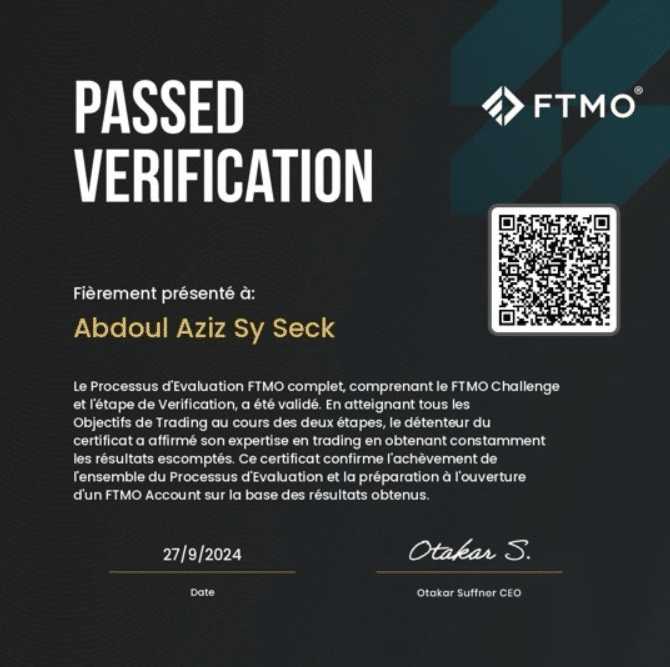
Challenges passed – the receipts
About the writer – Abdoul Aziz Sy Seck
Abdoul Aziz Sy Seck is a 28-year-old trader from Senegal with four years of trading behind him. He specializes in Gold (XAUUSD) and EURUSD, trading with the trend using Dow Theory, market structure and Volume Profile, with strict risk of 1% per trade and a daily limit of 2%. He has traded with FTMO and FundedNext.
Enjoyed this article? Add JoinProp as a preferred source on Google.


