
One Prop Trader a Day – Sadanand RohanKumar: I Stopped Asking Why I Can’t Pass and Started Asking Why I Keep Failing


One Prop Trader a Day – Episode 124

Sadanand RohanKumar
Sadanand RohanKumar is a 28-year-old futures trader from Hyderabad, India, with an engineering background. Prop-firm tested with Goat Funded Trader, MyFundedFutures, Maven Trading and Lucid, he trades NQ, ES, YM and Gold using price action and ICT concepts. Here is his story, in his own words.
FirmGoat Funded TraderFirmMy Funded FuturesFirmMaven TradingFirmLucid Trading
What does it take to come back after blowing around 14 prop-firm accounts in about three months? Sadanand RohanKumar, a 28-year-old engineer from Hyderabad, India, trades Nasdaq, S&P 500, Dow Jones and Gold futures with price action and ICT concepts. In this interview, he explains why his real problem was never his market analysis, how he went from asking why he could not pass to asking why he kept failing, and what he thinks of Goat Funded Trader, the firm he reviews here.
My name is Sadanand RohanKumar, I’m 28 years old and based in Hyderabad, India. I come from an engineering background, but over the past few years, trading has become a major part of my life and something I’ve become deeply passionate about. I primarily trade futures, focusing on Nasdaq (NQ), S&P 500 (ES), Dow Jones (YM) and Gold. My trading is based mainly on price action and ICT concepts, with a particular focus on fractal structures, liquidity, market structure and precise execution.
Becoming a funded trader was a major turning point for me. Before getting funded, I was mainly focused on proving that my strategy could work consistently. Once I became a funded trader, I realized that passing an evaluation and managing a funded account are two completely different things. It changed my mindset. I started understanding that making money isn’t the hardest part of trading. Protecting your capital and controlling your emotions are what allow you to stay in the game.
I haven’t made a major purchase or paid off a large debt with trading profits yet, so I don’t want to exaggerate that part of my story. For me, the first real proof that trading was working wasn’t something I bought. It was seeing myself reach funded stages and being able to generate results from a process that I had developed through years of studying and practicing the markets. That feeling of knowing “I can actually do this” was more valuable to me than any purchase.
I’ve had a lot of failures throughout my journey. At one point, I blew around 14 prop-firm accounts in approximately three months. The frustrating part was that my biggest problem wasn’t necessarily my market analysis. It was my behavior after losing trades. I would sometimes overtrade, revenge trade or increase my position size because I wanted to recover a loss immediately. What kept me coming back was realizing that I didn’t need another strategy, I needed to become a better trader psychologically. Every failure showed me something about myself. Eventually, I stopped looking at losing accounts simply as failures and started treating them as lessons about what I needed to fix.
My most expensive lesson was overtrading and revenge trading. I’ve lost multiple prop accounts because of those mistakes, with around 14 accounts lost in three months being the period that taught me the most. The financial cost was significant, but the bigger lesson was understanding that a losing trade is normal. Destroying an account because you can’t emotionally accept a losing trade is not. That experience completely changed the way I think about risk.
Did trading take a mental and emotional toll? Yes, absolutely. There were periods where losing an account affected me mentally and emotionally. The worst part wasn’t simply losing money. It was knowing that sometimes I had created the situation myself by breaking my own rules. Today, I try to separate my trading performance from my identity as a person. I focus on executing my setup correctly rather than trying to make every day profitable. If I take a loss, I accept it as part of the business. And if I notice myself becoming emotional or wanting to recover a loss immediately, I step away from the market.
I’ve traded with several prop firms, including Goat Funded Trader, MyFundedFutures, Maven Trading and Lucid. Earlier in my journey, I mainly looked at account size and pricing. Now my priorities are very different. I look for clear rules, reasonable drawdown conditions, reliable payouts, good execution and a structure that allows traders to manage risk properly. A good prop firm should allow a trader to focus on their strategy instead of constantly worrying about complicated or unclear rules.
I’m primarily a futures trader, trading NQ, ES, YM and Gold. My approach is based around ICT concepts and fractal price action. I focus on market structure, liquidity, displacement and identifying areas where price is likely to react. I use higher timeframes to understand the broader market context and lower timeframes for execution. I’m also much more selective now. I don’t feel the need to trade every market movement. If my setup isn’t there, I simply don’t trade.
My trading day starts with preparation. I first look at the higher-timeframe structure and identify important liquidity levels and areas of interest. From there, I build a few possible scenarios for how price could develop. Once the session begins, I wait for my setup rather than forcing a trade. If my conditions are met, I take the trade with predefined risk and a clear invalidation point. If the setup doesn’t appear, I’m perfectly comfortable finishing the day without taking a trade. Afterwards, I review my execution. I’m more interested in whether I followed my process than whether I made money that day.
My most recent losing trade was a situation where I had a setup based on my usual market structure and liquidity analysis, but price ultimately invalidated the idea and hit my stop. The important difference now is how I react to that loss. Earlier in my journey, a stop loss could lead to another immediate trade because I wanted to recover the money. Now I understand that the stop loss is simply the point where my trade idea is proven wrong. If I could change anything, it wouldn’t necessarily be the trade itself. I would make sure I don’t allow that loss to influence my next decision.
I haven’t had a major payout that I would describe as the defining achievement of my trading career, so I would rather be honest about that. My biggest milestone so far has been reaching funded stages and developing the ability to trade under prop-firm conditions. For me, the next major milestone is consistency: being able to manage a funded account responsibly, protect the drawdown and withdraw profits without giving them back.
Not everyone completely understands what I do. From the outside, trading can look very simple, you look at a chart and buy or sell. But the reality is very different. A large part of trading is waiting, managing risk, dealing with uncertainty and controlling your emotions. Some people around me support what I do, while others don’t fully understand it. I’ve learned that I don’t need everyone to understand my career. I need to understand what I’m doing, manage the risks responsibly and continue improving.
I don’t think what separates me from someone who quit after their third failed challenge is simply persistence. The biggest difference is that after failing repeatedly, I eventually stopped asking “Why can’t I pass?” and started asking “Why do I keep failing?” That forced me to look at my own behavior. I realized that overtrading, revenge trading and trying to recover losses quickly were hurting me more than the market itself.
If you gave me a 1 million dollar funded account today, I wouldn’t suddenly increase my risk just because the account was bigger. My first priority would be capital preservation. I’d spend the first few days understanding the account’s drawdown structure, rules and execution conditions. Then I’d trade my existing strategy with conservative risk and focus on establishing consistency. I wouldn’t try to make a huge return in the first week. A 1 million dollar account doesn’t require me to become a completely different trader. It requires me to become an even more disciplined version of the trader I already am.
My take on the firms
My experience with Goat Funded Trader has been an important part of my prop-trading journey. It gave me an opportunity to trade in a funded environment while continuing to develop my execution and risk-management skills. One thing I learned through the experience is that understanding the firm’s rules is just as important as understanding your trading strategy. Overall, GFT has been a valuable part of my development as a trader. My advice to anyone trading with a prop firm is to understand the rules thoroughly, manage risk conservatively and treat the account like a business rather than an opportunity to make quick money.
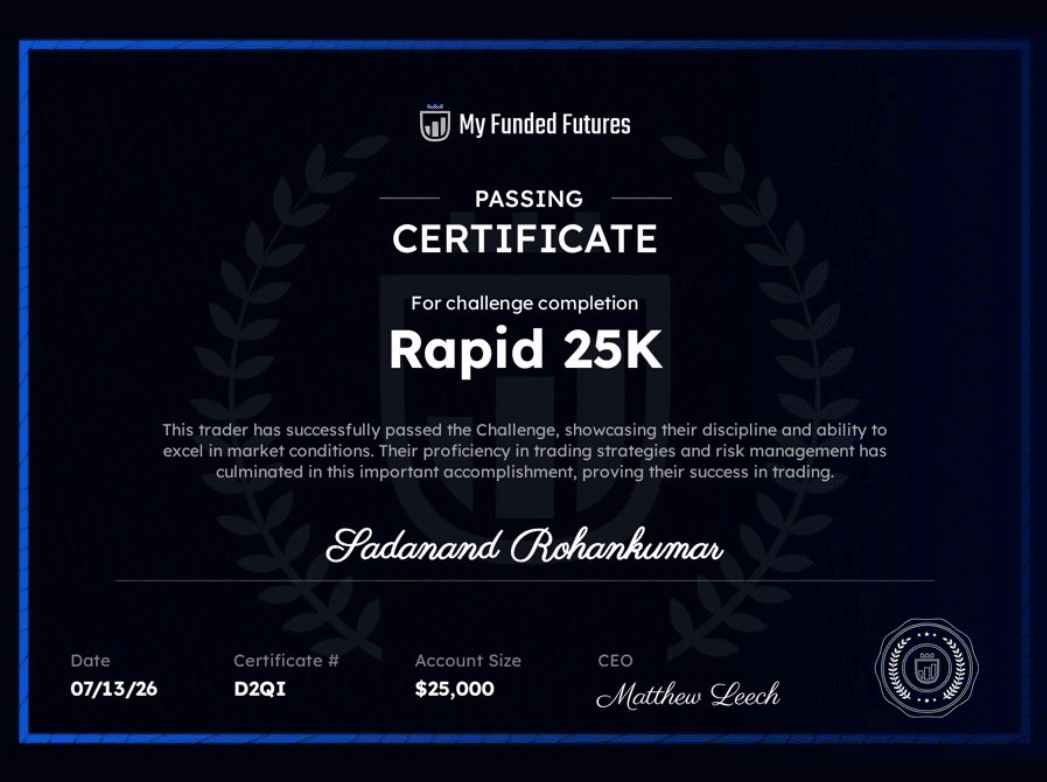
Challenges passed – the receipts


About the writer – Sadanand RohanKumar
Sadanand RohanKumar is a 28-year-old futures trader from Hyderabad, India, with an engineering background. Prop-firm tested with Goat Funded Trader, MyFundedFutures, Maven Trading and Lucid, he trades NQ, ES, YM and Gold using price action and ICT concepts.Connect on LinkedIn
Enjoyed this article? Add JoinProp as a preferred source on Google.


