
One Prop Trader a Day – Juan Esteban Hernández Orozco: Passed My First Challenge at 15, Then Failed Up to 25 More


Updated
TL;DR — Juan’s challenge setbacks and risk lessons
Juan Esteban Hernández Orozco describes learning to trade as a teenager, later losing 15–25 challenges and rebuilding his approach around risk management. His process combines macroeconomic context, market structure and five-minute entries, with a maximum of two trades a day. These are his reported experiences, not typical trader outcomes.
One Prop Trader a Day – Episode 99

Juan Esteban Hernández Orozco
My name is Juan Esteban Hernández Orozco, I am 19 years old and I am from Medellín, Colombia. I am a funded trader and I specialise in US indices, primarily the Nasdaq, as well as the US stock market.
How do you keep going after failing up to 25 challenge accounts? Juan Esteban Hernandez Orozco, a 19-year-old economics student from Medellin who trades the Nasdaq and US stocks, started studying the markets at 15 after overhearing a conversation in his parents’ house, and lost his first challenge along with about 200 dollars. In this interview, he explains the macro and structure read behind his 5 minute entries, the day he left class in tears to call his father, and how he would handle a million dollars of somebody else’s capital.
Juan’s early trading journey
I started studying trading on 12 December 2022, when I was 15. What began as curiosity became a profession, but my journey has not been one of success from the start. Like most traders I have collected losses, mistakes, failed assessments and moments when I had to rethink my understanding of the markets from scratch. What I learned is that success does not come from finding a perfect strategy. It comes from discipline, solid risk management, and the patience to execute the same plan over and over.
It started with a conversation I was not part of. A friend of a relative, who was doing P2P arbitrage on Binance, was visiting our house. I came home from school and overheard him telling my parents how much he had earned. I have always been a curious person, so I walked over and asked him exactly what he did. He explained roughly how the markets worked and told me he saw potential in me to learn trading. That conversation changed my life.
At first I learned entirely by trial and error: free content, hours in front of charts, trying to work the market out on my own. With that confidence I bought my first challenge account and lost it, along with about 200 dollars. To some people that is nothing. For a 15-year-old in Colombia it was a real sacrifice made by my parents.
I remember the day perfectly. I was in class when I realised the account was gone. I left the room crying and called my dad, sure he would be disappointed. He was not. “It is good that this happened to you now,” he told me. “You needed a dose of reality to understand that this is not easy, so you never let your ego take over. Now keep studying and prepare yourself better.” That call was a turning point in my career.
So I went back to the person who had introduced me to trading and told him I wanted to take it seriously. He put me in touch with a trader with many years of experience, and that man taught me a professional methodology. I still use the same foundation today, adapted and refined with my own experience.
I also made one decision early that I consider fundamental: I never let myself be swayed by influencers flaunting Ferraris, luxury watches or unrealistic profits. Comparing myself to them would only cost me focus. I measured my progress against my own reality instead, where a single good trading day could equal several weeks of work for many people in my country. That taught me to respect money, and to understand that the objective was consistency, not instant wealth.
On 6 August 2023 I became a funded trader for the first time, with MyForexFunds. I was still a minor, so the account had to be opened using my father’s information. That first certificate meant far more than a passed assessment. It was months of study, sacrifice and perseverance, finally rewarded. What changed was not my financial situation, it was my mindset. I stopped trying to prove I could make money and started protecting my capital, sticking to my plan and thinking like a professional.
My first major withdrawal went into a complete trading setup, around 4 million Colombian pesos of computer, monitors and peripherals, paid for entirely with money I had earned trading. Most people spend their first profits on something luxurious. I wanted to invest in my profession and build a space where I could keep improving, and I knew the equipment would serve me at university too, so I was investing in my present and my future at once.
That desk still means something to me. It is not a computer and some monitors. It is the hours of study, the nights I stayed in to learn instead of going out with friends, the mistakes, the lost accounts and the times I had to start over, and the trust my parents placed in me from the very beginning. That was the moment trading stopped being a dream and became a real life project.
Challenge setbacks and capital protection
Then the hardest stage of my career began. My first challenge had been a success, but shortly after I passed it, MyForexFunds closed due to legal issues, and the mindset that had carried me there went with it.
I started comparing myself to traders and influencers showing off large profits and glamorous lifestyles. I stopped focusing on my own progress and became obsessed with making more money. Without realising it, my risk management and my psychology deteriorated completely, and I reached the point where I could lose a challenge in less than a week. Before I passed another assessment I failed somewhere between 15 and 25 challenges. It is a number I am not proud of, but I am not ashamed to share it either, because it is part of my story and of the lessons I apply every day.
Put in money, the most expensive lesson cost me between 5 and 7 million Colombian pesos, lost in failed investments after MyForexFunds shut down. The strange part is that those losses had nothing to do with forgetting how to trade. I had forgotten why I was successful the first time. I chased unrealistic returns, let my ego make decisions for me, and abandoned the discipline that had got me funded in the first place.
Today I look at that money very differently. I would rather not have lost it, but it forced me to build a much stronger mindset. If I could go back, I would not change the lesson, I would only try to learn it faster. From then on, protecting capital mattered more to me than chasing a large profit, and that idea remains one of the principles I respect most every time I open a position.
The lowest point of my career was not losing a challenge, though. It was losing real money that was not only mine. My parents and the relative who introduced me to trading had seen my commitment and the time I had put into studying, and they decided to pool capital so I could trade a live account. It was not prop firm money, it was hard-earned savings, and that trust meant the world to me.
I was not prepared for that responsibility. I let my emotions get the better of me, took risks I should never have taken, and lost a significant portion of that capital in a very short time. It was not a strategy problem. It was poor risk management and a mentality completely out of control.
What followed was one of the hardest times of my life. I felt deeply ashamed. Many nights I cried silently and wondered why I had ever decided to get into trading. What hurt most was not the money, it was the feeling that I had let down the people who believed in me. I never considered harming myself, but there were times when I thought about quitting trading altogether.
The guilt was heavy enough that I decided to take responsibility. I used part of my savings, which I had invested in stocks, to start paying the money back. It did not cover everything, but I needed to prove to myself and to my family that I would answer for my mistakes. That episode changed my trading forever. Capital represents years of work, sacrifice and trust, and since then I have seen risk management as a responsibility rather than just a technique.
Trading has definitely affected me mentally and emotionally, and I think one of the biggest mistakes is assuming this is only about learning technical analysis. In my experience the mental side matters even more than the strategy. I have felt practically every emotion a trader can feel: euphoria after a winning streak, frustration after several consecutive losses, the anxiety of wanting to recoup, overconfidence, and real doubt about whether I had what it took to do this professionally.
There was a time when I failed evaluations in less than a week purely because my emotions were in charge. I overtraded, increased risk trying to recover losses and strayed completely from my plan. I was not fighting the market. I was fighting myself.
That is when I found stoicism. I started reading about philosophy, emotional control and discipline, and understood that I could not control the outcome of a trade, only my preparation, my discipline and how I reacted to a loss. I learned that losing is part of the job and that a single trade does not define who I am as a trader. I still feel emotions, because that never goes away. The difference is that they no longer make decisions for me. A professional trader is not someone who never feels fear or frustration, it is someone who executes the plan even when those emotions are present.
Macro context and five-minute execution
Today my process starts long before I open a position, because I do not make decisions by looking at a chart alone. My first analysis is monthly, identifying the most likely price direction for the period by combining macroeconomic and technical analysis. On four-hour charts I read market structure, breakouts and liquidity in the form of buy and sell stops, and build the higher-probability scenario from there.
Once the main narrative is clear, I drop to the one-hour and fifteen-minute charts to define my areas of interest and see how the week is unfolding inside that context. Execution happens on the five-minute chart, with an indicator I developed myself. It does not make decisions for me, it complements the analysis I have already performed by pointing at areas with a higher statistical probability inside my plan.
I aim for a maximum of two trades per day, and my favourite windows are the Asian session, the London open, or the New York open after 9:30 in the morning New York time. I would rather trade infrequently and only when the market offers the conditions I am expecting. If I had to define my methodology in a single sentence, it is a combination of macroeconomic analysis, market structure and risk management. I do not identify with any single trading school. I have taken concepts from different methodologies and adapted them into a process that fits how I understand markets.
The most important rule in the entire system is risk management. No trade is worthwhile if the risk-reward ratio is not favourable, and as a general rule I will not take one that does not offer at least 1:2. Consistency does not come from finding perfect entries. It comes from protecting capital and letting probability do its work over time.
A normal day starts between 7:30 and 8:00 in the morning. I study Economics at university and often get home late, so the routine has to let me perform in both places. Before I open any chart I take my dogs for a walk and get as many daily responsibilities done in advance as I can, because I want to be free of distractions when it is time to analyse. Then I review the macroeconomic context, the relevant news and the behaviour of the US stock market, and check whether my trading model aligns with all of it.
I only trade when the market meets the conditions I am expecting. My indicator does not generate opportunities every day, and that is precisely one of the reasons I trust it. I would rather have a few setups with a higher statistical probability than trade constantly just because I am in front of the screen.
A large part of my day also goes to studying. Beyond university I enjoy researching macroeconomics, companies and financial markets, and above all developing new ideas. I am passionate about creating indicators, systems and tools that help me understand market behaviour, and I am always asking how I can improve a process or analyse information more efficiently. When I finish trading I disconnect from the market completely. That habit has been fundamental to my consistency: as traders we will always find opportunities, but not all of them are worth pursuing, and once my window closes I move on to the rest of my responsibilities without looking at charts any more.
My most recent losing trade happened today. I was trading the Nasdaq and around 9:45 in the morning I identified an area where I expected a price reversal, a scenario I have seen repeat many times and that historically has a good probability within my methodology. The trade idea was not the problem. My execution was. I jumped the gun and entered before the market gave me the confirmation my plan requires, which means I traded what I thought was going to happen instead of waiting for it to actually occur. The result was a stop loss.
Reviewing it, the market did nothing wrong. It simply did not confirm the scenario I expected that day, and if I had fully adhered to my rules I probably would not have entered at all. It was entirely my mistake, not a flaw in the strategy. I value these experiences because they keep me grounded. It is easy to get overconfident on a winning streak, or when people around you start acknowledging your results, and the market always finds a way to remind you that no one is above their own rules. The difference between a consistent and an inconsistent trader is not avoiding mistakes, it is recognising them quickly and correcting them. Never anticipate the market. Wait for it to confirm the scenario, then execute the plan.
The popular idea I disagree with most is that technical analysis alone is sufficient. Charts show price behaviour, but they do not always explain why the market is moving, and to make higher-quality decisions I need the context behind the move. So I combine technical analysis with macroeconomic factors, relative strength, market structure and even seasonal aspects when the scenario calls for it. I do not try to predict what the market will do. I build scenarios where different pieces of evidence point in the same direction, and when the macroeconomic narrative, the technical structure and my plan align, I am trading with a much greater statistical edge.
I also disagree that diversification is always necessary. It makes a lot of sense when you do not have a clear advantage, or when your main objective is reducing portfolio volatility. But when there is a solid process and data behind a decision, I prefer to focus on the opportunities I am most confident in rather than opening positions simply to fulfil a diversification requirement. Risk management is not about the number of open positions. It is the quality of the analysis, the appropriate size of each position and, above all, the discipline not to invest when there is no clear opportunity. Often the best strategy is simply not to trade at all.
I almost never mention that I am a trader when I meet someone, and even within my family I avoid making it the main topic. There is a very distorted image of trading these days, tangled up with easy money, quick profits and the lifestyle some social media influencers portray, so when people discover I trade the markets the first questions are almost always the same: how much do you earn, can you give me some signals, I have some money, what should I invest it in. I understand the curiosity, but I prefer that people get to know me first for who I am, not for their preconceived notions about my profession. I do not like being approached by someone solely because they think I can make them money. The most valuable relationships I have built were based on trust, not trading.
For me, being a trader is a profession that demands responsibility, patience and years of preparation. It is not a shortcut to getting rich. True success here is not about how much money you make in a month, it is about how long you can maintain consistency. My goal has never been for people to admire me for trading the markets. I would rather be remembered for my discipline, my work ethic and the way I treat others. Financial results may change over time, but character is what truly endures.
Outside the charts, trading changed my way of thinking much more than it changed my financial situation. I used to follow a fairly traditional path: study Systems Engineering, get a good job, build a career that way. Trading showed me a different way of understanding the world. I discovered I could create, innovate and build my own projects, and I ended up changing my major to Economics, a decision that fits my vision of the future far better.
It changed the way I communicate too. When I was younger I found public speaking extremely difficult, and any kind of presentation made me very nervous. Constant study, and going deeper into market and macroeconomic topics, gave me the confidence to express my ideas, and today I enjoy sharing knowledge, participating in debates and giving my opinion when I feel I can add value. Trading also let me meet people I never imagined I would meet this early in life: entrepreneurs, managers, company presidents, professors and researchers. Talking with people who have built significant projects made me understand that success depends not only on talent, but on discipline, the ability to keep learning, and how you treat others.
Perhaps the most profound change was learning to think like an entrepreneur. I no longer dream only of getting a good job. I want to build projects, develop tools, create business models and, someday, generate opportunities for others. That mindset changed how I approach any job. Even when I worked as a delivery driver or a waiter, I acted as if the business were my own, because excellence does not depend on the position you hold but on the attitude you bring to it. It shows in my studies too. Despite only being a few semesters in, I have earned the trust of professors and classmates, been invited to talks, asked for opinions in class and given responsibilities inside the financial markets research group, where I now lead the research area. I also had the honour of placing sixth nationally among more than 350 students in a macroeconomic forecasting challenge organised by Banco de Occidente, an experience that confirmed that constant effort always ends up opening doors.
So what separates the traders who succeed from the ones who quit? Not intelligence, and not finding the best strategy. I have known extremely intelligent people who quit trading, and others with less technical knowledge who are consistent today.
Trading constantly tests your ego, your patience and your discipline. If your only goal is to make money quickly, you will probably quit when the first losses come. If your goal is to become a professional, every mistake stops being a failure and becomes part of the learning process. Humility plays a fundamental role too, because the market always finds a way to remind you that you do not know as much as you think, and the problems usually start when a trader stops learning because they believe they have mastered it. Consistency does not belong to the most talented trader, it belongs to the one who keeps executing the plan even when emotions demand the opposite.
If I could give one piece of advice to my younger self, it would be to stop comparing himself to others. For a long time I thought I was falling behind because I saw people showing off huge profits, massive accounts and lifestyles that seemed unattainable, and it took time to realise I was competing against a doctored version of reality. I would also tell him not to be afraid to slow down, because growing slowly is almost always better than rushing and having to start from scratch again and again. But above all I would remind him of something I now understand completely: the goal was never to pass a challenge or earn a specific amount of money.
When you understand that, your trading style changes completely.
If every proprietary trading firm disappeared tomorrow, my advantage would not disappear with them. I would keep trading my own capital, keep researching new methodologies, keep developing quantitative systems and tools that help me understand the markets, and keep investing long-term in stocks and other financial assets. Prop firms have been an excellent tool for accelerating my growth, but they have never been my ultimate goal. My objective has always been to build wealth, develop a solid investment process and create a structure that can be sustained for the next twenty or thirty years. A professional trader should not depend on a single firm, strategy or market. They should be able to adapt, because markets change constantly and our obligation is to evolve with them. Prop firms are an opportunity. Knowledge, discipline and adaptability are the true assets that no one can take away from you.
And if someone handed me a 1,000,000 dollar account tomorrow, the first thing I would do is remember the entire journey that got me here. When I started, losing 200 dollars was a huge blow to me and my family. Years later I understand that the size of the account does not change the principles you operate by.
In those first days I probably would not even aim for large profits. My priority would be adjusting to the level of responsibility, reviewing every risk management rule and making sure my process stayed exactly the same, because a strategy that works with a small account should work with a large one. Same discipline, same patience, same respect for risk. The biggest mistake a trader can make is believing that a larger account allows them to be less rigorous, when the opposite is true: the larger the capital, the greater the responsibility with which it must be managed.
I would not try to impress anyone with extraordinary returns in the first week. My goal would be to demonstrate that I can protect that capital and manage it consistently, because high returns are the consequence of a good process, not the primary objective. After everything I have been through, I understand that the market rewards those who survive long enough. If someone entrusted me with a million-dollar account I would feel gratitude, respect and an enormous responsibility, and I would manage it exactly as I would manage my own family’s money, because capital represents years of work, trust and sacrifice.
Certificates shared with this interview
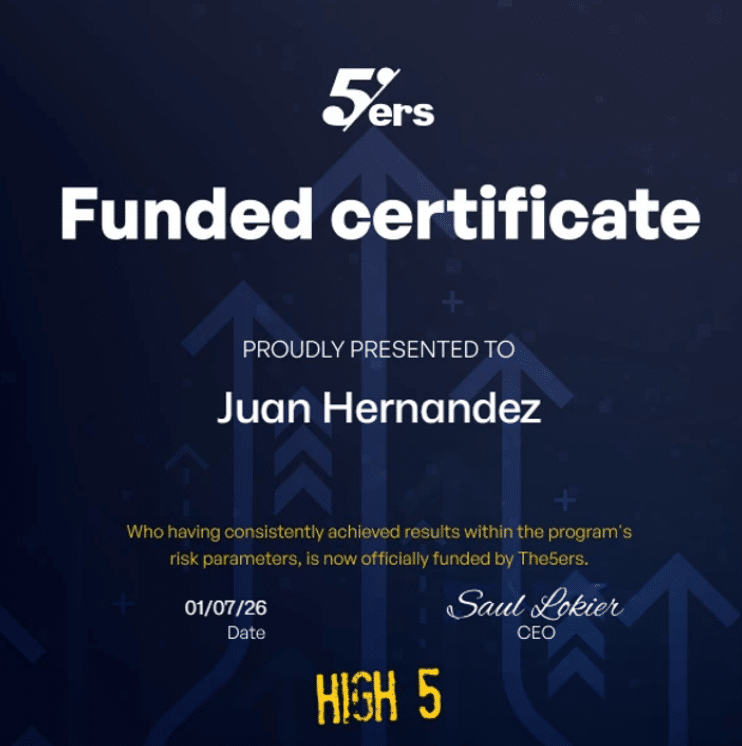
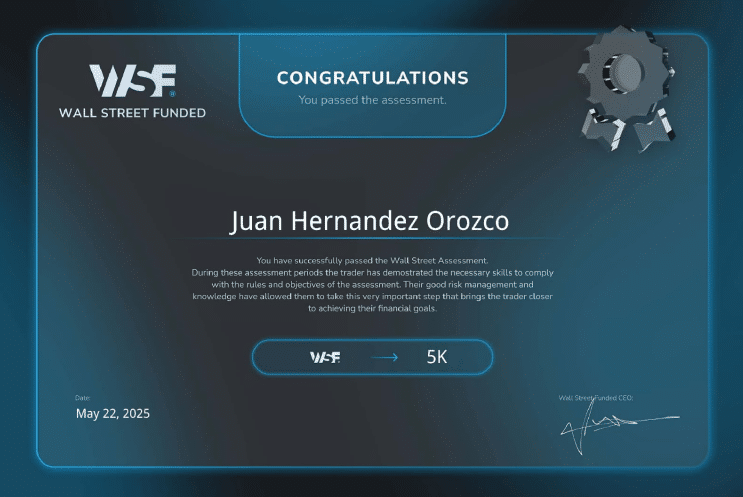
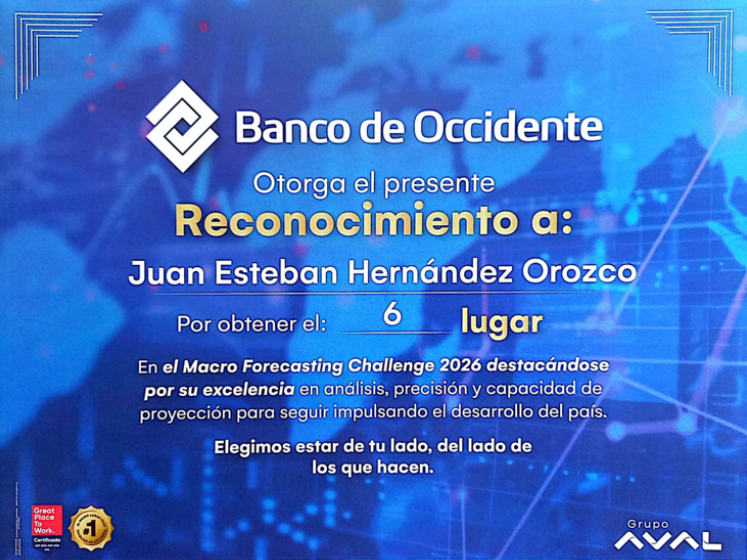
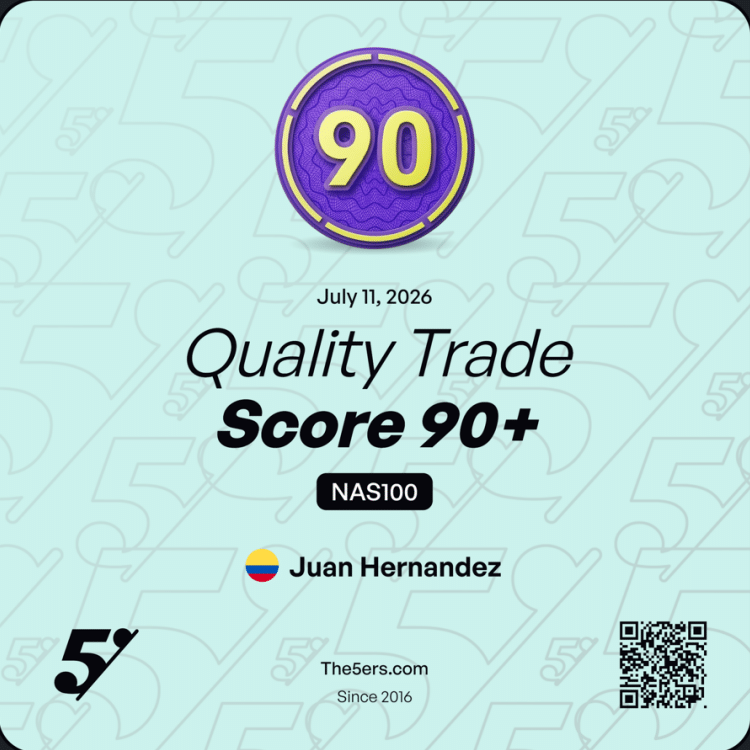
Juan’s certificates and account records reproduced with this interview; these individual records do not establish typical results.
About the writer – Juan Esteban Hernández Orozco
Juan Esteban Hernández Orozco is a 19-year-old economics student and funded trader from Medellín, Colombia, trading the Nasdaq and US stocks.
Frequently asked questions
Which markets does Juan trade?
Juan says he specializes in US indices, primarily the Nasdaq, as well as US stocks. His process combines macroeconomic analysis with market structure and five-minute entries.
How many challenges does Juan report failing?
He estimates failing between 15 and 25 challenges before passing another assessment. This is a personal recollection, not a measured industry failure rate or an expected number of attempts.
What limits does Juan describe in his trading plan?
He aims for no more than two trades per day, waits for confirmation and generally requires at least a 1:2 risk-reward ratio. These describe his approach; they do not establish a profitable strategy for other traders.
Sources and interview context
Primary source: Juan Esteban Hernández Orozco’s original interview above, published in JoinProp’s One Prop Trader a Day series. “The difference lies in the ability to stay long enough to learn.” — Juan Esteban Hernández Orozco. The challenge counts, losses, withdrawals and achievements are self-reported, not independently verified performance or industry statistics. His age and account history refer to the interview’s timeline. The reproduced certificates illustrate his individual story. The5ers link is a referral link; JoinProp may earn a commission.
See Juan Esteban Hernández Orozco’s LinkedIn profile for professional context.
Enjoyed this article? Add JoinProp as a preferred source on Google.


