


Updated
TL;DR — Benjamin’s return to trading
Benjamin Thorsell describes an early $8,000 loss, a six-month break and two years of paper trading before his first reported Topstep evaluation pass. His Nasdaq futures routine combines volume tools, a limited trading window and journaling, with time outside trading remaining a priority.
One Prop Trader a Day – Episode 85

Benjamin Thorsell
Benjamin Thorsell is a 24-year-old business administration student from southern Sweden who lost $8,000 early on, stepped away from the markets for six months, then rebuilt around discipline and volume-based structure to trade Nasdaq futures. Here is his story, in his own words.
What does an 8,000 dollar loss buy a 24-year-old? Benjamin Thorsell, a business administration student from southern Sweden who trades Nasdaq futures around the New York session, watched that much vanish in minutes after his first swing trades had doubled his account, then stepped away for six months and paper traded for two years. In this interview, he explains the volume profile, RSI and VWAP setup he rebuilt around, how he passed his first Topstep evaluation at the first attempt, and why he calls time his most valuable asset.
Benjamin’s trading journey
I am Benjamin, a 24-year-old business administration student from southern Sweden. Today I primarily trade Nasdaq futures (NQ), although I occasionally trade forex pairs, specifically GBP/JPY.
On my 18th birthday, I bought my very first shares: Volvo, Kinnevik and Investor, all household names among Swedish investors. The excitement I felt from being part of something larger was entirely new to me. I spent hours reading company reports, following market news, and learning about cash flow, valuation metrics, and why companies issue both A and B shares. Investing quickly became a genuine passion.
A couple of years later my interest expanded beyond individual stocks, funds and indices. My curiosity led me to commodities, leveraged products and technical analysis. Like many novice traders, I eventually reached a point where I thought I knew enough to begin trading with my own hard-earned money. That overconfidence turned out to be the most expensive lesson I have ever paid for.
My first swing trade doubled my account, followed by several profitable trades. Naturally, I believed I was ready to increase my leverage. Within minutes, I watched almost $8,000 vanish into thin air, wiping out the majority of my profits from the previous months.
Looking back, that loss was tuition. I believed trading was about predicting the market. In reality, it is about reacting when the market confirms your thesis. After losing that money, I completely stepped away from trading. For the following six months, I did not make a single investment, nor did I follow the markets, charts or financial news. My motivation had disappeared alongside the $8,000, and after getting burned, I had no intention of testing my luck again.
Eventually, something changed. I realized that what attracted me to trading was not only the possibility of financial success, but the freedom that comes with being able to decide how I spend my time. Because in the end, time is the most valuable asset of all. That realization reignited my motivation.
This time, I approached trading differently. Instead of searching for quick profits, I spent months, and eventually years, researching different strategies, backtesting, paper trading and studying the psychological challenges one has to face in order to succeed in the markets. I learned that becoming a successful trader was not about finding a perfect strategy. It was about developing the discipline to execute the same process consistently, regardless of the outcome.
In September 2025, after two years of practicing through paper trading, I passed my first evaluation account on Topstep, on my first attempt. The first payout was $400. Half went toward buying myself a new watch as a reminder of the milestone. The other half went into another $50,000 evaluation account. For me, the payout represented something bigger than the money itself. It was proof that the process I had spent years building could actually work.
Volume tools and daily routine
Today, my trading is built around a combination of indicators and tools, mainly focusing on market structure and volume. My approach is not built around predicting every move the market makes. Instead, I focus on identifying areas where multiple indicators align and reacting when the market confirms my strategy. The main tools I use are volume profile, relative strength index (RSI) and its moving average (RSI MA), volume imbalances, and volume-weighted average price (VWAP). I always look for confluence with higher timeframes to establish my overall market bias.
My trading days are usually more accurately described as a trading hour, sometimes two. I deliberately try to minimize the time I spend looking at charts, as trading needs to fit into my life rather than consume it. Alongside trading, I am a full-time university student, I maintain a regular exercise schedule, and I prioritize spending time with family and friends. On a typical day, I open the charts about 30 minutes before the New York session opens, which in Sweden is during the afternoon. If a setup that aligns with my strategy appears, I execute. If it does not, I walk away and trade another day. I have learned to view every non-trading day where I followed my rules as a win, and every losing day as an opportunity to improve.
Journaling and risk lessons
I journal every trade I take, regardless of the outcome. My most recent losing trade was on an evaluation account with Lucid Trading. Several of my indicators were pointing in the same direction, but that direction went against my daily bias. Since it was an evaluation account, I convinced myself that taking the trade was worth the risk. It was not. The trade ended up putting me halfway toward the maximum loss limit on the very first day. In retrospect, I should have trusted my strategy and adhered to my own rules instead of allowing the circumstances of the account to influence my decision making. Some lessons only truly stick when they cost you something.
Most people around me do not understand the specifics of what I do, but they understand the general idea. What many people underestimate is the amount of time, money and dedication required to actually become consistent. Trading is often portrayed as an easy way to make money, but the reality is very different. The difference between someone who continues improving and someone who gives up after blowing their third evaluation account comes down to one thing: persistence.
If prop firms disappeared tomorrow, I would continue trading with my own capital. If I was given a $1,000,000 funded account today, I would approach it exactly the same way I approach any other funded account. The only difference would be my position sizing. Success in trading is not determined by the size of the account, it is determined by the person managing it. If I could give my younger self one piece of advice, it would be to build a structure in life that leaves you feeling fulfilled at the end of each day. Because time is the most valuable asset of all, and learning how to use it wisely is the greatest investment you can make.
Certificates shared with this interview

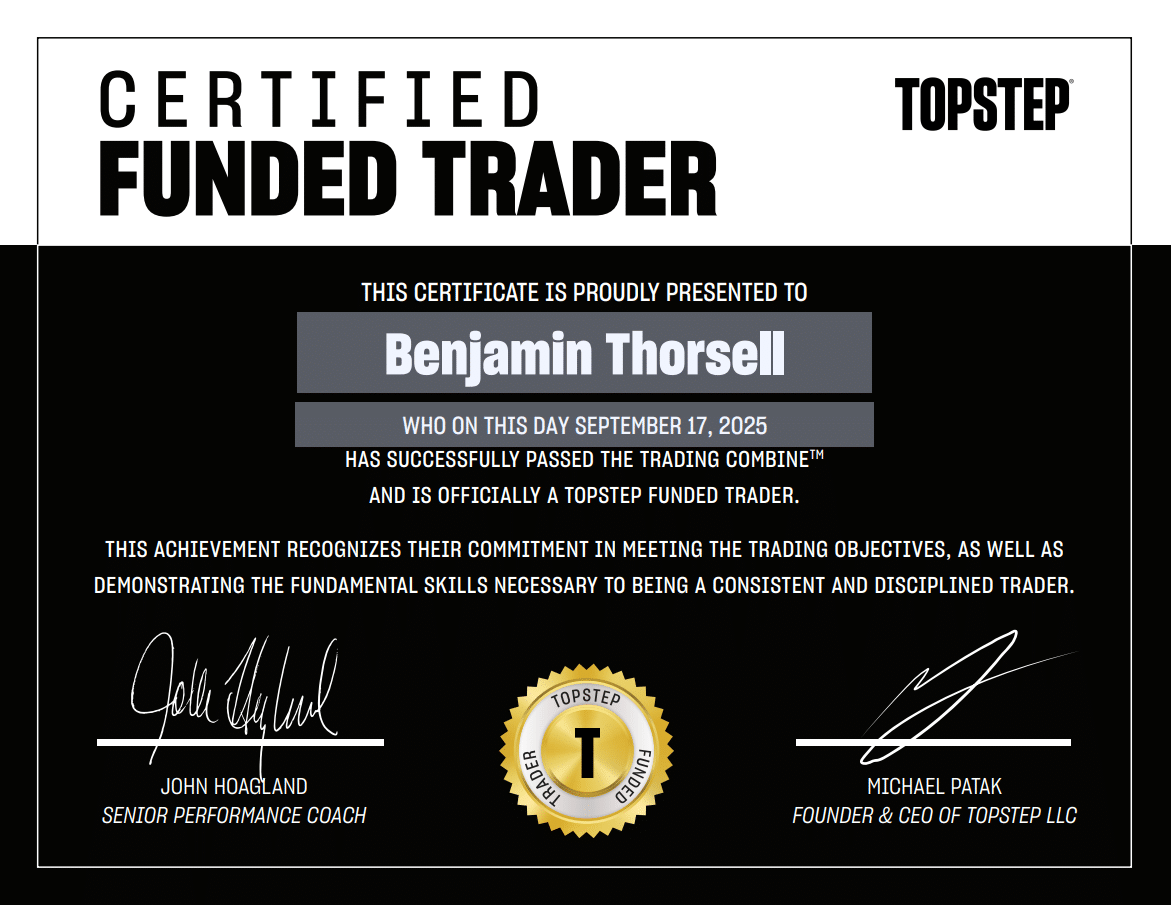
Benjamin Thorsell’s funded-account certificates, reproduced as part of his interview; individual records do not establish typical trader outcomes.
About the writer – Benjamin Thorsell
Benjamin Thorsell is a 24-year-old business administration student from southern Sweden who trades Nasdaq futures (NQ) and occasionally GBP/JPY using volume profile, RSI and VWAP around the New York session. After losing $8,000 early on and stepping away for six months, he rebuilt around discipline and process, paper traded for two years, and passed his first Topstep evaluation on the first attempt. He treats time as his most valuable asset and trading as something that complements the life he wants to build.
Frequently asked questions
Which markets and tools does Benjamin use?
Benjamin says he primarily trades Nasdaq futures and occasionally GBP/JPY. His tools include volume profile, RSI, volume imbalances and VWAP, with higher-timeframe context.
How did Benjamin prepare for his first funded evaluation?
He reports taking a six-month break after an early loss, then researching, backtesting and paper trading. He says he passed his first Topstep evaluation in September 2025 after two years of paper trading.
What happens when no setup meets Benjamin’s rules?
He says he walks away and trades another day. His routine generally starts about 30 minutes before the New York session, with trade journaling used to review both wins and losses.
Sources and interview context
Primary source: Benjamin Thorsell’s original interview above, published in JoinProp’s One Prop Trader a Day series. “Trading is the hardest way to make easy money.” — Benjamin Thorsell. The loss, first payout and evaluation history are his self-reported experiences, not independently verified performance or typical results. The certificates reproduced in the article illustrate his individual account history. His age and study circumstances refer to the time of the interview.
See Benjamin Thorsell’s LinkedIn profile for professional context.


