Friday, 6 November 2026 🗓️
🔎 What’s happening?
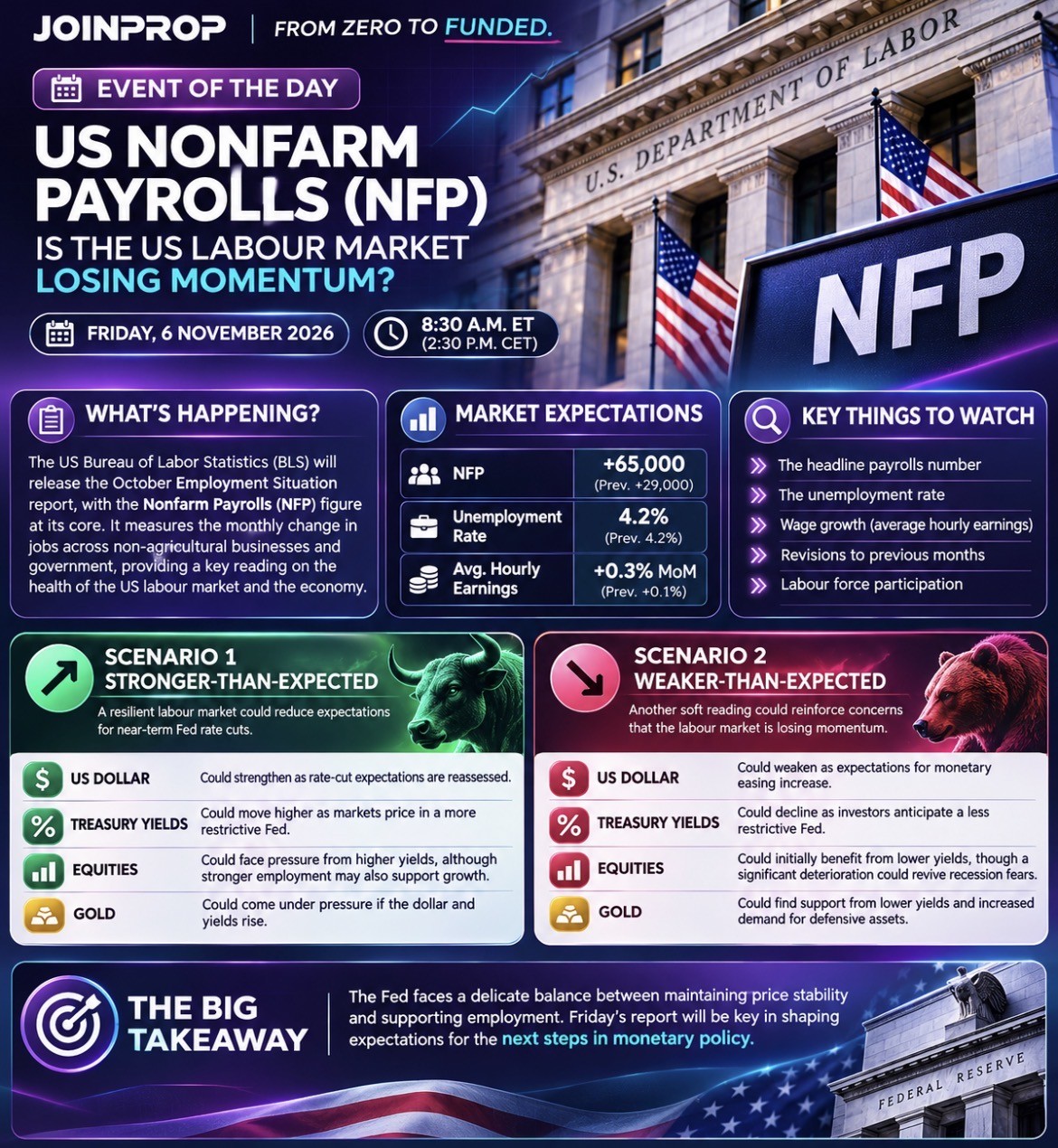
The US Bureau of Labor Statistics will release its October Employment Report, one of the most closely watched economic indicators for financial markets.
Nonfarm Payrolls (NFP) measures the monthly change in employment across US non-agricultural businesses and government. It provides an important snapshot of labour-market strength and helps investors assess the direction of the US economy.
The previous report delivered a significant slowdown: the US economy added just 29,000 jobs in September, against expectations of 90,000. The unemployment rate remained at 4.2%, while average hourly earnings increased by only 0.1% month-on-month. Previous employment figures were also revised down by a combined 60,000 jobs, figures that have been reflected as a general slowdown of the markets.
📊 What are markets expecting now?
Current consensus estimates point to:
- Nonfarm Payrolls: +65,000 jobs (previous: +29,000)
- Unemployment Rate: 4.2% (previous: 4.2%)
- Average Hourly Earnings: +0.3% MoM (previous: +0.1%)
The market will be looking for signs of stabilisation after September’s disappointing employment figures.
⚖️ The two possible scenarios
🟢 Scenario 1 – Stronger than expected employment
A significant upside surprise in payrolls could indicate that the labour market remains resilient.
- US Dollar: Could strengthen as expectations for interest-rate cuts are reassessed.
- Treasury Yields: Could move higher as markets price in a potentially more restrictive Fed.
- Equities: Could face pressure from higher yields, although stronger employment may also support growth expectations.
- Gold: Could come under pressure if the dollar and Treasury yields rise.
🔴 Scenario 2 – Weaker-than-expected employment
Another disappointing employment report could reinforce concerns that the US labour market is losing momentum.
- US Dollar: Could weaken as expectations for monetary easing increase.
- Treasury Yields: Could decline as investors anticipate a less restrictive Fed.
- Equities: Could initially benefit from lower yields, even though a severe deterioration in employment could revive recession fears.
- Gold: Could find support from lower yields and increased demand for defensive assets.
👀 What matters the most?
The headline payroll number is only part of the story. Investors should also pay close attention to:
- Unemployment Rate: Is the labour market continuing to deteriorate?
- Average Hourly Earnings: Are wage pressures accelerating again?
- Previous Revisions: Were previous employment figures stronger or weaker than initially reported?
- Labour Force Participation: Are fewer people entering or remaining in the workforce?
The combination of employment growth and wage inflation will be particularly important for the Federal Reserve’s assessment of economic conditions.
💡 The big takeaway
The Fed faces a delicate balance between maintaining price stability and supporting employment.
A stronger report could reinforce the case for keeping monetary policy restrictive, while another weak reading could increase pressure for a more accommodative approach.
For traders the key is not simply whether payrolls beat or miss expectations but how the entire report changes the outlook for interest rates, the US dollar, Treasury yields and equities.
Enjoyed this article? Add JoinProp as a preferred source on Google.