


One Prop Trader a Day – Episode 152

Ho Anh
Ho Anh is a 26-year-old trader from Vietnam who discovered trading at 23 while living and studying in France, after running a fashion business. He now focuses on Nasdaq (NQ/US100), swing trading CFD accounts and trading futures intraday with support and resistance, liquidity and price reactions, using the H1 and H4 for bias and the M1 and M5 for entries. He trades with FTMO, The5ers and Topstep. Here is his story, in his own words.
What if losing 80,000 euros in three months is what finally teaches you how to trade? Ho Anh, a 26-year-old trader from Vietnam who discovered trading while studying in France, trades Nasdaq (NQ/US100) with FTMO, The5ers and Topstep. In this interview, he explains how a fading fashion business and a Bitcoin loss pushed him into prop firms, why he blew nearly 20 accounts before becoming funded in early 2026, how he limits himself to 2-3 hours and 1-3 trades a day, and why he calls FTMO professional, transparent and reliable.
My name is Ho Anh, I’m 26 years old and originally from Vietnam. I first discovered trading when I was 23, while I was living and studying in France.
My journey into trading actually started from a very difficult turning point in my life. Before trading, I ran a successful fashion business that generated a very strong monthly income. However, I was young and had very little understanding of risk management. By early 2024, the business was no longer performing well, and I had to look for a new direction that could potentially provide an income comparable to what I had been making from my business.
That was when I entered the world of trading – and I learned my first lessons the hard way. In just three months, I lost around 80,000 euros of my own money trading Bitcoin, driven by the mindset that I could get rich quickly and change my life almost overnight. Eventually, I lost most of the money I had and found myself in a completely different situation. I had to take a job at a fast-food restaurant earning around 8 euros per hour just to cover my living expenses while continuing to learn and trade.
Because I no longer had much capital to trade with, I started researching alternatives and came across prop trading. The idea of accessing larger trading capital while risking only a relatively small evaluation fee completely changed the way I approached trading.
From that point on, I focused almost exclusively on prop firms. In the beginning, I traded a variety of markets, including Bitcoin, Gold, and Forex. But after years of experience, mistakes, and lessons learned, I gradually narrowed my focus and chose Nasdaq (NQ/US100) as my primary market.
Looking back, losing 80,000 euros was an extremely painful experience, but it also became one of the most important turning points in my trading journey. It forced me to understand that trading is not about getting rich quickly – it is about risk management, discipline, consistency, and surviving long enough to become profitable.
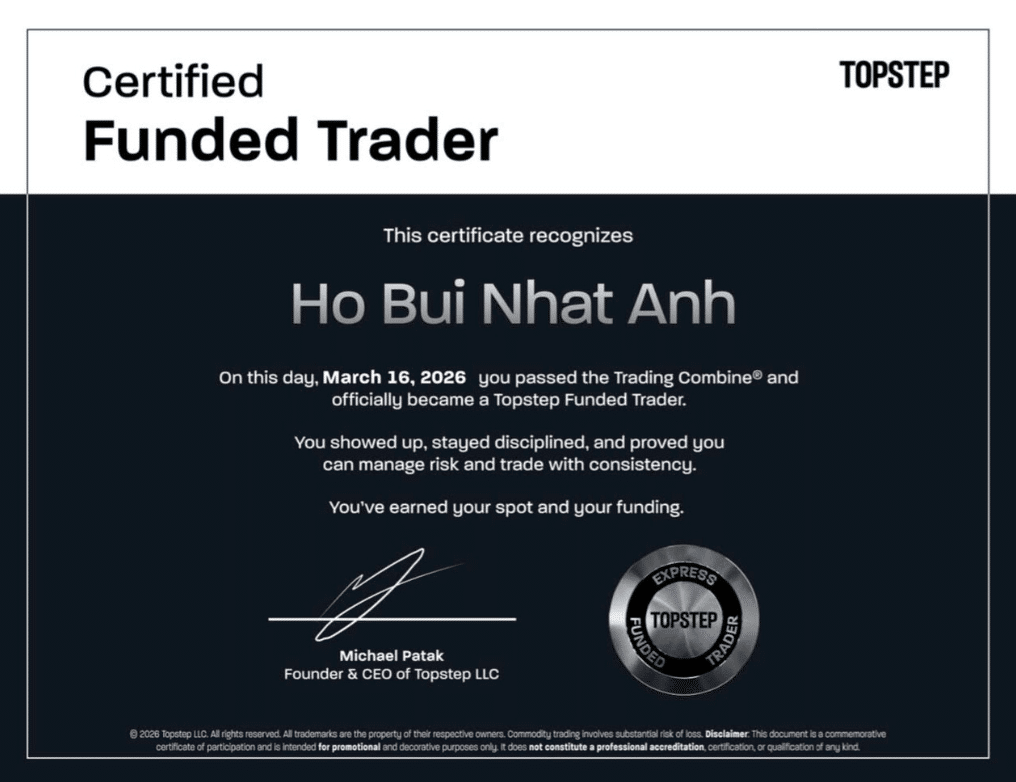
I officially became a funded trader in early 2026, after almost a year of being involved in prop trading and blowing nearly 20 prop firm accounts.
Like many new traders, every time I lost an account, I would blame myself, create a new set of rules, and promise myself that I would change. But eventually, I realized that if I kept approaching each loss in the same way, I was simply repeating the same mistakes and going nowhere.
That was when my perspective started to change. Instead of seeing every blown account as a failure, I began treating each one as an experience and asking myself what it was actually trying to teach me.
I realized that I didn’t just need to change the way I traded. I needed to change myself – my bad habits, my emotional reactions, my discipline, and even the way I looked at life.
During that difficult period, one thing I kept reminding myself was that I had to believe in myself and, most importantly, not give up.
Becoming a funded trader wasn’t simply the result of finding a better strategy. It came after I started taking responsibility for my own decisions and understanding that consistency in trading begins with consistency in yourself.
That mindset shift was the biggest change for me.
Just a good meal. Nothing fancy. I enjoyed it alone – a small celebration for the first milestone after a long and difficult journey.
I’ve failed around 20 prop firm accounts. What kept me going was probably my genuine passion for finance and this career.
Even when I was a student, I used to imagine myself becoming a financial analyst at an investment fund. I’ve always been fascinated by the mindset and lifestyle of professional investors.
Looking back, I feel like I’ve already come a long way. I’ve paid a pretty high price to get here, through failures, mistakes, and a lot of lessons.
So at this point, I don’t really see a reason to quit. I just want to keep learning, keep improving, and keep moving forward.
As I mentioned earlier, I lost 80,000 euros when I first started trading. But honestly, that wasn’t the biggest thing I lost.
I traded away my time, my energy, my health, and even the person I used to be. I also lost some important relationships during that period. And perhaps most painfully, I lost the trust and respect of many people around me.
Those were the things that cost me far more than money ever could.
In the beginning, trading was basically with me 24/7 because I didn’t know how to separate work from life. My emotions took over far too much, and it completely drained me mentally and physically.
I lost my appetite, couldn’t sleep properly, and even lost a significant amount of weight, dropping to just 55 kg.
Later, having a full-time job outside of trading actually helped me develop a healthier relationship with it. I simply didn’t have as much time to trade anymore, so I started trading only when I was available and within fixed hours.
Today, I spend around 2-3 hours a day on trading, mainly during the Asian and U.S. sessions. This balance has helped me become much more disciplined and detached from the market.
I currently trade with FTMO, The5ers, and Topstep. What I look for in a prop firm is mainly credibility and transparency – especially when it comes to payouts, payout speed, and their scaling policies.
For me, it’s important to know that a firm keeps its promises and provides a clear path for traders to scale their capital as they grow.
Currently, I mainly trade Nasdaq. Since I trade both CFD and futures accounts, I’ve developed two different approaches: swing trading and intraday trading.
For my CFD accounts, I’m comfortable holding positions for several days when the setup allows it. For my futures accounts, I take a more intraday-focused approach.
My analysis is mainly built around support and resistance, liquidity, and price reactions. I mark the key areas where price has reacted the most on higher timeframes, then wait for price to return to those zones or break through them. I want to see how price reacts before looking for an entry rather than simply placing a trade because price has reached a certain level.
For futures, I use the H1 and H4 timeframes to determine my overall bias, key levels, and liquidity. Once price reaches an important area and gives me the reaction I’m looking for, I move down to the M1 and M5 timeframes to find a more precise entry.
A typical trading day for me starts before I even open the charts. I have a habit of reading through my pre-trade checklist and reminding myself that my only job for the day is to execute my setups correctly.
Before each session, I map out my scenarios and define what I’m looking for. If the market doesn’t follow my plan, I simply don’t trade. If it does, I wait for price to reach my key area, react, and give me the confirmation I need before entering.
Once I’m in a trade, I always have my SL and TP in place and let the market do its job. I have my own trading rules, including a strict limit of 1-3 trades per day.
The goal isn’t to trade as much as possible. It’s to execute well, protect my capital, and stay disciplined.
One of my recent losing trades happened when I noticed that, during the London session, price hadn’t swept the Asia session low and was forming a pullback into an M15 resistance area.
I noticed a reaction just five minutes before the US session opened, so I entered the trade expecting price to sweep the Asia low. However, right after the US session opened, my stop loss was hit before price eventually dropped nearly 300 points.
Looking back, I probably should have been more patient and waited a few more minutes for the US session to open before taking the trade. Lesson learned. =)))
I only became a funded trader at the beginning of 2026, so my main goal right now is to keep my funded accounts for as long as possible and build consistency over time.
My biggest payout so far has been around 6,000 dollars, which came from FTMO. For me, the amount itself is nice, but what matters more is being able to maintain the account and keep generating payouts consistently.
Not really. Back when I wasn’t making money from trading, the people around me often encouraged me to stop. They didn’t have a very positive view of what I was doing, which was understandable from their perspective.
Things are more stable for me now, but I still don’t really tell people around me that I’m continuing to trade and invest. I’ve learned that I don’t need to prove anything to anyone.
Keeping it private takes away some of the psychological pressure. I can focus on my own process, my own goals, and let the results speak for themselves.
Maybe I’m just more stubborn? Just kidding.
I’ve simply been on a long journey with trading, and I’ve experienced almost every possible emotion along the way. I’ve had enough payouts to support myself, and more importantly, I’ve seen the potential this career can offer.
I’ve also sacrificed and lost a lot along the way. I guess that was simply the price I had to pay to keep going and get to where I am today.
That’s probably the biggest reason I’m still doing it. After everything I’ve been through, I know there’s something here worth pursuing. I’m not chasing quick money anymore – I’m focused on building something sustainable and becoming better at what I do.
Honestly, I wouldn’t try to make as much money as possible in those seven days.
My first priority would be to understand the account’s rules and risk parameters, then trade it exactly the way I trade my current funded accounts. I’d keep my risk small, focus on only the highest-quality setups, and probably take no more than 1-3 trades a day.
If the market doesn’t give me my setup, I simply wouldn’t trade. After seven days, I’d rather have the account intact and build a foundation for long-term payouts than make a big profit by taking unnecessary risks.
For me, 1 million dollars in buying power doesn’t mean I need to trade bigger. It means I have more responsibility to manage risk properly.
My take on the firms
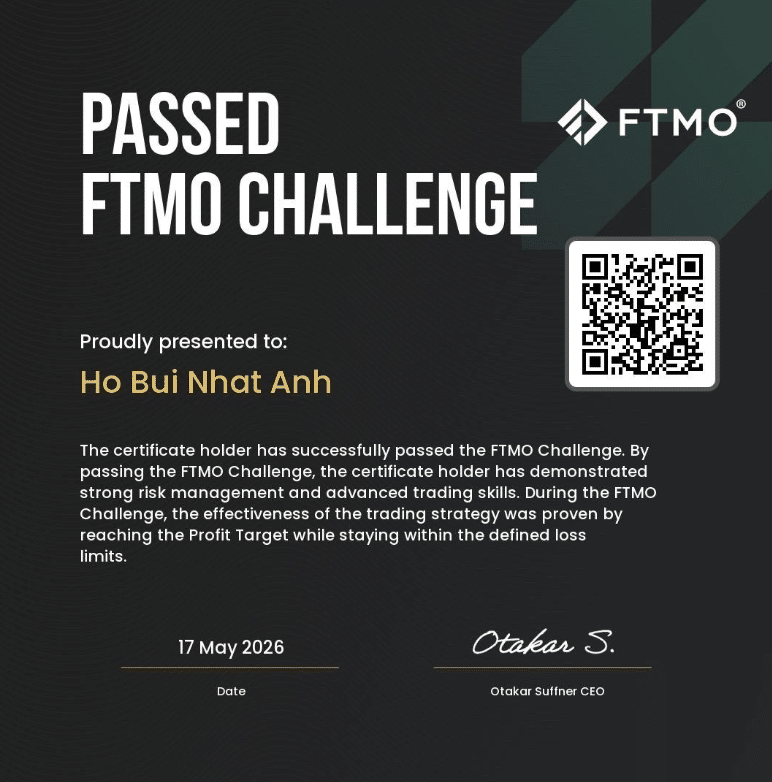
My experience with FTMO has been very positive. What I value most is their professionalism, transparency, and reliable payout process. The rules are clearly defined, and I appreciate that they give traders enough flexibility to develop their own trading style while still maintaining proper risk management. Overall, FTMO is one of the firms I trust and would recommend to traders who are looking for a professional and transparent prop firm.
Verified funded – the receipts

Challenges passed – the receipts
About the writer – Ho Anh
Ho Anh is a 26-year-old trader from Vietnam who discovered trading at 23 while living and studying in France, after running a fashion business. He now focuses on Nasdaq (NQ/US100), swing trading CFD accounts and trading futures intraday with support and resistance, liquidity and price reactions, using the H1 and H4 for bias and the M1 and M5 for entries. He trades with FTMO, The5ers and Topstep.
Enjoyed this article? Add JoinProp as a preferred source on Google.


