
One Prop Trader a Day – Anıl Özpoyraz: Funded Trading Is 80% Risk Control and 20% Chart Reading


One Prop Trader a Day – Episode 151

Anıl Özpoyraz
Anıl Özpoyraz is a 24-year-old trader from Ankara, Turkey who has been in the markets since 2020, starting with crypto and Turkish equities (BIST) and now trading major FX pairs, gold and silver, indices and crypto with pure price action alongside macro context, executing on the 15 minute and 5 minute charts. He moved into prop firms in the 2025-2026 period and mainly trades with FTMO. Here is his story, in his own words.
What if the hardest part of funded trading is not passing the challenge but keeping the account? Anıl Özpoyraz, a 24-year-old trader from Ankara, Turkey, trades major FX pairs, gold, silver, indices and crypto with pure price action and macro context. In this interview, he explains how the XRP rally cost him around 100,000 dollars, how he rebuilt a 25k dollar funded account from a 160 dollar buffer with 16 straight green days, why he watches himself more after a win than after a loss, and why he rates FTMO 4.5 out of 5.
I’m Anıl Özpoyraz, 24 years old, based in Ankara, Turkey. I’ve been in the markets since 2020. I started out trading crypto and Turkish equities (BIST), and today I focus on major FX pairs, Gold and Silver, indices, and crypto using pure Price Action alongside macro context.
After trading my own capital for years, I moved into prop firms during the 2025-2026 period. Becoming funded shifted my entire focus from “making money” to “protecting the drawdown buffer.” On a personal account, you can survive sloppy risk management for a while. On a funded account, losing emotional control once ends the game. Early on, I went through classic “funded account syndrome” – I passed evaluations with clean intraday setups, then overthought things and tried swing trading as soon as I got the live funded account. That taught me funded trading is 80% risk control and 20% chart reading.
I didn’t buy any material thing – I chose to travel instead. Until you withdraw profits, numbers on a screen just feel like pixels in a video game. Packing a bag, hitting the road, and paying for trips entirely with money pulled from the market was the first time it felt real.
Honestly, I didn’t blow multiple challenges before getting funded – I passed the two-step evaluation within a month and got the live account right after. That doesn’t mean it was easy. While grinding through the phases, the constant mental pressure and the “am I going to blow this?” anxiety were very real. What got me through was not forcing random trades every day; catching one clean trend was enough to carry me past the targets. My real test wasn’t failing challenges – it was learning how to keep the account once I actually got funded.
The late 2024 / early 2025 XRP rally. Between round-tripped profits and the revenge trades that followed, that lesson cost me around 100,000 dollars. The worst part is that my entry was completely right. I entered on a clean pullback according to my plan and saw more money than I had ever seen before. Then confidence turned into greed. I scaled up leverage without any new technical signal, didn’t take partials, and didn’t trail my stop-loss to new structural levels as price went up. When it reversed below my entry, I fell in love with the position and kept telling myself “let’s wait a bit longer.” Once it wiped me out, I deposited more money out of FOMO and opened unplanned revenge trades to get it back immediately. If I had done nothing and just sat on my hands, my capital would have been safe.
Heavily. My worst losses always happened right after my biggest wins. I realized that sometimes you don’t even open a trade to make money – you do it out of boredom, just to feel something again. Now, I watch myself much closer after a win than after a loss. After a winning trade, I ask myself: “Am I following my plan right now, or am I chasing the good feeling of making money?” If the answer is the second one, I close the screen. When the urge to revenge trade shows up, I step away from the desk – sometimes for a week or two. Because if the money runs out, the game is over.
I mainly trade with FTMO. I don’t care about cheap discount codes or flashy promotions. I look for three things: clean execution without weird slippage, straightforward rules without hidden traps, and a proven payout history. Trading is hard enough; the firm itself shouldn’t be an extra risk.
My plan is built on intraday Price Action. I mark structural levels and liquidity zones on higher timeframes and execute on the 15m and 5m charts. I don’t try to catch the whole move anymore. Where I could make ten, taking seven or eight and stepping back is much more valuable to me than chasing the last two. As price moves in my favor, I move my stop-loss to new structural levels – doing the exact thing I failed to do during the XRP run.
I check the market open and macro calendar before my morning coffee. When I sit down before London open, my first job isn’t finding a trade – it’s seeing if the market is too choppy to touch. If structure is messy, I do nothing. There are plenty of weeks where I stay flat from Monday to Wednesday and only take 3 or 4 trades on Thursday or Friday. When a clean setup forms during London or New York hours, my exact dollar risk is set before I enter. Once I take my piece of the move or get trailed out, I close the platform and spend the rest of the day writing market analysis or doing other things.
My toughest recent drawdown happened on a 25k dollar funded account right after passing the evaluation. Instead of sticking to my intraday system, I forced higher-timeframe swing trades without waiting for intraday confirmation. Price went against me and my remaining drawdown buffer dropped all the way to 160 dollars. What would I do differently? Stick to the plan that works. In football, if a coach changes tactics and players every match, the team falls apart – trading is the same. Right after that mistake, I went back to strict intraday Price Action micro-scalping and closed 16 straight active trading days in the green, rebuilding that 160 dollar buffer to over 364 dollars without a single rule breach.
More than any payout, my biggest milestone was bringing that 25k dollar account back from a 160 dollar remaining buffer. Almost everyone in that position treats the last 160 dollars like a casino chip and goes full-margin to either double it or blow the account. Refusing to gamble, dropping my size down to micro-lots, and closing 16 consecutive green days across September and October to rebuild the cushion proved to me that my discipline is stronger than my impulses.
In Turkey, high inflation makes everyone talk about stocks, gold, or FX, but almost nobody understands risk management or prop trading. To most people around me, it looks like either gambling or easy money made by looking at lines on a screen. It’s hard for outsiders to understand sitting on your hands for four days just to take three disciplined trades on Friday. Instead of trying to explain it in daily conversation, I write about it on Substack and share my charts on X (@crosschartist).
Not hiding from my mistakes. People who quit after three tries usually blame market makers, news spikes, or bad spreads, and change their strategy every week. When I lose, I don’t look for a new indicator – I write down exactly how my own ego or impatience caused the loss. Changing your plan after every loss is a mistake; you have to fix your behavior, not just your entry signal.
I wouldn’t take a single trade for the first two or three days. Seeing a seven-figure balance gives you the exact same rush as a huge winning trade, and trading while excited is dangerous. Once that feeling settles, I would trade the rest of the first week with tiny risk – around 0.1% per trade – just to build a safety buffer. I wouldn’t touch normal position sizes until that cushion was there.
My take on the firms
FTMO: 4.5/5. In an industry where prop firms constantly change rules overnight or shut down, FTMO is still the standard for reliability. As an intraday Price Action trader, what I need most is knowing the rules won’t change mid-game and that execution is clean. FTMO provides that stability, so I give them a 4.5 out of 5.
Their biggest strengths are execution quality and their trader dashboard. Fills on major FX pairs and metals are reliable, and the daily PnL calendar makes it very easy to track your own trade count and risk habits. When you are carefully rebuilding an account buffer or sending weekly updates to an investor, having transparent metrics and knowing payouts are reliable takes a lot of stress off your shoulders.
What they could improve are the news-trading restrictions on funded accounts and spread widening during rollover hours or on certain crypto/index pairs, which can be tough on tight intraday stops. Also, offering a slightly more flexible starting buffer or scaling transition right after passing Phase 2 would help a lot of traders deal with the initial pressure of a live funded account. Even so, they remain the most solid option in the space.
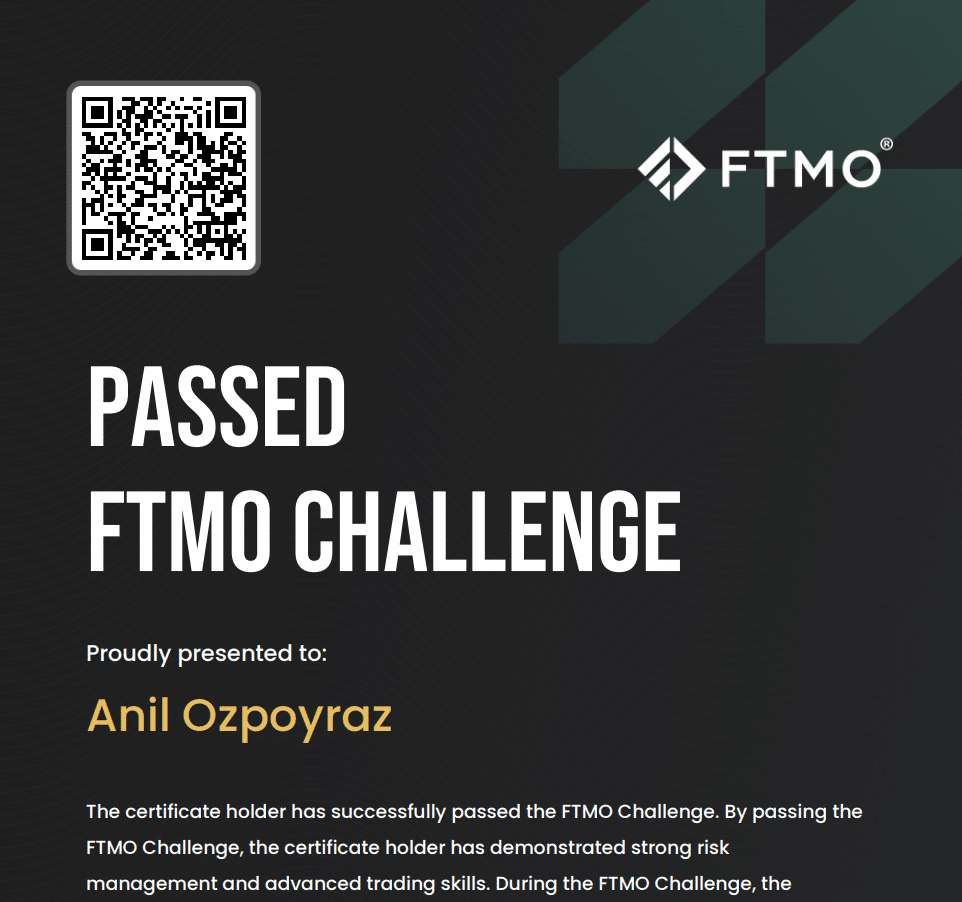
Challenges passed – the receipts

About the writer – Anıl Özpoyraz
Anıl Özpoyraz is a 24-year-old trader from Ankara, Turkey who has been in the markets since 2020, starting with crypto and Turkish equities (BIST) and now trading major FX pairs, gold and silver, indices and crypto with pure price action alongside macro context, executing on the 15 minute and 5 minute charts. He moved into prop firms in the 2025-2026 period and mainly trades with FTMO.
Enjoyed this article? Add JoinProp as a preferred source on Google.


