


One Prop Trader a Day – Episode 118

Abdul Gafoor Wangde
Abdul Gafoor Wangde is a 26-year-old trader from Mumbai who has spent more than five years in the markets, mainly trading Gold (XAUUSD) and Nasdaq with a price action and liquidity approach. He has lost count of the challenges he failed along the way, puts the cost of his biggest lesson at 5,000 to 7,000 dollars, and remembers the first thing his trading money bought as groceries for his mom. Here is his story, in his own words.
FirmFunding PipsFirmAlpha CapitalFirmLucid TradingFirmAudacity Capital
What would you do if someone handed you a 1 million dollar funded account tomorrow? Abdul Gafoor Wangde, 26 and from Mumbai, says he would become even more conservative, not more aggressive, after more than five years of trading Gold and losing between 5,000 and 7,000 dollars to failed challenges and rushed attempts to win money back. In this interview, he explains why a missed trade costs nothing, what his first trading money bought for his mom, and how he learned that the biggest battle in trading is fought against yourself.
My name is Abdul Gafoor, I’m 26 years old and I’m from Mumbai, India. I’ve been involved in trading for more than five years, and over time I’ve mainly focused on forex and prop trading. My main instrument has always been Gold (XAUUSD). I’ve also traded indices such as Nasdaq depending on the market and the opportunities available. Trading has become much more than just trying to make money for me. It’s taught me discipline, patience, risk management and, probably most importantly, how to control myself when things don’t go according to plan.
I became interested in funded trading after spending years trading and learning with my own capital. Becoming a funded trader changed my perspective quite a lot. Before that, I was much more focused on finding trades and making money. Then I started understanding that trading isn’t about how much you can make on a single trade, it’s about how consistently you can protect capital and execute your strategy. Prop trading forced me to take risk management and consistency much more seriously. It made me realise that being a good trader isn’t necessarily about having the highest returns. It’s about being able to survive long enough for your edge to play out.
The first thing I bought with trading money was groceries for my mom. It wasn’t some expensive purchase or luxury item, but honestly, it meant a lot more to me than buying something for myself would have. I remember thinking that the money I was making from something I’d spent years struggling to learn was now actually helping my family. That was one of the first moments where trading felt real to me. It wasn’t about the amount of money. It was about what that money represented.
Honestly, I’ve lost count of how many challenges I failed. There were plenty of them, and every failure came with its own lesson. Sometimes it was overtrading, sometimes taking too much risk, sometimes forcing a setup, and sometimes simply not following the rules I’d already created for myself. What kept me coming back was the belief that I could get better. I never expected trading to become easy. I just didn’t want to quit before giving myself enough time to actually figure it out. Eventually, I realised that every failed challenge was showing me something about my trading and, more importantly, about myself.
The most expensive lesson I’ve paid for came to around 5,000 to 7,000 dollars. That amount came from the mistakes and losses that accumulated during the learning process: failed challenges, taking too much risk and sometimes trying to make money back too quickly. It was painful at the time, but it taught me one of the most important lessons in trading: protecting your capital is more important than chasing returns. You can have the best strategy in the world, but if your risk management is poor, eventually the market will expose it.
Trading definitely took a serious mental and emotional toll, especially when I had a losing streak or failed a challenge. Earlier in my journey, a loss could stay in my head and make me want to immediately recover the money. That’s when things can go wrong: you start forcing trades, taking setups you normally wouldn’t take, and making decisions based on emotion rather than your strategy.
Over time, that is what I’ve learned. Now I focus much more on the process. I have predefined risk, I accept that losses are part of trading, and if my setup isn’t there, I don’t trade. Learning to walk away from the charts has probably helped me more than learning another strategy.
I’ve traded with firms including Funding Pips, Alpha Capital, Lucid Trading and Audacity Capital, along with several others over the years. What I look for in a prop firm has changed quite a lot. In the beginning, I was mainly interested in the account size and profit target. Now I look much more closely at the drawdown structure, payout conditions, trading rules, consistency requirements, execution and transparency. For me, a large account size doesn’t mean much if the rules don’t fit my trading style. I also think it’s important for traders to actually understand the rules before buying a challenge rather than simply choosing a firm because someone online recommended it.
My trading style is primarily price action and liquidity based. Gold is my main instrument, although I also trade Nasdaq. I normally start with the 4H and 1H charts to understand the overall market structure and identify important liquidity areas. Then I move down to the 15M and 5M charts for confirmation and execution, and occasionally use the 1M chart when I need more precise execution. I’m mainly looking for things such as liquidity sweeps, order blocks, market structure breaks and reactions around important levels. I also use Fibonacci retracement as part of my analysis. The biggest difference between my trading today and my trading several years ago is that I’m much more selective. I’m not interested in catching every move in the market. I’m waiting for the market to come to my setup.
One of the biggest lessons I’ve learned from losing trades is that a losing trade doesn’t automatically mean the analysis was bad. Sometimes you can have a valid setup, execute it correctly and still lose because the market simply doesn’t do what you expected. What I’ve become much more careful about is entering before I have the confirmation I originally planned for. In the past, I could sometimes see the setup developing and enter because I expected the confirmation to come. Now I’m much more disciplined about waiting for the actual confirmation. If I could go back, I’d rather miss a trade completely than enter early just because I’m afraid of missing the move.
One of my biggest milestones wasn’t necessarily a single payout. For me, it was reaching the point where I could take money generated from trading and actually use it in my real life, even something as simple as buying groceries for my mom. That was a very different feeling from seeing a profit number on a trading platform. It made me realise that the years of losing, learning and trying again were eventually turning into something tangible. Of course, payouts are important, but for me the bigger milestone has been developing the discipline to consistently approach trading as a business rather than as a quick way to make money.
Not everyone understands trading, especially prop trading. From the outside, people sometimes see someone sitting in front of a laptop and think it’s an easy way to make money. They don’t see the years of studying charts, losing money, failing challenges, analysing mistakes and dealing with the psychological side of trading. I’ve learned that I don’t need everyone around me to understand what I do. As long as I understand why I’m doing it and I’m responsible with the risks I’m taking, that’s what matters. Over time, when people see that you’re serious about it and treat it like a profession rather than gambling, their perception changes too.
I don’t think I’m necessarily different from someone who quit after their third failed challenge because I never failed. I’ve failed plenty of times. The difference is that I didn’t interpret those failures as a reason to stop. I tried to understand why I was failing. If I failed because I overtraded, I had to fix that. If I took too much risk, I had to fix my risk management. If I was emotional after a loss, I had to work on that. Persistence by itself isn’t enough.
For me, the important part is failing, learning, adapting and coming back better.
If you gave me a 1,000,000 dollar funded account today, honestly, I wouldn’t suddenly start trading aggressively just because the account was 1 million dollars. I’d probably become even more conservative. The first thing I’d do would be to understand the account’s drawdown, rules and risk parameters completely. Then I’d trade the same setups I already trade rather than changing my strategy just because the account size is larger. I’d focus on protecting the account and building consistency. A 1 million dollar account doesn’t mean I need to make 100,000 dollars immediately. If anything, having access to that much capital would make me even more focused on risk management and preservation. The goal would be to treat the account like a business asset, not like an opportunity to take bigger and bigger bets.
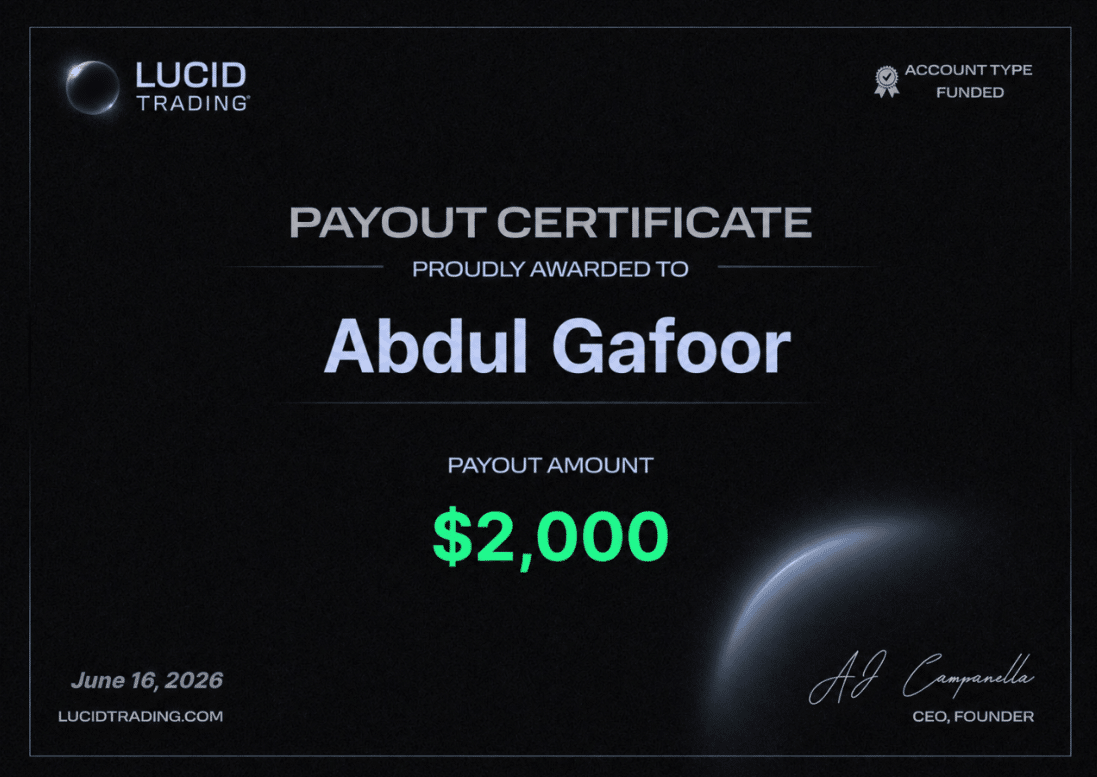
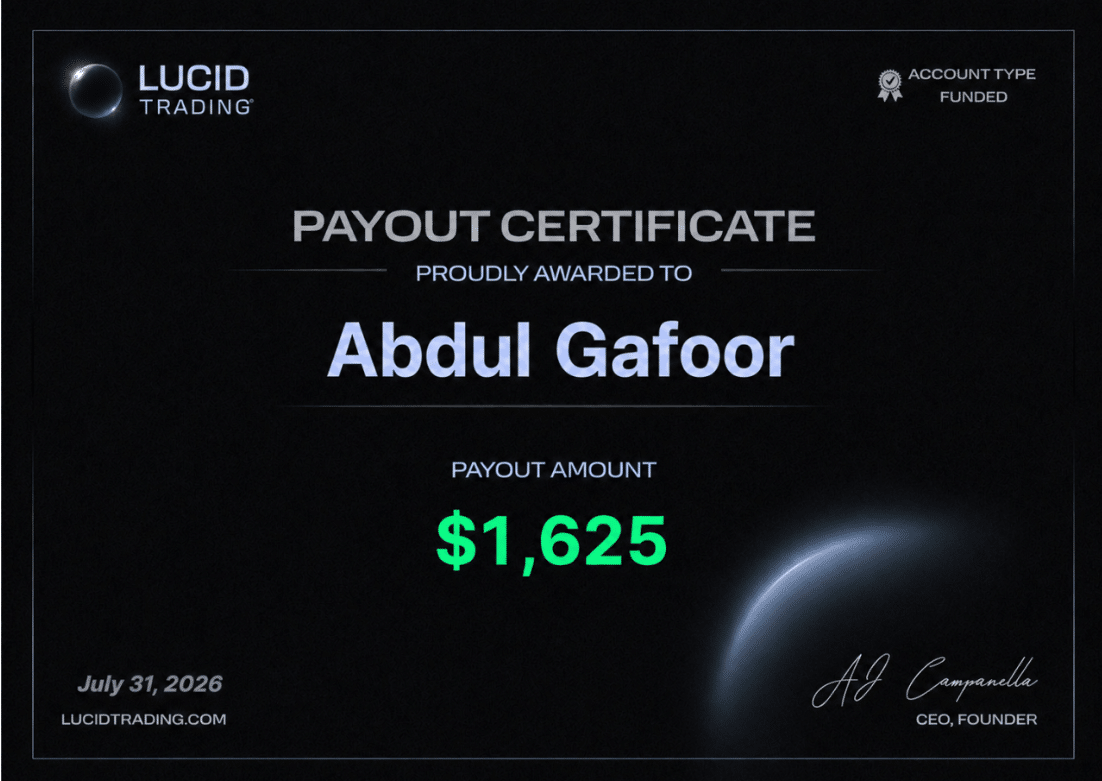
Verified funded – the receipts



About the writer – Abdul Gafoor Wangde
Abdul Gafoor Wangde is a 26-year-old trader from Mumbai, India, who has been involved in trading for more than five years, mainly in forex and prop trading. He trades Gold (XAUUSD) and Nasdaq with a price action and liquidity approach, starting from the 4H and 1H charts and executing on the 15M, 5M and occasionally 1M, and has traded with Funding Pips, Alpha Capital, Lucid Trading and Audacity Capital.Connect on LinkedIn
Enjoyed this article? Add JoinProp as a preferred source on Google.


