
One Prop Trader a Day – Giancarlo Cutrufello: My Job Is to Protect My Capital and Execute My Edge


One Prop Trader a Day – Episode 113
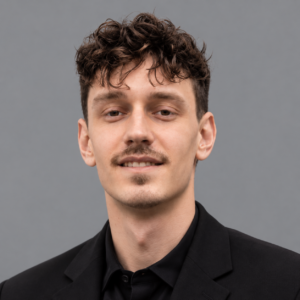
Giancarlo Cutrufello
I’m Giancarlo, I’m from Pennsylvania, and I’m in my 20s. I primarily trade futures, especially ES and occasionally NQ, working from a higher-timeframe bias down to a one-minute execution.
How does a trader who started with options at 18 end up trading ES futures on a funded account? Giancarlo Cutrufello, a Pennsylvania trader in his 20s, moved from options into crypto, built his own trading education group, and hosted a sponsored morning market show before settling on futures. In this interview, he explains the higher-timeframe bias behind his entries, the losses in the thousands that taught him risk control, and why a $1,000,000 account would make him trade smaller rather than bigger.
I’m Giancarlo, I’m from Pennsylvania, and I’m in my 20s. I’ve been involved in the markets for several years, starting with options when I was 18. Around 20, I got heavily involved in crypto and eventually built my own trading education group. I also hosted a morning market show that brought in sponsors and focused heavily on trade education and market analysis. Today, I primarily trade futures, with a strong focus on technical analysis and price action. The market has been a genuine passion of mine for years, and I’m constantly studying how price moves, liquidity, market structure, and trader psychology come together.
Becoming a funded trader was a major transition, because it changed the way I looked at risk. Before that, it was easy to think about trading in terms of simply trying to make as much money as possible. With a funded account, the emphasis became much more about consistency, risk management, and protecting capital. It forced me to understand that being a good trader isn’t just about finding great entries, it’s about being able to execute your strategy repeatedly without letting one bad day erase weeks of progress.
The proof that it was working wasn’t necessarily one specific purchase. It was being able to take money that I had generated through trading and actually use it in my everyday life. That was the moment it started feeling less like something I was chasing and more like something I had built. Seeing trading transition from an idea on a chart to something that could produce tangible results was a huge milestone for me.
I had plenty of failures before I became consistent. I’ve blown accounts, failed challenges, made emotional decisions, and had periods where I questioned whether I was actually capable of doing this. What kept me coming back was that I love the market. Even when I was losing, I still wanted to understand why I lost. I wanted to study the chart, figure out what I missed, and come back better. Trading has never just been about the money for me. The analysis itself is something I enjoy.
The most expensive lesson has been learning that being right about the market doesn’t matter if you can’t control your risk. I’ve had losses in the thousands of dollars, and those losses taught me that one emotional decision can undo a tremendous amount of good trading. The biggest lesson was understanding where my job actually starts and ends.
If I do that consistently, the money takes care of itself.
Trading has taken a mental and emotional toll, absolutely. It can expose every weakness you have, impatience, greed, fear, ego, revenge, and the need to be right. The biggest change for me has been learning to separate my identity from the outcome of a trade. A winning trade doesn’t make me a genius, and a losing trade doesn’t make me a failure. Now I focus much more on process. I have rules for when I trade, what setups I’m looking for, how much I’m willing to risk, and when I’m done for the day. I also understand that sometimes the best trade is no trade at all.
I’ve traded with several prop firms, but I’m currently primarily focused on Topstep. When I look at a prop firm, I care about the rules, payout structure, transparency, execution, and how realistic the risk parameters are. A firm can offer a large account size, but if the rules encourage traders to over-leverage or make it difficult to actually withdraw profits, the account size doesn’t mean much. For me, the goal is finding a firm that rewards consistency and responsible risk management.
Today I primarily trade futures, especially ES and occasionally NQ. My approach is heavily based on technical analysis, market structure, liquidity, price action, and key levels. I like to establish a higher-timeframe bias and then drop down into lower timeframes to find a precise execution. I typically use higher timeframes for context, a 5-minute chart for confirmation, and a 1-minute chart when I’m looking for execution. I’ve experimented with a lot of indicators over the years, but I’ve gradually stripped my charts down. The more experience I’ve gained, the more I’ve come to see that price itself tells you a lot.
A typical day starts with looking at the broader market and building a plan before I put any money at risk. I’ll identify important levels, liquidity, market structure, and the overall directional bias. I’m not interested in jumping into the market just because the session has opened. Once the market opens, I want to see how price reacts around the levels I’ve already identified. I’m looking for confirmation rather than trying to predict every move. If my setup appears, I execute according to my plan. If it doesn’t, I don’t force it. And probably the most important part of my trading day is knowing when to walk away.
My most recent losing trade was a good reminder of how quickly a technically sound idea can become a bad trade if you don’t respect your risk. I had a setup that fit the general market structure I was watching, but the execution wasn’t as clean as it needed to be. Instead of accepting that the trade wasn’t working and moving on, I gave the position more room than I should have. Looking back, I would have either waited for stronger confirmation or taken the loss according to my original plan. That’s one of the biggest things I’ve learned: the problem isn’t necessarily being wrong about direction. The problem is allowing a wrong trade to become a bigger problem.
One of my biggest milestones has been building multiple funded accounts and continuing to grow my presence in the trading space. More importantly, I’m proud of the progression from starting with options at 18, moving into crypto, building an education group and hosting a sponsored morning show, to now trading futures professionally through funded accounts. The money is obviously important, but the bigger milestone for me has been turning years of experience, failures, and education into an actual process that I can continue to build on.
Some people around me understand what I do and some definitely don’t. Trading is difficult to explain to someone who has never experienced it, because from the outside it can look like you’re just sitting in front of a screen clicking buttons. The reality is that there are years of study, preparation, psychology, risk management, and technical analysis behind those decisions. The people closest to me have seen how seriously I’ve taken it over the years, especially because I’ve been involved in the markets for so long. They’ve also seen the ups and downs, which I think gives them a better understanding of what it actually takes.
What separates me from someone who quit after their third failed challenge is that I never stopped being curious. Every failure gave me something to study. Instead of viewing a loss as proof that I couldn’t trade, I tried to figure out what caused it. I’ve been doing this for years, and I’ve already gone through multiple phases of my trading career: options, crypto, education, hosting a market show, and now futures. I’ve reinvented the way I trade multiple times, but the one thing that never changed was my desire to understand the market. That’s what keeps me going. I’m not looking for a shortcut. I want to become better at this.
If someone gave me a $1,000,000 funded account today, I wouldn’t suddenly start trading like I had $1 million. I’d probably trade smaller than people would expect. The first seven days would be about understanding the account’s risk parameters, establishing a daily loss limit, and making sure my strategy translates properly to that account size. I’d focus on protecting the account first and generating consistent returns second. If I could consistently make a small percentage while keeping drawdowns extremely controlled, I’d much rather do that than swing for huge returns.
The biggest mistake would be seeing $1 million of buying power and thinking I need to trade like I have something to prove. I’ve spent years learning that the goal isn’t to make the most money possible in one day. The goal is to still be trading, and profitable, years from now.
Verified funded – the receipts
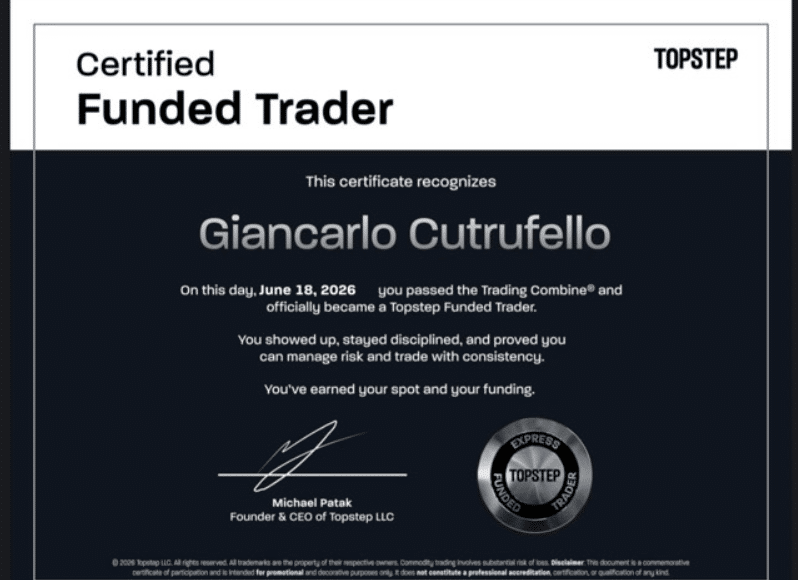
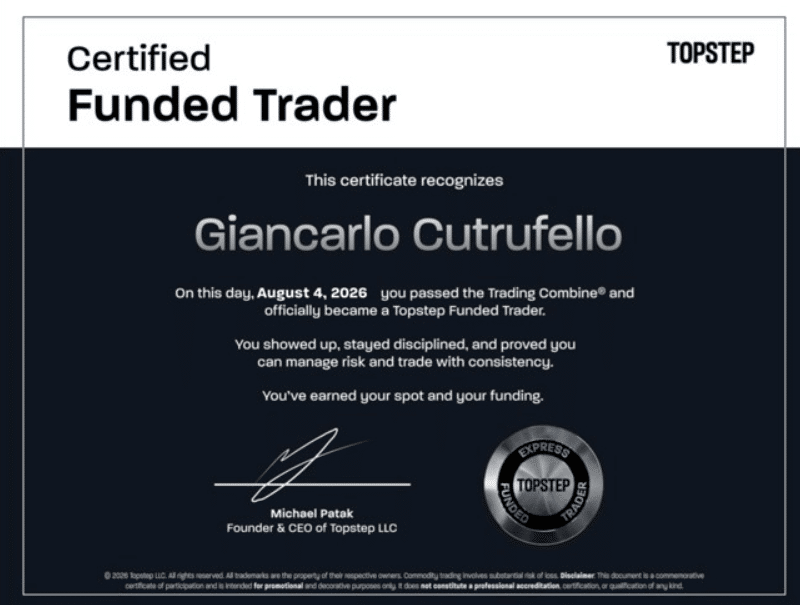
About the writer – Giancarlo Cutrufello
Giancarlo Cutrufello is a Pennsylvania trader in his 20s who started with options at 18, moved into crypto around 20, built his own trading education group and hosted a sponsored morning market show, and now trades ES and NQ futures on funded accounts with Topstep.Connect on LinkedIn


