
One Prop Trader a Day – Bright Akudu: Firms Can Disappear, but My Edge Was Still Mine


One Prop Trader a Day – Episode 108

Bright Akudu
My name is Bright Akudu. I am 28 and from Nigeria, and I have traded forex and indices for over six years. I trade the yen crosses on price action, market structure and liquidity, and I work as a Trading Accountability Coach.
My name is Bright Akudu. I am 28 years old and I am from Nigeria. I have been trading the financial markets for over six years, since covid, primarily focusing on forex and indices.
My favorite pairs are USDJPY and GBPJPY, and my approach is built around price action, market structure and liquidity concepts. Alongside trading, I work as a Trading Accountability Coach, helping traders improve their discipline, execution and decision-making.
I became a funded trader in 2023, when I successfully passed a $100,000 FTMO challenge for a client I met on Upwork. It was a remarkable experience because it was not just my own account on the line. Someone had trusted me with a paid opportunity, and I was compensated $500 for completing it.
The experience came with a lot of pressure, because I knew I was responsible for delivering results. At the same time, it gave me a huge boost in confidence. I used the income to start scaling my own trading activities, and it changed the trajectory of both my trading career and my life. It was the moment I realized that my skills could create opportunities beyond just trading my own capital.
The first trading money that truly felt real was not spent on anything flashy. I used part of it to pay off debt, part of it to help with family expenses, and I reinvested a smaller portion back into my trading.
That was the moment it felt tangible. Trading had moved beyond charts and numbers on a screen. It was solving real problems, reducing financial pressure and creating opportunities. Looking back, that meant far more to me than buying a luxury item ever could.
I failed seven times before I finally passed my first funded challenge. Some failures happened in Phase 1, others in Phase 2. Each one taught me something different about discipline, patience and risk management.
What kept me going was simple: I was not ready to walk away. I am naturally an introvert, and trading felt like one of the few paths that truly suited who I am. I had also lost a significant amount of money during my early years in the markets, and I became determined to earn it back the right way. Every failure gave me more information about what was not working, so quitting never felt like the answer.
The single most expensive lesson I paid for cost me roughly $4,400. It happened in 2021, when I was only about a year into trading. I had convinced myself that I had finally figured the market out. Within one month I lost the entire amount, and around 70% of it disappeared in a single day.
The worst part was not the loss itself. After losing money, I borrowed from close friends and doubled down, because I could not accept what had already happened. I kept trying to recover the loss instead of accepting it and moving on.
That experience taught me two lessons that still guide me today: never fight the market, and never borrow money to trade.
My lowest point came in 2024, when I was denied more than $13,000 in payouts from some of the HFT-funded prop firms that were popular at the time.
The money hurt, but what hurt even more was the realization that I had invested my time, effort, skill and capital into opportunities that ultimately did not pay out. After years of working on my craft, it felt like the reward had been taken away at the finish line.
That period made me question everything. I seriously considered quitting. For a while I wondered whether all the sacrifices were worth it.
In the end, I stayed because I realized that my edge was still mine.
Did trading affect me mentally or emotionally? Absolutely. It affected me in ways I never expected when I started. I struggled with overtrading, self-doubt, and periods where I became completely obsessed with the charts. There were times I lost sleep because I was either thinking about trades I had taken or trades I thought I should have taken.
One of the biggest dangers was that I gradually lost my perception of money. After staring at profit and loss numbers every day, large amounts started to feel normal on a screen. That mindset can be dangerous, because it disconnects you from the real value of what you are risking.
Looking back, many of my worst decisions came when I was emotionally attached to outcomes. The more obsessed I became, the worse my decision-making got. Learning how to separate my identity from my trading results was one of the most important skills I developed.
My focus today is exclusively on CFDs, primarily major forex pairs. The pairs I trade most are USDJPY, GBPJPY and CHFJPY.
One thing people quickly learn about me is that I do not trade Gold. Gold and I are mortal enemies. I have had enough battles with that market to know it is not for me.
I also used to trade indices, particularly US30, the Dow Jones, and there was a period when it was one of my better markets. Over time I decided to simplify my approach and focus on forex.
For directional bias I mainly use the Daily timeframe. My execution timeframe is the 45-minute chart, where I look for opportunities around volume profile levels and session breakouts. My approach is built around identifying where liquidity is likely to enter the market and then trading the reaction during key trading sessions.
My trading day is fairly structured these days. I start by reviewing the Daily timeframe to understand the broader market direction and key areas of interest. I do not spend all day watching charts. Most of my attention is focused around the London session open, which is when I actively engage with the market and look for opportunities.
Once London is underway, I am looking for session breakout setups and volume profile reactions on the pairs I follow. I prefer quality over quantity, so I am not interested in forcing trades just because I am at my desk.
Outside of trading, a lot of my time goes into writing on LinkedIn and working with students. Teaching traders has actually helped improve my own discipline, because it forces me to explain concepts clearly and stay accountable to the standards I encourage others to follow. By the time New York is active, I am usually managing existing positions or observing rather than aggressively looking for new trades.
My most recent losing trade was on CHFJPY. I entered based on my normal process, and the setup met the conditions of my trading plan. My risk management is mechanical rather than discretionary. Every trade has a fixed 30-pip stop loss and a fixed 60-pip take profit.
The trade simply did not work. Price moved against me and hit my stop loss. What stands out is that there was not much emotion attached to it. Earlier in my trading career, a losing trade could affect my confidence or tempt me to change my plan. Today I see losses as part of the business.
I would not necessarily do anything differently on that specific trade, because it followed my rules. My focus is on executing my edge consistently rather than judging individual outcomes.
One piece of advice I do not follow rigidly is the idea that every trader must risk exactly 1% per trade. I understand why the rule exists, and for many traders it is a good guideline. Personally, my risk can vary depending on the situation, although I never go beyond 2%.
Another common rule is to avoid holding positions through news events at all costs. I do not automatically close trades because news is approaching. If a trade fits my plan and my risk is already defined, I am comfortable letting it play out.
I do not see either of these as breaking rules. I see them as examples of how traders eventually adapt general principles to fit their own system. The important part is having boundaries and respecting them consistently.
It took my family years to adjust to the idea of trading as a profession. In the beginning it was difficult for them to understand what I was doing, because the results were not always visible and the career path was not conventional.
Even today, many people still see trading as gambling. I understand why. Most people only hear stories about quick money, losses or scams, so they rarely get to see the discipline and structure behind professional trading.
Over time, I have noticed that people become more accepting when they see consistent results. I am not talking about massive wealth or flashy lifestyles. Just seeing that I have stayed committed to it for years and continue to make progress changes the conversation.
The truth is, I usually tell people I am unemployed. It is often easier than explaining what trading is and answering the same questions over and over again.
Trading has given me a level of freedom that I value deeply, although it is often misunderstood. From the outside, some people see me spending most of my time indoors and assume it is laziness. In reality, my work happens behind screens, charts and research.
As an introvert, trading made life more palatable. It allowed me to build a career around an environment that suits my personality rather than forcing myself into one that does not.
Trading also changed my relationship with money. I no longer see money as something my entire life depends on. I see it as a tool that can create opportunities, solve problems and provide options.
Perhaps the biggest change is how I view failure. Trading forces you to confront failure regularly. Over time I have learned to see setbacks as part of the process rather than something to fear. That mindset has helped me far beyond the markets.
I have met talented traders who understood the charts better than I did, but they could not handle the emotional side of the journey. A few losses, a failed evaluation, a denied payout or a difficult month was enough to push them out of the game.
My journey has not been smooth. I have failed challenges, lost money, experienced self-doubt, and gone through periods where I questioned whether trading was worth it. What kept me going was not perfect execution or extraordinary talent. It was the ability to take a hit, learn from it, and continue.
Trading rewards people who can stay in the game long enough to develop. Emotional resilience is what allowed me to do that.
The advice I would give myself one year ago is this: “Slow down, tiger. You’re not in a race with others who’ve made it.”
A lot of my frustration came from comparing my progress to people who were further ahead. Looking back, I would remind myself that every trader has a different timeline. Rushing decisions, forcing growth and chasing milestones only creates unnecessary pressure. The goal is to build something that lasts, not to arrive first.
If prop firms disappeared tomorrow, I would still be trading, absolutely. Prop firms have been a useful vehicle for accessing capital, but they were never the reason I got into trading in the first place. I would continue trading my own capital, work with investor capital where appropriate, and continue coaching traders.
At its core, my career is built around trading and trader development, not any single company or funding model. Markets existed before prop firms, and they will exist long after them. The skills I have developed over the years would still have value regardless of what happened to the industry.
And if someone gave me a $1,000,000 funded account today, I would continue executing the same strategy, the same process and the same risk management principles that got me there in the first place.
One of the biggest mistakes traders make is believing a larger account requires a completely different mindset.
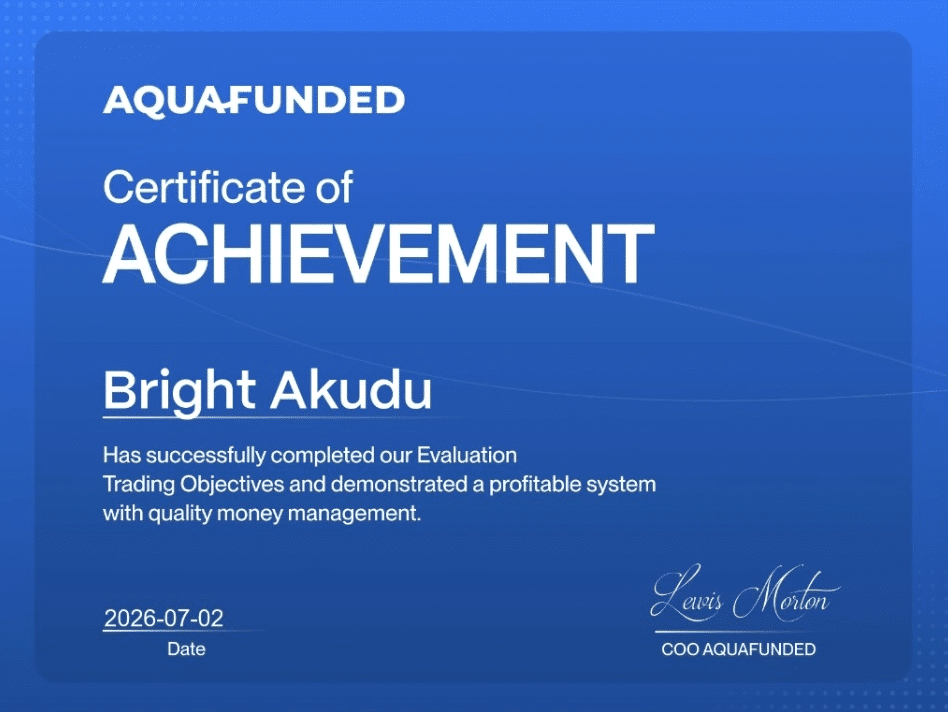
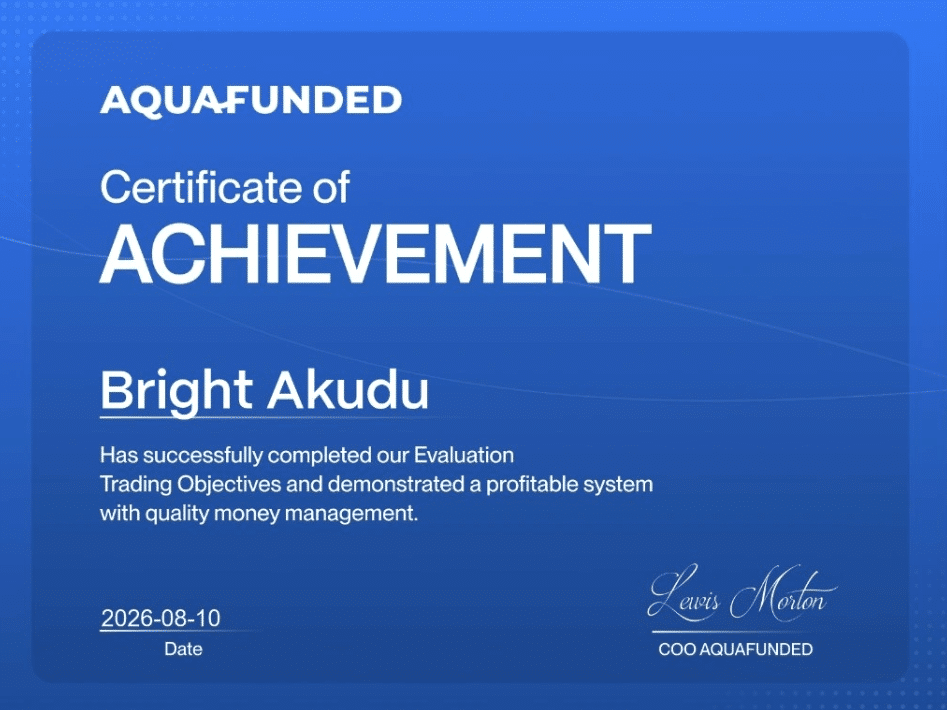
Verified funded – the receipts
About the writer – Bright Akudu
Bright Akudu is a CFD trader and Trading Accountability Coach from Nigeria, trading the yen crosses on price action, market structure and liquidity.


