


One Prop Trader a Day – Episode 120

Paresh Khopkar
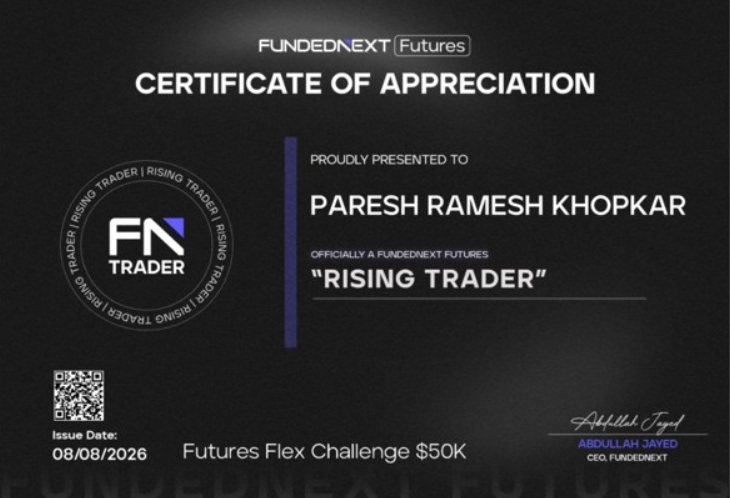
Paresh Khopkar is a day trader from Mumbai who trades NQ and MNQ futures with ICT and Smart Money Concepts. After five failed evaluations, he passed the Tradeify 50k Select Flex evaluation in July 2026 and earned Rising Trader status through the FundedNext 50k Futures Flex Challenge a month later. Here is his story, in his own words.
How many failed evaluations does it take before capital preservation finally clicks? Paresh Khopkar, a day trader from Mumbai, failed five, then passed the Tradeify 50k Select Flex in July 2026 and earned Rising Trader status through the FundedNext 50k Futures Flex Challenge a month later. In this interview, he explains the 700 dollar session that came from revenge trading, the bracket order rule that takes the guesswork out of every exit, and why a sudden volatility spike pushed him to wait for an Inverse FVG before entering.
I’m Paresh Ramesh Khopkar, a day trader based out of Mumbai, India. I spend my time in the futures market, mainly focused on the NQ (E-mini Nasdaq-100) and the MNQ for smaller positions.
I hit my first big milestone in July 2026 when I passed the Tradeify 50k Select Flex evaluation. Just a month later, in August 2026, I earned “Rising Trader” status through the FundedNext 50k Futures Flex Challenge. Once I started trading live capital, my whole mindset shifted. I stopped racing toward big profit targets and started focusing purely on protecting my capital. It really changed everything for me. Trading became less about aggressive gains and more about the discipline needed to stay in the game for the long haul.
It really started to feel real when my trading profits began covering my setup and daily life. Paying for my software, data feeds, and even household bills without touching my personal savings was the ultimate proof of concept. It showed me that this wasn’t just a hobby or a gamble anymore, but a sustainable path if I treated it like a business.
I actually went through five failed evaluations before I finally got funded. Every single one of them was a tough lesson that helped me find my footing. What kept me going was a deep belief in price action and a drive to block out all the market noise. Instead of letting those failures defeat me, I started looking at them as valuable feedback. I knew that if I could just master my risk and stay disciplined, the results would eventually follow.
My most painful lesson was a 700 dollar drawdown in a single session. It happened because I let my emotions take over, revenge trading and ignoring my stop-loss. Between that and the fees for those five failed challenges, I probably spent around 1,000 to 1,200 dollars in total just to learn the ropes. That rough patch taught me that the market doesn’t care about your feelings, and it will punish you for using too much leverage.
Trading absolutely took a mental and emotional toll. Early on, blowing accounts and breaking my own rules caused a lot of anxiety and FOMO. It’s hard not to let that get to you. These days, I manage the stress by sticking to a few solid habits. I use bracket orders, so I don’t enter a trade without my risk and reward targets already set, which takes the guesswork out of the exit. I trade active hours, sticking to the U.S. sessions when the market is moving and staying away from low-volume times where the price just chops around. And I know when to walk away: once I hit my daily goal or my max loss, I shut down the computer. No exceptions.
So far, I’ve worked with Tradeify (passing their 50k Select Flex) and FundedNext (via the 50k Futures Flex Challenge). When I’m looking for a new firm, I keep an eye out for a few key things. First, clear rules: I want to know exactly what the rules are, with no hidden catches with drawdowns or consistency. Second, good tech: they need to work well with platforms like Tradovate or NinjaTrader and have reliable data. Third, reliability: quick payouts and a support team that actually answers are huge for me.
I trade using ICT and Smart Money Concepts (SMC). I focus solely on NQ and MNQ futures, and here’s how I break down my charts. The 1-hour chart is my “big picture.” I use it to figure out the market structure and where the price is likely headed for the day. The 15-minute chart is where I look for Order Blocks and spots where liquidity is sitting. The 5-minute chart is my entry chart. I’m looking for market structure shifts and Fair Value Gaps (FVG) to time my trades with my bracket orders.
A typical day starts with prep time. I check the news for any big data releases and look at the 1-hour chart to get my directional bias on the NQ. Then I map my levels, marking out my 15-minute Order Blocks and zones where I think the price might react. During the U.S. session, I wait for the price to sweep liquidity into my zones. If I see a 5-minute FVG, I’m in. Once the trade hits my TP or SL, I log it in my journal and walk away for the day. I don’t overtrade.
I recently took a long on the NQ after seeing a 15-minute bullish Order Block and a 5-minute FVG. It looked perfect, but a sudden spike in volatility pushed price right through the FVG to grab deeper liquidity before eventually heading up. My stop got hit, and it was a clean loss. I didn’t panic or try to “save” the trade. I let the bracket order do its job and took the loss as it was. Next time, I’ll wait for a bit more confirmation, like an Inverse FVG shift, to make sure the market has actually finished its liquidity sweep before I jump in.
Passing those two 50k evaluations back-to-back with Tradeify and FundedNext was huge for me. Keeping my account balance above 52,500 dollars while following all the drawdown rules perfectly felt like I’d finally turned a corner.
Most people see day trading as either a gamble or something way too complicated to understand. My friends and family were pretty skeptical at first, especially when I was failing those early challenges. But once they saw me sticking to a real routine and actually getting certified by these firms, their attitude changed. Now, they really respect the work I put in.
I think the difference between me and someone who quit after their third failed challenge is how you handle those failures. A lot of people keep making the same mistakes over and over, but I used those early losses to really audit my trading. I realized I was holding too long and using too much leverage, so I built a system of rules to fix it.
Honestly, if you gave me a 1,000,000 dollar funded account today, I’d keep doing exactly what I’m doing now. I wouldn’t go crazy just because there’s more money in the account. For days 1 to 3, I’d focus 100% on not losing money. I’d keep my risk really low, maybe 0.25%, just to get comfortable with the account. For days 4 to 7, I’d stick to my regular FVG/IFVG setups on the NQ and use my bracket orders to build up a little bit of a profit cushion so I don’t have to worry about the drawdown limit. The main goal would be to treat that million-dollar account with the same discipline I used for the 50k one.
Verified funded – the receipts

About the writer – Paresh Khopkar
Paresh Khopkar is a day trader based in Mumbai, India, who trades NQ and MNQ futures using ICT and Smart Money Concepts, with the 1-hour chart for bias, the 15-minute for Order Blocks and liquidity, and the 5-minute for entries. He has passed the Tradeify 50k Select Flex evaluation and earned Rising Trader status through the FundedNext 50k Futures Flex Challenge.Connect on LinkedIn
Enjoyed this article? Add JoinProp as a preferred source on Google.


